
Repair is preferred under preservation standards, and when a baluster is too deteriorated to save, professional baluster replication is the surest way to preserve both visual integrity and eligibility for preservation incentives. Simple, unadorned stock profiles are reasonable candidates for a careful do-it-yourself approach. Historic, highly detailed, or tax-credit-sensitive projects call for a specialist shop such as Gepetto Millworks, where turning, scanning, and finishing work is matched to the original by trade.
TL;DR:
- Repair minor splits or loose tenons with epoxy or veneer shims; historic replacements need photographic or physical evidence to support preservation incentive eligibility.
- Hand turning suits carved twists and undercuts; duplicators work best with an intact sample and plain profiles, while scanning helps when originals are fragile.
- If the original species is impractical, choose a substitute that matches its visual and physical properties, and test the finish on a sample first.
- A useful quote package includes a surviving sample, profile tracing, photos, caliper readings at several points, rail angle, and each baluster’s finished length.
- Dry fit each baluster before fastening, ensure its tenon seats without force, and keep gaps no wider than four inches under most residential codes.
Table of Contents
- When to Repair Versus When to Replace a Baluster
- Replication Methods: Lathe Turning, Duplicators, CNC, and 3D Scanning
- Matching Materials: Species, Finishes, and Acceptable Substitutes
- How to Prepare and Order a Replica: Measurements, Samples, and Lead Times
- Installing Replicated Balusters: Fit, Fasten, and Finish
- How Gepetto Millworks Documents and Executes a Replication Project
- Why Craftsmanship Matters for an Honest Historic Match
- Commissioning a Custom Replica from Gepetto Millworks
- FAQ
- Sources
When to Repair Versus When to Replace a Baluster
The Secretary of the Interior’s Standards for Rehabilitation hold that deteriorated features should be repaired rather than replaced, and that when replacement becomes necessary, the new piece must match the old in design, color, texture, and visual qualities under Standard 6. In practice, that principle translates into a few clear field signs.
- Surface checking, minor splits, or a loose tenon usually respond to epoxy consolidation or a wood-veneer shim rather than full removal.
- Rot that has reached the core, a snapped baluster, or a missing element generally requires fabrication of a new piece.
- Any replacement on a documented historic property should be substantiated with photographs or physical evidence before fabrication begins, a requirement the Standards attach to tax-credit eligibility.
A typical shop timeline runs from on-site inspection and documentation, through pattern-making and fabrication, to finishing and install, often spanning several weeks depending on the complexity of the turning and the finish schedule.
Replication Methods: Lathe Turning, Duplicators, CNC, and 3D Scanning
The right production method depends on how much three-dimensional detail the original carries and how intact the sample is. Hand turning on a traditional lathe remains the standard for balusters with carved rope twists, barley-sugar spirals, or other undercut ornament that a machine cannot trace in one pass. A lathe duplicator, by contrast, copies a straight profile quickly from an intact sample, which makes it efficient for plain colonial or Federal-style spindles but limited when rope or deep carving is involved.
- Hand turning on a lathe suits complex, three-dimensional ornament that duplicators cannot reproduce.
- Lathe duplicators excel at fast, accurate profile copying when a sound sample exists.
- CNC turning and 3D scanning paired with printing or machining become the practical route when the original is too damaged to use as a direct pattern, as documented in a historic baluster replication project that combined laser scanning and 3D printing to reproduce spiral balusters too fragile to copy by hand.
Pro Tip: Bring a damaged original to a shop even if it looks unusable; scanning can often extract enough geometry for an accurate digital pattern that a lathe or CNC can then execute.
Cost and turnaround generally favor duplicators for simple runs, hand turning for ornamental work in smaller quantities, and scanning-based methods for one-off replication where no sound sample survives.
Matching Materials: Species, Finishes, and Acceptable Substitutes
Species selection affects grain pattern, paint absorption, and long-term durability as much as appearance. Older stair sets were commonly turned from poplar, white oak, mahogany, or heart pine, and matching the original species keeps the grain and the finish behaving the same way over time.
- Poplar and similar close-grained woods paint cleanly and resist warping in interior stair runs.
- Oak and mahogany carry a more pronounced grain that should be matched when the original is left in a clear or stained finish.
- Heart pine appears in many older Southern staircases and takes stain differently than modern dimensional lumber.
NPS guidance on evaluating substitute materials permits a substitute when the original species is economically or technically infeasible, provided the substitute closely matches the visual and physical properties of the historic material, a standard that weighs location, physical compatibility, and expected performance over time. Before committing a full run to any species or finish, shops typically produce a test piece: a sanded sample finished with shellac or a gel stain to even out color and texture differences against the aged original.
How to Prepare and Order a Replica: Measurements, Samples, and Lead Times
A clean, well-documented submission shortens both the quoting process and the fabrication timeline. Shops that replicate balusters for a living generally ask for the same core package of information before cutting any wood.
- Trace the profile onto manila paper or heavy cardstock to capture the silhouette accurately, a technique documented in professional restoration how-tos.
- Record diameters at several points along the baluster with calipers, since a single measurement rarely captures a tapered or turned profile.
- Photograph the top, bottom, and side of a representative baluster, including any carved or turned detail.
- Measure the sliding bevel angle where the baluster meets a sloped handrail, since rake angles vary by stair pitch.
- Note the finished length for each position on the run, since treads on a sloped stair often require a different length baluster at each step.
Most shops also expect a sample baluster when one survives, a minimum order per project, and sometimes a customization fee for one-off profiles; lead times vary with turning complexity and finish schedule.
Installing Replicated Balusters: Fit, Fasten, and Finish
Installation is where a well-made replica either disappears into the original run or stands out. The sequence below follows standard trade practice for dowel or tenon-based balusters.
- Dry-fit each piece in position before any glue or fasteners go in, checking that the tenon seats fully in its mortise.
- Trim the baluster to finished length using the bevel angle recorded during measurement.
- Shape or adjust the tenon or dowel so it seats without force; a tight dry fit prevents future rattling.
- Set the piece with wood glue and a pilot-drilled screw or finish nail, then countersink and fill with matching putty.
- Sand, prime, and finish to match the surrounding balusters, using the test piece developed during material selection as the reference.
Pro Tip: A loose tenon on an older original can often be saved by wrapping it in thin wood veneer or a tapered shim rather than enlarging the mortise, a reversible fix that preserves more of the original fabric.
Spacing matters structurally as well as visually: most residential codes cap the gap between balusters at roughly four inches to prevent a small child from passing through, and any replacement run should preserve that spacing along with secure attachment at both the top rail and the tread.
How Gepetto Millworks Documents and Executes a Replication Project
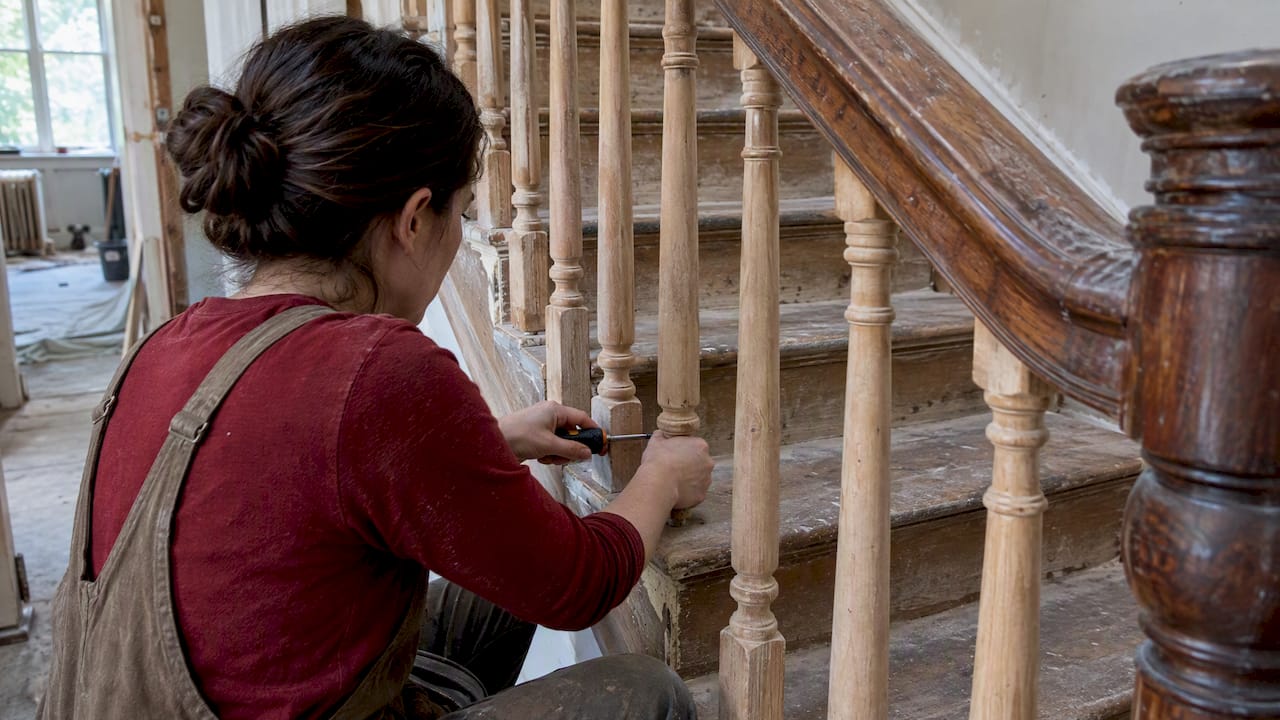
We approach every baluster replication the same way we approach any historic millwork commission: document first, fabricate second. A typical project moves through on-site measurement and photography, species and finish selection matched to the original fabric, turning or CNC and scanning work sized to the complexity of the profile, and a finish schedule that brings the new piece into visual alignment with its neighbors before installation.
- We request the same baseline package described above: a physical sample when one exists, profile tracings, caliper measurements, and photographs of the original in place.
- For tax-credit or landmark-review projects, we document replacement with the photographic and physical evidence that certified rehabilitation review expects.
- Past replication work, along with examples from our broader replica millwork and complex wood manufacturing archives, shows how a shop-level process holds up across different stair styles and periods.
Why Craftsmanship Matters for an Honest Historic Match
A baluster run is one of the more visible pieces of joinery in an older house, and a mismatched profile or the wrong sheen reads as wrong from across the room even to an untrained eye. We accept a close substitute material when the original species is no longer practical to source or finish safely, but we insist on in-kind turning and profile accuracy wherever the detail is visible. When a project sits near that line, a conversation with a specialist before fabrication begins saves far more time than a second attempt after installation.
— Gepetto
Commissioning a Custom Replica from Gepetto Millworks
We fabricate custom balusters, balustrades, and the full range of period stair cases that surround them, alongside our wood turning work for other turned architectural elements. We also take on the custom casework, entry doors, and windows that round out a full restoration scope, so a single project brief can cover more than the staircase alone.

To quote a baluster replication, we need the same package outlined above: a sample baluster where one survives, profile tracings or photographs, caliper measurements, and a short note on the project’s scope and any preservation review it needs to satisfy. For intake measurement, some trades now lean on digital scanning for accurate fit, and we welcome scanned data alongside traditional templates when it’s available. Reach out through our residential woodworking page to start a quote, or browse our custom fabrication services for the rest of your project scope.
FAQ
Is it difficult to replace balusters?
Replacing a simple, undamaged baluster with a matching stock profile is a manageable weekend project for an experienced do-it-yourselfer with a caliper and a bevel gauge. Matching a carved or historic profile, sloped-rail angles, or multiple lengths per tread is considerably harder and is where most homeowners bring in a specialist shop.
What’s the difference between balusters and spindles?
In most trade usage, “baluster” and “spindle” refer to the same vertical stair element, with “spindle” used more often for slender, turned pieces and “baluster” used more broadly for any upright supporting a handrail. The terms are largely interchangeable in residential stair work.
How far apart should balusters be spaced?
Most residential building codes require no more than a four-inch gap between balusters to prevent a small child’s head or body from passing through. Always confirm the exact figure with your local code, since requirements can vary by jurisdiction.
How do you make your own balusters?
Making a basic baluster starts with tracing the original profile onto manila paper and capturing diameters with calipers, then reproducing that profile on a lathe or lathe duplicator. Published how-to guidance covers template-making, turning, and the finishing steps needed to match an aged surface, though carved or three-dimensional detail usually exceeds what a hobbyist lathe setup can achieve.
Sources
- The Secretary of the Interior’s Standards for Rehabilitation – Historic Preservation Tax Incentives (U.S. National Park Service)
- Evaluating substitute materials in historic buildings – Historic Preservation Tax Incentives (NPS)
- Historic Hagen Baluster Replication Project | Gannon MakerSpace
- How to Replicate Antique Staircase Balusters – This Old House