
There is no separate “historic preservation permit” in the District: preservation review is simply an additional step woven into the standard DOB building permit process. Depending on scope, your application receives either a delegated administrative review from the Historic Preservation Office (HPO) or a fuller evaluation from the Historic Preservation Review Board (HPRB). Before filing with DOB, we recommend a preliminary consultation with HPO to understand which path applies to your project.
TL;DR:
- Visible exterior work on designated properties can trigger review, including replacement windows, roofing, or siding; verify the property’s status before planning.
- HPO administratively approves over 95% of applications, usually within one to three business days after referral; HPRB cases follow monthly meetings and deadlines.
- Submit permit materials through the appropriate DOB portal, then email HPO or HPRB photographs, plans, narratives, and relevant specifications separately to historic.preservation@dc.gov.
- Seek conceptual review before final drawings for additions or new construction, because early HPRB feedback can prevent costly redesign after formal review.
- Full window replacements typically require photographs and shop drawings that show matching profiles; simple sash repairs may need only photos and a short narrative.
Table of Contents
- Which projects trigger historic-preservation review in DC
- How HPO and HPRB review fits into the DOB permit workflow
- Step-by-step: preparing and submitting a permit application for historic property
- Fees, timelines, and realistic expectations for historic review
- Representative project examples and documentation expectations
- How specialized millwork documentation helps secure preservation approvals
- Quick sequencing and a compact planning checklist
- Gepetto Millworks: documentation that moves historic permits forward
- FAQ
- Sources
Which projects trigger historic-preservation review in DC
Any exterior work visible from a public right-of-way on a designated historic property typically draws preservation scrutiny, and the threshold is lower than most owners expect. Demolition, additions, and substantial alterations almost always require review, but so do a surprising number of modest repairs that property owners assume are routine maintenance.
- Exterior alterations visible from the street, including new openings, porch changes, and material swaps
- Full or partial demolition of any building element, however minor it may seem
- In-kind replacement of windows, roofing, or siding, which often still requires documentation even when the new material matches the old
- Masonry repointing, especially when mortar composition or color differs from the historic fabric
Before assuming your project falls outside these categories, confirm your property’s status. The DC Office of Planning maintains lookup tools for historic district and landmark designation, and that single check can save weeks of redesign later.
How HPO and HPRB review fits into the DOB permit workflow
Once DOB receives your application, it forwards historic properties to HPO for an internal referral rather than routing you to a separate agency. This is the mechanism that surprises many first-time applicants: the review happens inside the permit pipeline, not alongside it.
- DOB logs your permit application and flags the property as historic
- HPO staff review the scope against preservation guidelines and either approve it administratively or refer it to HPRB
- HPRB evaluates larger or more visible interventions, often after a concept review has already shaped the design
HPO holds delegated authority to approve the significant majority of applications without a board hearing. DC Office of Planning reports that HPO staff administratively approve over 95% of permit applications for historic properties, with expedited reviews typically completed within one to three business days once DOB forwards the file. HPRB involvement becomes necessary for new construction, substantial additions, and demolitions where the delegated review authority does not apply.
Pro Tip: Request a conceptual review before finalizing construction drawings on any addition or new structure. It gives you board-level feedback while changes are still inexpensive to make.
Step-by-step: preparing and submitting a permit application for historic property
Filing for a historic property means coordinating two parallel submission paths rather than one. DOB processes the building permit itself, while HPO and, when necessary, HPRB require their own documentation delivered separately.
- Schedule a preliminary consultation with HPO, especially for additions, demolitions, or any scope with design ambiguity
- For complex projects, pursue conceptual design review before drafting final construction documents
- Assemble your document pack: context and detail photographs, architectural plans, a written narrative describing the work, and material samples or specifications where relevant
- File the building permit through the DOB Permit Wizard for most residential scopes, or through Citizen Access/ProjectDox for other filings
- Separately email your HPO/HPRB materials, since DOB’s online systems do not automatically forward these documents
- Post public notice placards when HPRB review applies, as required under the HPRB application instructions
- Submit HPRB attachments and narratives to historic.preservation@dc.gov ahead of the relevant filing deadline
- Expect fee invoicing only after DOB confirms your application is complete
Fees, timelines, and realistic expectations for historic review
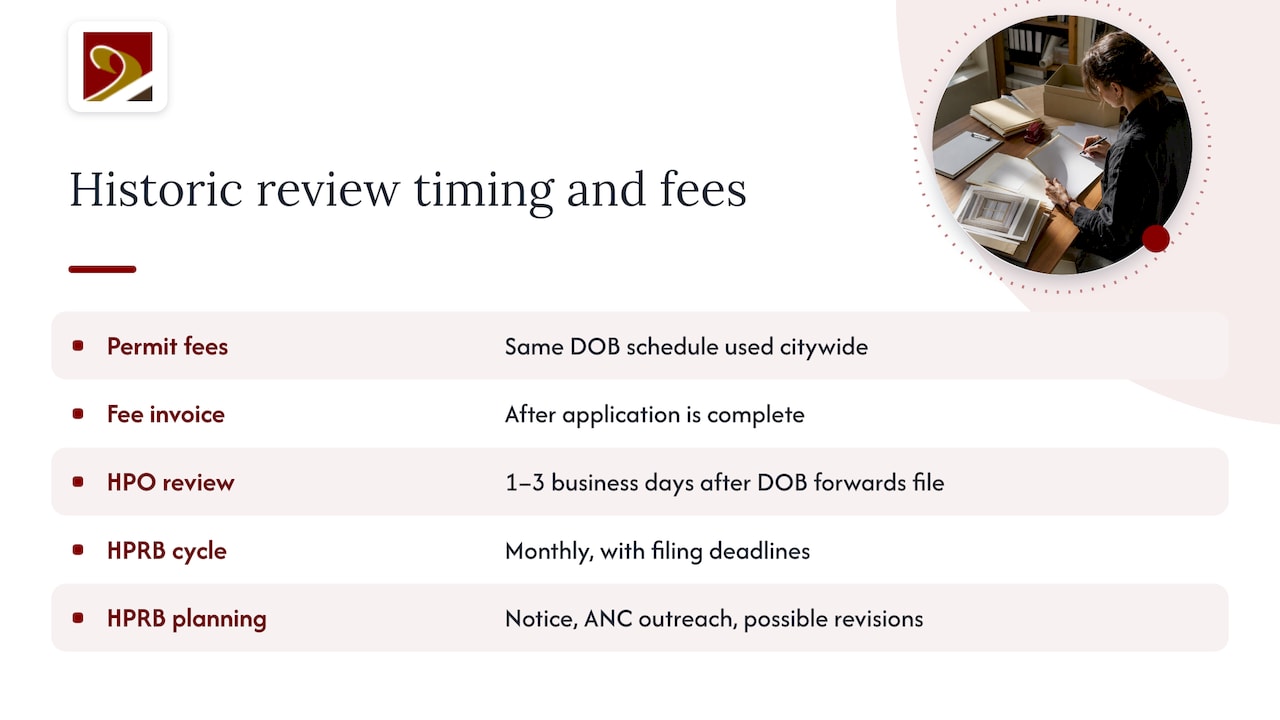
Permit fees for historic properties follow the same DOB fee schedule used citywide, with smaller repair scopes landing in lower tiers and larger projects scaled by valuation. DOB invoices fees after it confirms your application is complete, not at the moment of submission, so budget for that sequencing when planning cash flow.
HPO’s delegated review authority approves most historic-property applications administratively within one to three business days once DOB forwards the file, according to the Office of Planning. Projects requiring HPRB involvement move on a different clock entirely, since the board meets on a monthly cycle with its own filing deadlines. We encourage building in extra time for public notice requirements, ANC outreach, and the possibility that the board requests revisions before final approval.
Representative project examples and documentation expectations
The documentation burden scales with how much of the historic fabric a project disturbs. A window restoration that keeps original sash and simply repairs rot may need only photographs and a brief narrative, while a full replacement program typically calls for measured elevations and shop drawings demonstrating profile match.
- Window restoration: photographs of existing conditions, plus shop drawings when replacement rather than repair is proposed
- Demolition: documentation identifying which elements are historic, a narrative explaining the necessity, and HPRB routing in most cases
- Small additions and porches: concept review is strongly advised, since redesigning after a denial costs far more than early board feedback
- Material specifications: profile dimensions, species, and finish notes for any new or replacement millwork
Owners weighing an addition alongside a landmark property often underestimate how much a single conceptual review session can reshape the eventual permit set, sparing them a costlier revision cycle after HPRB’s first look.
How specialized millwork documentation helps secure preservation approvals
HPO staff reviewing a window or door replacement are looking for evidence that the new work matches the old in profile, material, and method, not just appearance from the curb. Shop drawings that document muntin dimensions, glazing bead profiles, and species selection give reviewers the specificity they need to treat a replacement as in-kind rather than a departure requiring further scrutiny.
Our historic window restoration documentation includes shop drawings, material specifications, and sample photographs built for exactly this purpose, and the same records support historic tax-credit applications down the line. Clear material notes also speed HPRB presentations, since board members can evaluate a proposal on paper rather than requesting a site visit.
Pro Tip: Ask your millwork fabricator for dimensioned shop drawings before you submit to HPO, even on small repairs. A single clear drawing often resolves questions that would otherwise trigger a request for more information.
Quick sequencing and a compact planning checklist
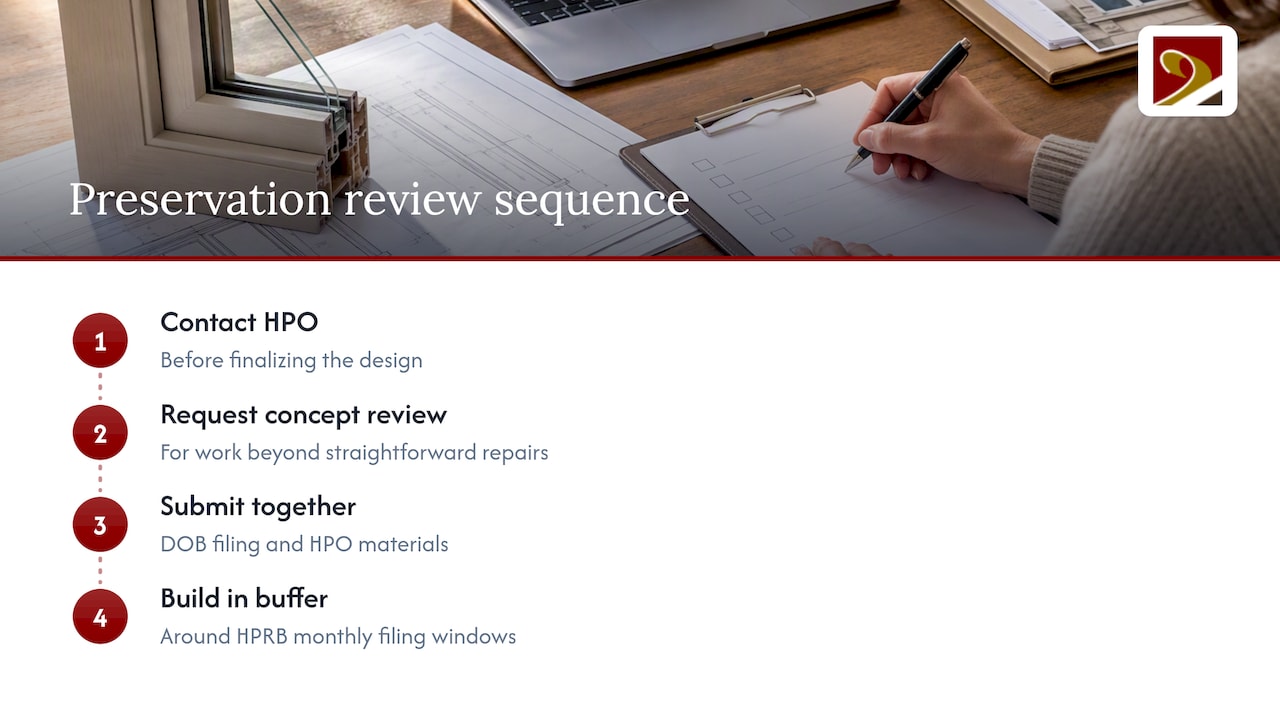
The sequence that keeps projects moving is simple: contact HPO before you finalize a design, pursue concept review for anything beyond a straightforward repair, and submit your DOB filing and HPO materials in the same window rather than staggering them. Property owners who treat preservation review as an afterthought tend to lose the most time, not because the process is slow by design, but because late documentation forces a restart.
A compact checklist: contact HPO early, gather context and detail photographs, confirm which DOB portal fits your scope, estimate your likely fee tier, and download the public notice placard if HPRB review applies. Build in buffer time around HPRB’s monthly filing windows.
— Gepetto
Gepetto Millworks: documentation that moves historic permits forward
Shop drawings, material specifications, and sample photographs help property owners and contractors move through HPO and HPRB review with fewer rounds of questions. Our wooden windows and custom fabrication work, including shutters, entry doors, and casework, is documented to the level of detail preservation staff expect to see on an in-kind replacement claim.
If your project involves window replacement, door fabrication, or custom millwork for a historic property, we welcome a conversation about preparing documentation that aligns with DC’s review process from the outset.
- Historic Window Restoration: shop drawings and material specs for HPO submissions
- Custom Fabrication: doors, casework, and millwork built to documented historic profiles
- Gepetto Millworks: reach our team to start a project consultation
FAQ
Is there a separate historic preservation permit in DC?
No, there is no standalone historic permit. Preservation review is an additional step inside the standard DOB building permit process, triggered automatically when DOB identifies a property as designated.
How long does historic review typically take in DC?
Most applications receive HPO’s delegated administrative approval within one to three business days once DOB forwards the file, according to the DC Office of Planning. Projects referred to HPRB follow a monthly meeting schedule and take considerably longer.
Does replacing windows in-kind still require historic review?
Yes, in-kind window and roof replacement commonly still requires documentation, even when materials match the original. Photographs and, for full replacements, shop drawings showing profile match are typically expected.
What is conceptual design review and when should I use it?
Conceptual design review lets applicants get HPRB feedback early, before final construction drawings are complete. It is especially useful for additions and new construction, since an approved concept often lets HPO handle the final permit administratively.
Where do I submit HPRB application materials?
HPRB applications, including photographs, plans, and a narrative, are submitted by email to historic.preservation@dc.gov ahead of the posted filing deadline, as outlined in the HPRB application form.
Sources
- Building permits for historic property | DC Office of Planning
- Apply to the Historic Preservation Review Board for Concept Review | DC Office of Planning
- Building permit fee schedule | DC Department of Buildings
- HPRB application (Application for Historic Preservation Review) | DC Office of Planning