
Choose true divided lite (TDL) when a project demands authentic shadow lines and historic tax credit compliance, and choose simulated divided lite (SDL) when energy performance and budget carry more weight than absolute period accuracy. The reason comes down to construction: TDL separates glass into individual panes held by structural muntins, while SDL applies bars to one continuous insulated pane. That single difference governs cost, thermal performance, and how each window reads from the sidewalk and the sofa alike.
TL;DR:
- True divided lite windows require wider muntins and multiple glass panes, making them more costly and harder to repair but more authentic for historic districts.
- Simulated divided lite options with spacer bars or GBG constructions offer better energy performance, larger sizes, and easier maintenance, at the expense of visual depth and authenticity.
- SDL with spacer bars closely mimics TDL’s look from a distance but features a sealed glazed unit that is more energy-efficient and better suited for modern budgets.
- Expert measurements of sash thickness and rebate depth are crucial to determine if true divided construction is physically feasible or if a hybrid approach is needed.
- Owners should ask detailed supplier questions about bar width, seal failure, and maintenance to ensure the chosen method aligns with project standards and long-term performance.
Table of Contents
- TDL vs SDL: What True Divided Lite Actually Is
- TDL vs SDL: How Simulated Divided Lite Works
- Comparing TDL and SDL Across Seven Decision Factors
- Planning for Lifecycle Costs and Maintenance
- Choosing Between TDL and SDL: A Practical Checklist
- What millwork fabricators have learned matching historic muntins
- Key Manufacturer and Specialist Resources
- Gepetto’s Take: Authenticity and Performance Aren’t Always Opposites
- Sources
- FAQ
TDL vs SDL: What True Divided Lite Actually Is
True divided lite construction places separate panes of glass into individual openings, each held by muntins that do real structural work rather than decorative ones. Light hits each pane at a slightly different angle, and the muntins themselves cast a shadow line with real depth. That’s why TDL windows look different up close than they do from across the street, and why architects specifying historic replication almost always start here.
The construction carries a technical constraint that catches many renovation clients off guard: standard insulated glass units conflict with historic muntin widths built for single-pane glazing. A muntin profiled at 7/8 inch in 1890 was never meant to hold two panes of glass and a spacer bar.
- Each pane sits in its own glazing rebate, sealed and puttied or set with bead
- Muntin depth and profile can be replicated to match a building’s original millwork
- Individual panes can be reglazed one at a time without disturbing the whole sash
- Thermal performance depends on the glass itself, since there is no sealed IG unit
TDL remains the right specification for landmark districts, tax credit projects with strict Secretary of the Interior standards, and any sash where the muntin profile itself is part of the building’s documented character.
TDL vs SDL: How Simulated Divided Lite Works
Simulated divided lite flips the construction entirely. A single, continuous insulated glass unit fills the opening, and grid bars are applied to the interior and exterior surfaces to mimic the look of separate panes. SDL construction trades individual panes for one sealed unit with applied trim, which changes almost every performance and cost variable downstream.
Three variants show up in practice, each with a different depth-to-performance ratio:
- Surface-applied SDL bars sit directly on the glass face, the simplest and least expensive option but with the flattest shadow line
- SDL with spacer bars places a matching bar inside the sealed unit between the panes, which restores visual depth closer to TDL while keeping one continuous IG unit
- Grilles between glass (GBG) locates the grid entirely inside the sealed cavity, eliminating any surface bar to clean around
SDL suits large window replacements, additions where energy codes apply, and any project where the owner wants the divided lite look without the maintenance load of dozens of individual panes.
Comparing TDL and SDL Across Seven Decision Factors
The core TDL vs SDL trade-off narrows to seven factors that actually drive a specification decision on a real project.
- Authenticity and visual depth. TDL wins decisively at close range, since real glass edges catch light differently under each muntin. SDL with spacer bars closes most of that gap from ten feet back; surface-applied SDL closes very little.
- Sightlines and muntin width. TDL requires wider muntins to structurally hold glass and glazing putty, often 7/8 inch or more. SDL can achieve narrower profiles since the bar carries no structural glazing load, per Simpson’s documented divided lite construction specs.
- Cost drivers. TDL costs more per opening, since it multiplies glass count, cutting, and labor per pane. SDL’s single IG unit and applied bar reduce fabrication steps substantially.
- Energy performance. SDL and GBG generally outperform TDL because the sealed IG unit provides consistent insulating value, a point Marvin’s technical documentation confirms directly.
- Repairability. TDL allows single-pane reglazing when one section fails. SDL requires full IG unit replacement if the seal fails, since the bars are bonded to one sealed assembly.
- Large openings and transoms. SDL and GBG handle oversized lites and transoms more reliably, since a single IG unit resists wind load better than many small individual panes.
- Long-term cleanability. GBG wins outright here, since there’s no exterior bar to dust or repaint; surface-applied SDL and TDL both require cleaning around every muntin face.
Planning for Lifecycle Costs and Maintenance
Glass count drives most of the TDL vs SDL cost gap. A six-over-six TDL sash means twelve individual panes to cut, glaze, and seal, while an SDL version of the same sash uses one IG unit and a bonded grid. Custom muntin profiles, curved or diamond-pattern lites, and matching an existing building’s exact reveal depth all add fabrication time beyond the basic glass count.
Maintenance schedules diverge just as sharply. TDL glazing putty and glazing points typically need inspection every few years, with reglazing as sealant dries and cracks. SDL introduces a different failure mode: seal failures in insulated glass units show up as fogging or condensation between panes, and spacer bar adhesives can degrade under sustained UV and thermal cycling.
- TDL: periodic reglazing, individual pane replacement, ongoing paint maintenance on exposed muntins
- SDL: IG seal inspection, occasional full-unit replacement, adhesive checks on applied spacer bars
- GBG: minimal exterior maintenance, since bars are sealed inside the unit
Vacuum insulated glass and other thin IG technologies now let some historic projects achieve TDL-style profiles with better thermal performance than traditional single-pane TDL, though the fabrication requires specialist capability and a higher budget line.
Pro Tip: Ask any fabricator quoting SDL with spacer bars to show a cross-section sample, not just a photo. The depth of that internal bar relative to the glass surface is what determines whether the finished sash reads as authentic or flat.
Choosing Between TDL and SDL: A Practical Checklist
Work through these steps before finalizing a specification, in order:
- Confirm the project’s governing standard: is this under a historic tax credit review, a local historic district ordinance, or unrestricted renovation?
- Measure existing muntin width, glazing rebate depth, and sash thickness on any openings being matched.
- Set an explicit energy target (a U-factor or a code requirement) before comparing glass options.
- Request sample cross-sections from any supplier, not marketing photos.
- Ask ten direct questions: What’s the actual bar width? Is the spacer bar structural or cosmetic? What warranty covers seal failure? Can individual panes be reglazed later? How does GBG affect cleaning access? What’s the lead time for custom muntin profiles? Has this exact profile been matched before? What happens if the historic review board rejects the sightline? Is VIG an option for this opening size? What does a failed seal repair cost in five years?
As a rule of thumb, specify TDL for small multi-pane units where shadow lines are part of a documented historic character, and specify SDL with spacer bars or GBG for large insulated openings where energy targets and budget outweigh close-range authenticity. Watch for vendors who claim their SDL “looks exactly like TDL” without offering a physical sample. That claim rarely survives daylight.
What millwork fabricators have learned matching historic muntins
Every glazing decision starts the same way in Gepettomillworks’ shop: measuring the original sash thickness, the glazing rebate shoulder, and the muntin return depth before anyone discusses glass options. That measurement determines whether true divided construction is physically feasible or whether a hybrid approach becomes the honest recommendation.
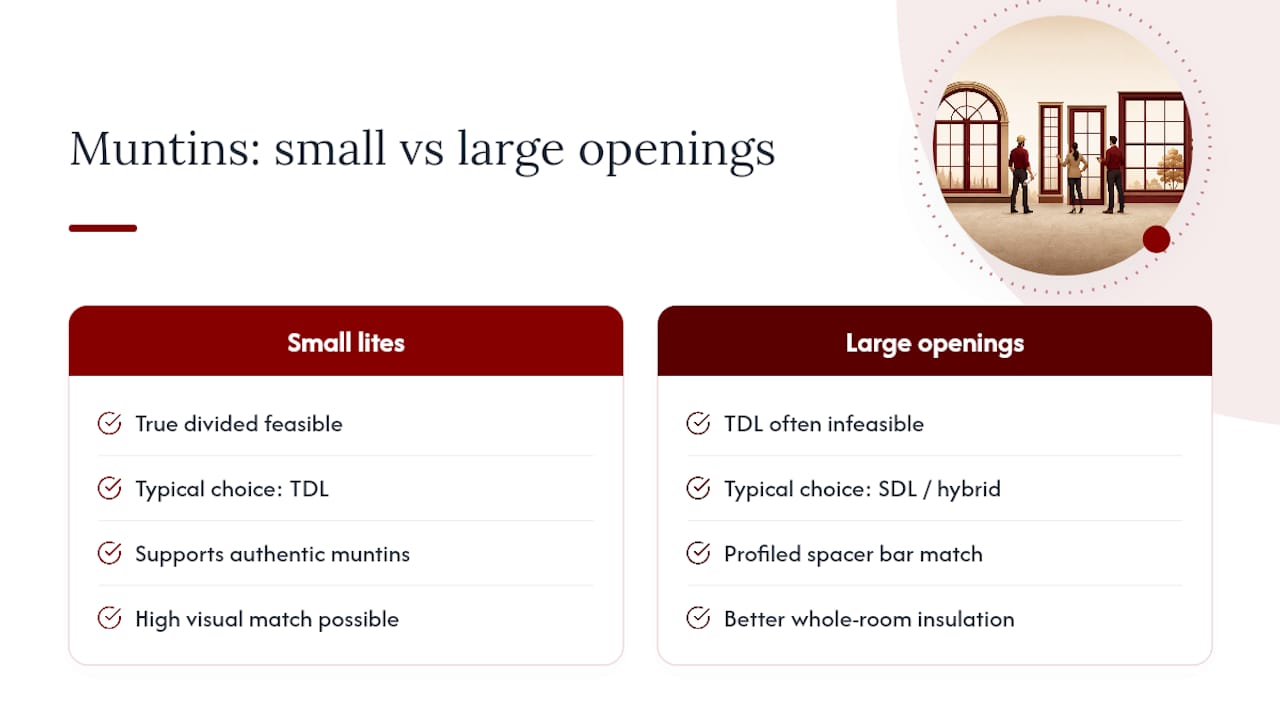
China cabinet doors and library sash, with their small individual lites, almost always support true divided construction without compromise. Larger openings, particularly where an owner wants insulated performance across a whole room, more often push toward an SDL with spacer bar profiled and painted to match the original muntin proportions. The lesson across these projects has stayed consistent: proportion matters more than method, and a well-matched hybrid outperforms a poorly proportioned TDL every time, which is why coordinating custom millwork with general contractors is crucial for success in these installations (Services – Axenia Construction).
Key Manufacturer and Specialist Resources
For technical drawings and construction specifics, Simpson’s divided lite construction page and Marvin’s divided lites overview cover manufacturer-grade detail on bar widths and IG options.

Gepetto’s Take: Authenticity and Performance Aren’t Always Opposites
The instinct to treat TDL vs SDL as a binary choice misses how most historic projects actually get solved. The real question isn’t which method wins in the abstract. It’s whether the specific opening, its proportions, and its rebate depth can physically support true divided construction without forcing a compromise the owner will regret. Millwork fabricators approach every window and door with that measurement first, then recommend the construction method that fits the opening rather than the one that fits a preconceived standard. Sometimes that means true divided glass. Sometimes it means a carefully profiled hybrid that a passerby would never distinguish from the original. Either way, the commitment to matching historic profiles, paired with an honest account of what modern glass options can and cannot do, tends to serve owners better than chasing an ideal that the building’s own dimensions won’t support. Readers restoring a historic building are welcome to bring their measurements to that same table.
— Gepetto
Sources
FAQ
What is the difference between SDL and TDL?
TDL uses separate panes of glass held by structural muntins, while SDL uses one continuous insulated glass unit with bars applied to the surface or set inside the sealed cavity to mimic that look.
Is SDL still being developed?
Yes. Manufacturers continue refining SDL variants, particularly spacer bar and grilles between glass designs, to close the visual gap with TDL while preserving insulated glass performance.
What is a TDL window?
A TDL window is built with individual panes of glass, each set into its own glazing rebate and separated by muntins that do real structural work, rather than decorative bars applied over a single sheet of glass.
What are the differences between simulated divided light and true divided light glass?
True divided lite glass consists of multiple separate panes, each independently glazed and repairable. Simulated divided lite glass is one continuous insulated unit with bars applied on top or sealed inside, trading individual-pane repairability for better thermal performance and lower cost.