
Maryland has no single rulebook for historic buildings. Three layers apply: the federal Secretary of the Interior’s Standards for Rehabilitation, the Maryland Historical Trust (MHT) when state tax credits are involved, and the design guidelines of a local historic district commission, such as those in Baltimore or Hagerstown. A project in a locally designated district may answer to all three, and the strictest layer governs the millwork you can specify.
This guide sets out how the layers fit together, what reviewers look for in windows, doors, trim and stairs, and how to sequence a project so that approval precedes construction.
TL;DR
- Maryland preservation review is layered: federal Standards, MHT review for state credits, and local commission guidelines for designated districts.
- The core principle is consistent everywhere: repair deteriorated historic features rather than replace them, and match the original when replacement is unavoidable.
- The state’s Historic Revitalization Tax Credit offers 20% of eligible rehabilitation expenses, with separate homeowner, small commercial and competitive commercial tracks.
- All work, even minor exterior repair, must be approved by MHT before construction begins if you intend to claim the credit.
- Document existing conditions first, and bring your millwork fabricator into the design phase, not after permits.
Table of Contents
- The three layers of review
- The rule that sinks projects: approval before construction
- What reviewers expect from historic millwork
- A practical sequence for owners, architects and contractors
- Our perspective
- Where Gepetto Millworks fits
- FAQ
- Sources
The three layers of review
Federal: the Secretary of the Interior’s Standards
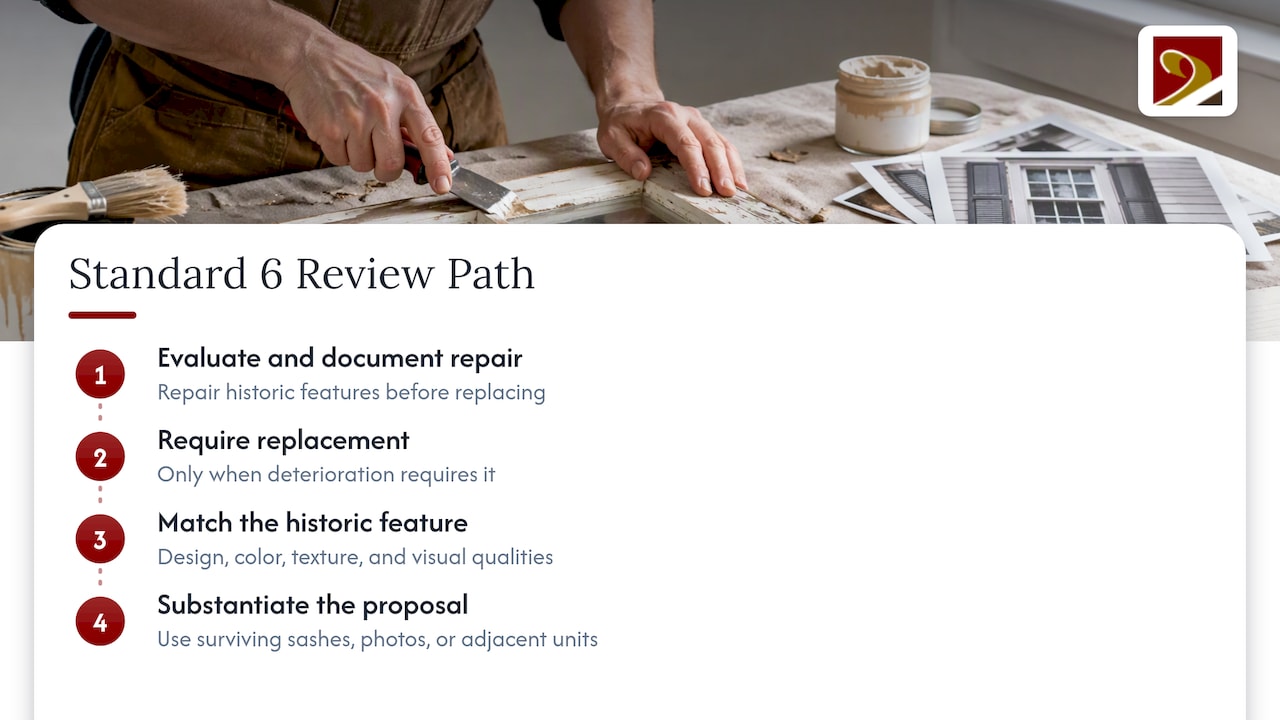
The Standards for Rehabilitation are the measure that MHT and most local commissions borrow. Standard 6 is the one that most often governs millwork. The National Park Service frames it as a requirement that deteriorated historic features be repaired rather than replaced, and that where severity of deterioration requires replacement, the new feature match the old in design, color, texture and other visual qualities. Replacement must also be substantiated by documentary, physical or pictorial evidence, not by taste.
In practice, a reviewer reading your window schedule asks three questions. Was repair evaluated and documented? If not repairable, does the replacement reproduce the original profile, muntin dimensions, glazing and operation? And is there evidence, such as surviving sashes, photographs or adjacent units, for what you propose?
State: the Maryland Historical Trust
MHT administers the Maryland Historic Revitalization Tax Credit Program. Its tax credit overview describes a 20% state income tax credit on eligible rehabilitation expenses, divided into three categories:
| Category | Credit | Minimum expense | Notes |
|---|---|---|---|
| Homeowner | 20%, capped at $50,000 in a 24-month period | $5,000 | Rolling applications |
| Small commercial | 20%, capped at $50,000 in a 24-month period | $5,000 | For smaller income-producing projects |
| Competitive commercial | Up to $5,000,000 | Greater of $25,000 or adjusted basis | Annual competitive round, typically with an August 31 deadline |
The homeowner program accepts applications year-round, and MHT states that review typically takes 30 to 45 days once a complete application arrives, though complexity can lengthen it. MHT also announced that the FY27 application became available on June 1, 2026. Confirm current deadlines and forms with MHT before you plan a schedule, since they can change from year to year.
Local: the historic district commission
Most day-to-day design review in Maryland happens at the municipal or county level. Local commissions regulate exterior changes in designated districts and on individual landmarks, and each publishes its own guidelines.
- Hagerstown. The city adopted a preservation ordinance in 1987 that frames its program, and its effects of designation page explains what locally designated districts and landmarks mean for owners.
- Baltimore. The city’s Commission for Historical and Architectural Preservation (CHAP) maintains design guidelines. The chapter on historic buildings, in a draft revision available from the city, states that deteriorated historic fabric should be repaired rather than replaced and notes that wood has always required regular maintenance. Check CHAP for the version currently in force.
A local approval does not substitute for MHT approval, and the reverse is also true. Owners who plan to claim the state credit in a local district should treat the two reviews as parallel tracks.
The rule that sinks projects: approval before construction
MHT’s homeowner credit page states that all work must be approved by MHT, and the practical corollary is blunt. Starting work before MHT review can disqualify a project from the credit. The same discipline applies to commercial applicants.
That has scheduling consequences:
- Order matters more than speed. Do not authorize demolition, sash removal or even exterior repair until approval is in writing.
- Emergency repairs need a call first. MHT asks homeowners who want to use the credit for emergency work to contact tax credit staff before beginning.
- Long-lead items belong in the design phase. Custom sash, entry doors and stair components take weeks to build. Drawings and profile sections should be ready for the application, even though fabrication waits for approval.
MHT’s own guidance also stresses early consultation and the stage-by-stage application process. The distinction between eligible and ineligible expenses is applied strictly, so itemize your budget accordingly.
What reviewers expect from historic millwork
Windows
Windows draw more scrutiny than any other element, because they define a facade’s rhythm and are so often replaced for energy reasons. The National Park Service notes that only 10% to 20% of a building’s energy loss typically occurs through windows, with air infiltration at the joints responsible for much of it. The standard-compliant path is therefore repair, weatherstripping and a compatible storm window, not wholesale replacement.
Two practices help at review:
- Survey each opening. Record the condition of sash, stiles, rails, muntins, sills and glazing with photographs and notes. A reviewer cannot approve replacement of a window that was never shown to be beyond repair.
- Run a sample repair. Restoring one representative window lets the owner, the design team and the reviewer judge the feasibility, appearance and cost before committing to the whole building.
When replacement is unavoidable, the NPS also publishes an interpreting bulletin on selecting new windows to replace non-historic windows, which ties the decision to Standards 2 and 6. The question is whether the new unit reproduces the character of the historic opening, including its sightlines and proportions.
Doors, trim and shutters
Entrance doors, surrounds, transoms and sidelights carry much of a building’s historic identity. Reviewers generally want to see the original panel layout, stile and rail proportions, and moulding profiles preserved or replicated, and they scrutinize stock replacements that flatten those details. Shutters are a common sticking point: operable louvered or paneled shutters sized to the opening are historically credible, while fixed, undersized ones are not.
Stairs, balustrades and interior woodwork
Interior work is reviewed by MHT when it falls within the credit application, and by local commissions rarely, since most only regulate exteriors. Where an original newel, handrail or balustrade survives, repair it. Where a missing section must be reproduced, use evidence from surviving components to establish the turning profile, baluster spacing and rail section.
Materials
Material substitution is the other recurring problem. The NPS treats materials that mimic original historic materials with caution, particularly in projects seeking tax credit certification. A wood window should generally be replaced in wood, with glazing, profile and finish consistent with the original, and that is where the guidelines meet the workshop.
A practical sequence for owners, architects and contractors
- Confirm designation. Determine whether the property sits in a local historic district, is individually landmarked, or is listed on the National Register. Each triggers different review.
- Contact MHT early if you plan to claim state credits, especially on complex projects.
- Document existing conditions with measured drawings, photographs and a condition survey of every window, door and major woodwork feature.
- Test with a sample repair before committing to full restoration.
- Prepare millwork drawings showing profiles, joinery, species and finish, so that reviewers can see precisely what will be installed.
- Secure written approvals from MHT and the local commission before any construction starts.
- Build, install and photograph the completed work, since credit documentation closes with proof of what was done.
Once construction wraps, a specialist crew handles the final turnover. Commercial projects often schedule a post-construction cleanout in Maryland before tenants or visitors arrive, so that fine dust from milling and sanding does not settle on newly finished wood.
Our perspective

We build and restore millwork for historic buildings, and the pattern we see is consistent: projects succeed when the shop is consulted before the drawings are final. A reviewer’s objection is rarely about taste. It is almost always about evidence, a profile that was guessed, a muntin that is thicker than the original, a replacement approved without a documented attempt at repair.
Our work centers on exact replication with authentic materials and techniques, so that new components can meet the matching requirements that tax credit reviewers apply. We also take on complex, architecturally significant projects and unusual custom requests. Our advice to architects is to send us the survey photographs and the sash you hope to match, and let us tell you what can be repaired, what must be rebuilt, and what the evidence will support. We have written a separate guide on millwork documentation for Maryland’s 20% credit.
— Gepetto
Where Gepetto Millworks fits
If your project involves original sash that can be saved, our historic window restoration service addresses repair first, in line with the Standards. Where a window cannot be saved, we fabricate wooden windows to replicate the original. Doors, shutters, casework, period staircases and balustrades are covered under our custom fabrication offering. Pricing is by project, so send drawings or photographs through our main site and we will review the scope with you.
FAQ
Does Maryland have one set of historic preservation guidelines?
No. The Secretary of the Interior’s Standards apply to federally certified or state credit projects, MHT administers the state credit program, and each local commission publishes its own design guidelines. Start by finding which of these apply to your address.
Can I begin repairs while my tax credit application is pending?
Not if you intend to claim the credit. MHT requires approval of all work before it begins, and starting early can disqualify the project. If a repair is an emergency, contact MHT tax credit staff before you start.
Do I have to keep my original windows?
The Standards prefer repair over replacement for deteriorated features. If a window is truly beyond repair, a replacement that matches the original in design, color, texture and visual qualities, supported by evidence, is the accepted route.
How large is the Maryland historic tax credit?
It is 20% of eligible rehabilitation expenses. Homeowner and small commercial projects are capped at $50,000 in a 24-month period, while the competitive commercial track can provide up to $5,000,000. Check MHT for the current year’s rules before applying.
Sources
- Tax Credits for Historic Revitalization, Maryland Historical Trust
- Homeowner Tax Credit, Maryland Historical Trust (program page)
- Homeowner Tax Credit, Maryland Historical Trust
- FY27 Application Now Available, Maryland Historical Trust
- Evaluating Historic Windows for Repair or Replacement, National Park Service
- ITS Number 23: Selecting New Windows to Replace Non-Historic Windows, National Park Service
- Historic Preservation, Hagerstown, MD
- Effects of Designation, Hagerstown, MD