
Yes, Maryland offers state historic revitalization tax credits, and certified projects can typically claim a credit of 20% of qualified rehabilitation costs after certification by the Maryland Historical Trust and filing Form 502S. Start by determining which of the three program tracks fits your project, then contact the Trust early to begin certification and prepare the documentation Form 502S requires at filing time.
TL;DR:
- The Maryland historic tax credit offers 20% of qualified rehabilitation costs, with up to 5% additional if high-performance standards are met.
- Certification is a three-stage process through the Maryland Historical Trust, with an initial application before work begins and final certification after completion.
- The maximum credit caps at $50,000 for homeowner and small commercial projects, but can be up to $5 million for larger commercial rehabilitations.
- Proper documentation, including the approved Part 3 certification and photographs sent to MHT, is crucial to avoid application rejection.
- Engaging experienced historic rehab professionals early, especially architects and millwork specialists, improves certification success and overall project quality.
Table of Contents
- The Three Maryland Historic Tax Credit Tracks
- Eligibility and MHT Certification: What Counts as a Certified Rehabilitation
- Step-by-Step Application: Prepare, Certify, File
- How the Credit Is Calculated and What Caps Apply
- Timelines and Recapture: Completion Windows and the Five-Year Schedule
- Documentation and Common Mistakes to Avoid
- Gepetto’s Practical Guidance for Certified Rehabilitation Claims
- Benefits and Incentives Beyond the Tax Credit
- Maryland’s Credit Versus the Federal Historic Tax Credit
- Typical Costs and Fees of Applying for Maryland’s Credit
- Choosing Qualified Professionals for a Certified Project
- Case Examples: How Certified Projects Play Out in Practice
- Why Maryland’s Program Rewards Early Planning
- How Gepetto Millworks Supports a Certified Rehabilitation
- Sources
- FAQ
The Three Maryland Historic Tax Credit Tracks
Maryland’s Historic Revitalization Tax Credit Program is not a single incentive but a set of three related credits, each calibrated to a different kind of building and owner. The homeowner tax credit applies to owner-occupied residential properties, carries a modest expenditure floor, and is capped at a level designed for household-scale restoration rather than commercial redevelopment. It suits the family restoring a Federal-period rowhouse in Baltimore or a farmhouse in Frederick County, where the rehabilitation touches windows, trim, and structural elements without the scale of an income-producing project.
The small commercial tax credit occupies the middle ground: projects with qualified rehabilitation expenditures falling under a defined small-commercial ceiling, often storefronts, small mixed-use buildings, or modest adaptive reuse projects that do not need the full application weight of a large development.
The competitive commercial tax credit governs income-producing properties, larger redevelopment projects, and buildings where the rehabilitation budget runs into the hundreds of thousands or millions of dollars. This track carries a formal application and certification path through MHT, higher caps, and a more demanding documentation burden, reflecting the scale of the projects it serves. Choosing the correct track early shapes every subsequent step, from the paperwork you file to the deadlines you must track.
Eligibility and MHT Certification: What Counts as a Certified Rehabilitation
Certification by the Maryland Historical Trust is not optional. It is the statutory gateway that determines whether a project qualifies for any of the three credits, and COMAR regulations codify the homeowner, small commercial, and competitive commercial tracks under MHT’s authority. The certification process generally moves through three stages: an initial application describing the property and proposed work, a review during construction, and a final certification once the rehabilitation is complete. This three-part structure mirrors the federal process, though Maryland’s forms and thresholds are distinct.
Substantial rehabilitation thresholds determine whether a project even qualifies for review. Form 502S instructions set the floor at $5,000 in qualified expenditures for a single-family, owner-occupied property, while other property types must meet a threshold equal to the greater of the building’s adjusted basis or $25,000. A modest cottage restoration might clear the homeowner floor with new sash windows and repointed masonry, while a commercial building’s threshold scales with its existing basis, meaning a higher-value property must spend proportionally more to qualify.
Eligible applicants extend beyond individual owners. Nonprofits, trusts, and pass-through entities such as partnerships and limited liability companies can pursue certification, though pass-through entities face specific allocation and filing rules when the credit passes to individual partners or members. Anyone uncertain whether their ownership structure qualifies should raise the question with MHT before submitting Part 1, since a certification granted to the wrong applicant can complicate the eventual Form 502S filing.
Step-by-Step Application: Prepare, Certify, File
The application sequence follows the certification’s three parts, and the order matters because expenditures incurred before Part 1 approval generally will not qualify.
- Submit the Part 1 Certification Application to MHT before beginning work, describing the property’s historic status and the proposed scope of rehabilitation.
- Receive a project number and MHT’s initial approval, which establishes the baseline against which later work is measured.
- Complete Part 2 documentation as the work proceeds, since MHT reviews progress against the approved scope rather than certifying everything retroactively at the end.
- File Part 3 once construction is finished, requesting final certification of the completed rehabilitation.
- Attach the approved Part 3 certification to Form 502S when filing your Maryland tax return, since the Comptroller will not honor the credit without it.
Corporations and pass-through entities generally must file electronically, and the Form 502S instructions direct applicants to send supporting photographs and project documentation directly to MHT at 100 Community Place, Crownsville, Maryland 21032-2023, not to the Comptroller’s office. Confusing these two recipients is one of the more common procedural errors, since the Comptroller processes the tax form while MHT retains authority over the underlying certification.
How the Credit Is Calculated and What Caps Apply
Form 502S walks applicants through a straightforward calculation once certification is in hand: certified qualified rehabilitation expenditures are multiplied by 20%, and an additional 5% may apply if the building meets high-performance standards, bringing the potential credit to 25% of qualified costs for buildings that meet that bar.
A credit calculated at 20% of certified rehabilitation expenditures, with a possible 5% high-performance add-on, forms the backbone of Maryland’s program, according to Form 502S. That percentage applies uniformly across the homeowner and small commercial tracks, though the dollar caps differ by scale of project.
- Homeowner and small commercial projects are generally subject to a $50,000 maximum credit.
- Competitive commercial rehabilitations can claim up to $5,000,000, reflecting the larger scope of income-producing redevelopment.
- The credit is nonrefundable in most circumstances but can typically be carried forward, so a project that generates more credit than the owner’s current tax liability is not necessarily wasted.
- The approved Part 3 Final Certificate must be attached to Form 502S at filing, since the Comptroller’s form treats it as the evidentiary backbone of the claim.
An owner restoring a modest brick town house with $60,000 in qualified window, door, and plaster work would calculate a credit near the $50,000 cap, while a developer converting a former mill building into apartments might approach the $5,000,000 commercial ceiling on a much larger rehabilitation budget.
Timelines and Recapture: Completion Windows and the Five-Year Schedule
Commercial rehabilitations must be completed within an approved timeframe; applicants should coordinate with MHT for any extensions to avoid eligibility loss. Owners who anticipate delays, whether from permitting, material sourcing, or contractor scheduling, should notify MHT before the deadline lapses rather than after, since a documented postponement request preserves eligibility in a way that a missed deadline does not.
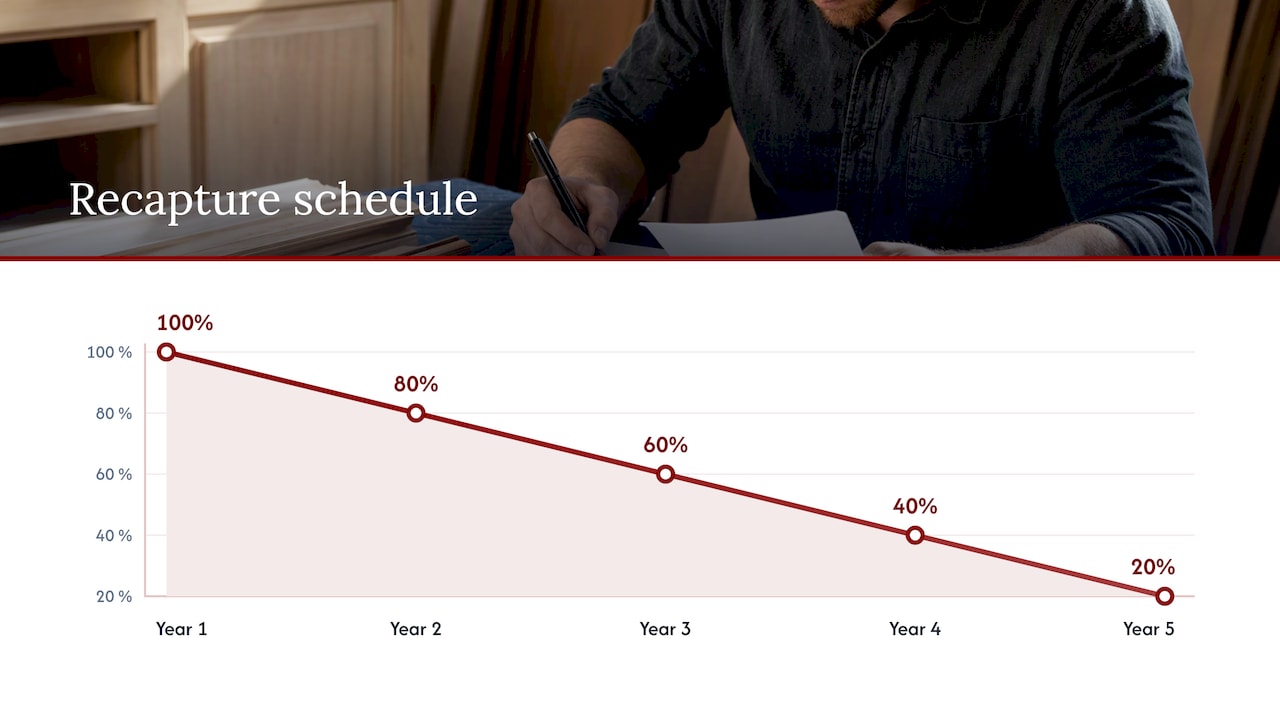
Recapture is the mechanism that claws back credit already claimed if the property is sold or altered in a disqualifying way within five years of certification. The schedule generally reduces the recapture percentage each year: 100% in the first year, tapering to 80%, 60%, 40%, and 20% by the fifth, according to Form 502S. A sale, a demolition of certified features, or work that undoes the approved rehabilitation can all trigger this clawback, so owners planning a sale within that window should factor recapture exposure into their timing.
Documentation and Common Mistakes to Avoid
Strong recordkeeping is what separates a smooth Form 502S filing from a rejected one. Keep itemized invoices tied to each certified expenditure, proof of payment, the MHT-approved Part 3 certification, detailed contractor scopes of work, and photographs documenting conditions before, during, and after the rehabilitation.
- Failing to attach the approved Part 3 certification to Form 502S, which the Comptroller treats as grounds for disallowing the credit outright.
- Sending photographs or project documentation to the Comptroller instead of to MHT at its Crownsville address, delaying review of both the certification and the tax filing.
- Reusing the same certified expenditures across multiple tax years, which invites scrutiny during any subsequent audit.
Pro Tip: Keep a single project folder, physical or digital, that pairs every invoice with its corresponding photograph and MHT correspondence, so an auditor or a future buyer can trace each certified dollar back to its source.
Gepetto’s Practical Guidance for Certified Rehabilitation Claims
Period-accurate windows, entry doors, and interior millwork are commonly accepted as qualified expenditures when the paperwork behind them is airtight. From a fabricator’s perspective, that means shop drawings that reference the historic profile being replicated, change orders that explain any deviation from the original scope, and serial-numbered invoices that tie each sash, muntin pattern, or balustrade run to a specific line item on the certification.

Gepetto Millworks has documented this kind of work through its historic building tax credits guidance and its broader look at how historic tax credit builders approach rehabilitation scopes. Involving a restoration millwork specialist during the design phase, well before Part 2 or Part 3 submission, gives an applicant time to document the existing conditions and match replacement elements convincingly, which strengthens the eventual MHT certification rather than complicating it after the fact.
Benefits and Incentives Beyond the Tax Credit
The state credit is rarely the only incentive available to a Maryland rehabilitation project. Many jurisdictions layer local preservation grants, facade improvement programs, or reduced property tax assessments for designated historic structures on top of the state credit, though the specifics vary by county and municipality. Owners should check with their local planning or historic preservation office to see what complements the state program, since a county-level grant can sometimes be paired with the state credit to offset a different portion of the same project’s costs.
Separately, Maryland’s business tax incentives, such as the One Maryland Project Tax Credit administered by the Department of Commerce, exist for economic development purposes distinct from historic preservation and should not be confused with the Historic Revitalization Tax Credit’s certification requirements. A developer pursuing a large adaptive reuse project might qualify for both, but each program has its own application, its own agency, and its own rules, and conflating them risks an incomplete filing on either side.
The cumulative effect of these overlapping programs is that a well-documented rehabilitation, one that establishes clear qualified expenditures and a certified scope of work, is positioned to draw on more than one source of support, even though the state historic credit itself remains the central incentive for most preservation-driven projects in Maryland.
Maryland’s Credit Versus the Federal Historic Tax Credit
Maryland’s state credit and the federal historic tax credit are separate programs administered by different agencies, and a project can potentially claim both if it meets each program’s independent requirements. The federal credit generally applies to income-producing, certified historic structures and is administered through the National Park Service in coordination with the Internal Revenue Service, while Maryland’s credit is administered by the Maryland Historical Trust and claimed through the state Comptroller’s Form 502S.
The two programs do not automatically track each other. A property listed on the National Register of Historic Places, or located in a registered historic district, is a common starting point for both, but MHT certification of a rehabilitation does not substitute for federal certification, and vice versa. Developers pursuing a large commercial rehabilitation often pursue both certifications in parallel, since the combined credits can meaningfully change a project’s financing picture, but each application, each set of qualified expenditures, and each recapture schedule must be tracked separately. An owner-occupied residential rehabilitation, by contrast, is generally only eligible for the state homeowner credit, since the federal program is largely limited to income-producing property. Understanding this distinction early prevents a developer from assuming federal eligibility automatically confers state eligibility, or the reverse.
Typical Costs and Fees of Applying for Maryland’s Credit
The state does not charge a fee to submit a certification application to the Maryland Historical Trust, but pursuing a certified rehabilitation carries real costs beyond the construction budget itself. Applicants commonly engage an architect or restoration consultant to document existing conditions and prepare the drawings MHT reviews during Part 1 and Part 2, and that professional fee scales with project complexity rather than following a fixed schedule.
Larger competitive commercial projects often retain a historic preservation consultant specifically to manage the certification process, since the three-part application and the documentation MHT expects can be time-consuming for an owner or developer without prior experience. Legal and accounting costs also enter the picture for pass-through entities that need to structure how the credit allocates among partners or members.
None of these costs are set by the state program itself, and they vary widely depending on project scale, the complexity of the historic fabric involved, and whether the owner is pursuing the homeowner track or a multimillion-dollar competitive commercial rehabilitation. A homeowner replacing a handful of windows on a rowhouse faces a far smaller documentation burden, and correspondingly smaller consulting costs, than a developer converting a mill complex into mixed-use space. Budgeting for professional fees alongside construction costs from the outset avoids the surprise of discovering, mid-project, that certification requires more documentation than the owner anticipated.
Choosing Qualified Professionals for a Certified Project
A successful MHT certification depends heavily on the professionals assembled around it. An architect experienced in historic rehabilitation understands how to document existing conditions in the language MHT reviewers expect, and knows which alterations preserve character-defining features versus which risk disqualifying a project midstream. A preservation historian, whether independent or attached to a consulting firm, can strengthen the Part 1 application by grounding the property’s significance in its documented history, which matters most for buildings not already individually listed on a historic register.
Contractors matter just as much as the design team. A general contractor unfamiliar with historic tax credit projects may default to standard replacement materials or techniques that MHT will not accept as consistent with the building’s historic character, jeopardizing certification after work has already begun. Seeking contractors and specialty fabricators with a documented history of historic tax credit projects, people who understand why a millwork profile needs to match an original muntin pattern rather than approximate it, reduces the risk of a Part 2 review flagging work for correction.
Given the stakes, owners and developers benefit from assembling this team before submitting Part 1 rather than after, since an architect or historian brought in mid-project has less ability to shape the documentation that MHT will ultimately review.
Case Examples: How Certified Projects Play Out in Practice
A rowhouse restoration in a Baltimore historic district illustrates the homeowner track in practice: an owner replacing deteriorated wood sash windows and repairing original trim, plaster, and staircase elements can build a qualified expenditure total that clears the $5,000 threshold well before reaching the $50,000 cap, provided the work is certified through MHT’s Part 1 through Part 3 process rather than treated as an ordinary renovation.
A small commercial storefront rehabilitation in a town like Frederick or Cumberland often follows a similar arc at a slightly larger scale, where a business owner restoring a facade, interior trim, and a period staircase documents each phase for MHT review before claiming the credit on Form 502S.
Larger adaptive reuse projects, such as converting a historic mill or warehouse into mixed-use commercial and residential space, illustrate the competitive commercial track’s greater complexity. These projects typically involve a formal application process, phased Part 2 reviews as construction proceeds over many months, and a final certification package substantial enough to support a credit approaching the $5,000,000 ceiling. The common challenge across all three scales is the same: expenditures incurred or documentation created outside the certification window rarely qualify, regardless of how historically appropriate the work itself may be.
Why Maryland’s Program Rewards Early Planning
Maryland’s historic tax credit program does more than offset a rehabilitation budget. It channels private investment into buildings that would otherwise face costly deferred maintenance, and preservation advocates have long argued the program returns measurable community and economic value beyond the credit itself. The owners who benefit most are the ones who coordinate with MHT and their design and construction team before breaking ground, not after, and who keep documentation precise enough to survive both the certification review and the five-year recapture window.
— Gepetto
How Gepetto Millworks Supports a Certified Rehabilitation
Applicants pursuing a Maryland historic tax credit often need documented, invoice-ready millwork that matches a building’s original character, and that is where Restoration millwork specialists engaged during design, before Part 2 or Part 3 submission, can help certification packages reflect accurate profiles and maintain a clean paper trail.

- Historic window restoration for sash, muntin, and glazing work that matches original profiles.
- Wooden windows fabricated to period specifications for replacement or infill work.
- Custom fabrication covering doors, casework, and staircases documented for certification packages.
Consider discussing your project’s scope and timeline with a restoration millwork specialist before you file Part 1.
This article is general information, not a substitute for advice from a qualified financial advisor. Consult a qualified financial professional about your own circumstances before acting on anything here.
Sources
- MARYLAND 2025 FORM 502S — Maryland Comptroller
- Tax-Credit-Program-Statute.pdf — Maryland Historical Trust
- Md. Code Regs. 34.04.07.03 – The Historic Revitalization Tax Credit Program — LII / Cornell Law
FAQ
How does a historic tax credit work?
A historic tax credit reduces the tax an owner owes by a percentage of the money spent rehabilitating a certified historic property. In Maryland, that generally means 20% of qualified expenditures, plus a possible 5% high-performance add-on, claimed on Form 502S once MHT has certified the completed work.
Who is eligible for the $1,000 senior tax credit in Maryland?
That credit falls under a different Maryland property tax program than the Historic Revitalization Tax Credit covered in this guide, and its eligibility rules are set at the county level rather than by MHT. Homeowners should check with their local county tax office for the specific age, income, and residency requirements that apply where they live.
How do I apply for MD’s homestead tax credit?
The homestead tax credit is a separate Maryland property assessment program, distinct from the historic rehabilitation credit, and applicants apply through the State Department of Assessments and Taxation rather than through MHT or Form 502S. It limits taxable assessment increases on a principal residence and has its own application and eligibility criteria unrelated to historic certification.
What are the requirements for receiving the Senior tax credit in Frederick County, Maryland?
Frederick County administers its own senior tax credit program with locally set age, income, and residency thresholds that differ from the state’s historic revitalization credit discussed throughout this guide. Homeowners in Frederick County should contact the county’s finance or tax office directly for the current eligibility requirements and application steps.