
Most old wood windows in Asheville can be repaired, and repair is the course that preservation standards, historic review boards and tax-credit reviewers all prefer. Where a sash, sill or muntin has deteriorated past saving, a shop can fabricate an exact replica of the lost part, or of the whole unit, from matching species and profiles. The work lies in telling the two situations apart, in knowing which approvals a given address requires, and in choosing a shop that can do both honestly.
TL;DR
- Most historic wood windows are repairable. Test the wood with an awl, locate the moisture source, and decide unit by unit rather than for the whole house.
- Custom fabrication is for parts or units that are truly beyond repair, and the new work should match the old in profile, proportion, texture and, where possible, material.
- In Asheville’s local historic districts, exterior window changes need design review and a Certificate of Appropriateness, which is separate from building permits.
- Properly restored windows, paired with weatherstripping and storm windows, can be made energy-efficient without losing original fabric, which also protects tax-credit eligibility.
- Ask any restorer for a written, window-by-window condition survey before accepting a scope or a price.
Table of Contents
- Why Asheville’s windows are worth saving
- Can your old wood windows be repaired?
- Repair, rebuild or replace: how the decision is made
- Materials, glazing and hardware
- Energy performance without replacement
- Approvals in Asheville: review, permits and tax credits
- What drives cost
- Perspective: what we see on historic window projects
- Working with Gepetto Millworks
- How to brief a restoration and fabrication project
- FAQ
- Sources
Why Asheville’s windows are worth saving
Asheville holds an unusual concentration of intact early twentieth-century architecture: the Queen Anne and Shingle Style houses of Montford, the English-cottage vocabulary of Biltmore Village, the Arts and Crafts bungalows of Albemarle Park and Haw Creek, and the commercial blocks of downtown. In nearly all of them the windows are character-defining features. Their sash proportions, the depth of their muntins, the wavy glass in the lower lights and the slim meeting rails are what give a facade its scale and shadow.
That is also why the question of restoration versus replacement matters here more than in a subdivision. A vinyl or aluminum-clad insert changes the sightlines of a facade at once, and in a regulated district it is rarely approved. The older material, often dense, tight-grained, old-growth heartwood, also tends to outlast the fast-grown stock sold today when it is maintained.
Can your old wood windows be repaired?
Usually, yes. The National Park Service’s guidance on the repair of historic wooden windows states that old wood windows can often be repaired, and that each unit should be assessed on its own physical condition. The practical test is simple: probe the wood with an ice pick or awl. Sound wood resists the point; rotted wood gives way and lifts in soft fibers.
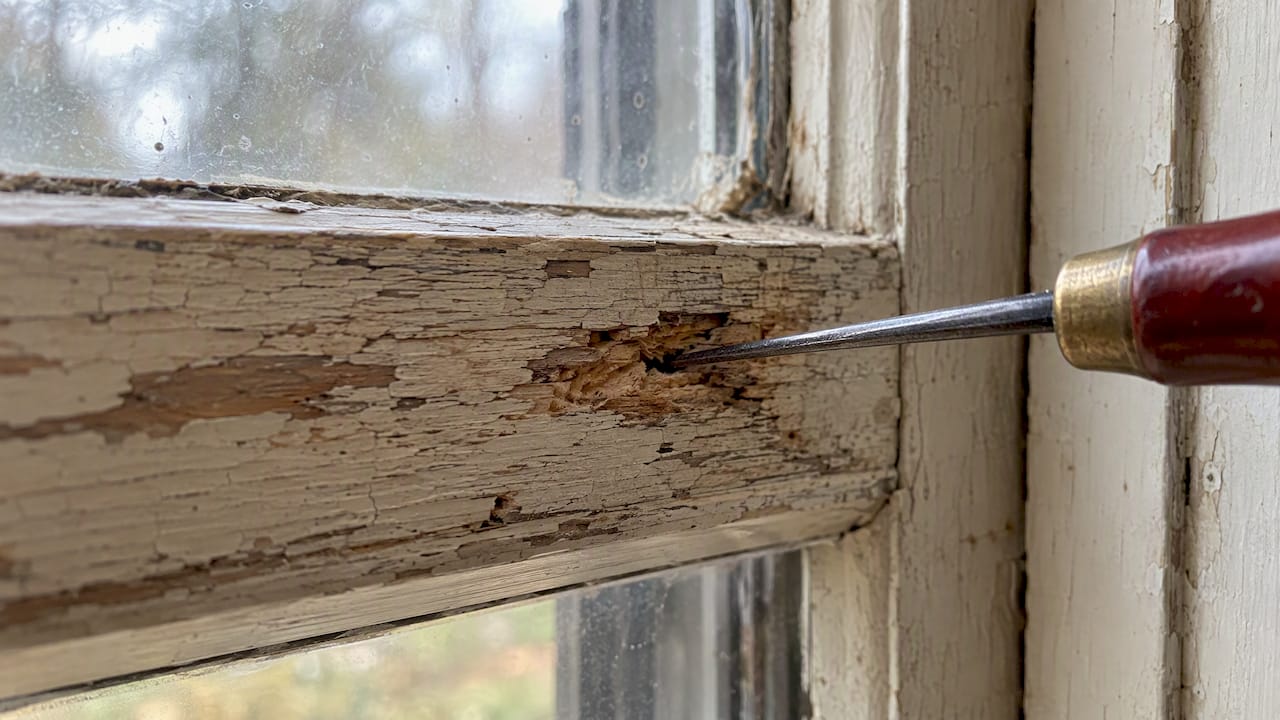
Find the water first
The same guidance identifies moisture as the primary contributing factor in wooden-window decay, and notes where it collects: sills, sill-and-jamb joints, the corners of bottom rails and muntin joints. In practice a surveyor should look at:
- Sills and lower rails. Standing water and failed paint here are the usual first signs.
- Glazing putty. Cracked or missing putty lets water behind the glass and into the rabbet.
- Exterior caulking and flashing. A leaking head or a clogged gutter above a window can rot a sash that is otherwise sound.
- Interior stains and plaster damage. These point to water entering well before the sash itself shows distress.
A window that has failed because of a gutter problem will fail again after repair if the gutter is left alone. A credible estimate addresses the cause as well as the symptom.
A quick field triage
| Condition | Typical response |
|---|---|
| Sticking sash, loose putty, flaking paint | Routine maintenance: strip, reglaze, repaint, rebalance |
| Open joints, loose rails, minor surface rot | Stabilization: epoxy consolidation, dutchman repairs, tightened joinery |
| Localized rot in a sill, rail or muntin | Splice in new matching wood, or fabricate the single part |
| Most of a sash is soft, or a whole unit is missing | Fabricate a replica sash or unit to match the original |
The NPS describes repairs along these same lines: routine maintenance, structural stabilization, and replacement or splicing of parts. Most Asheville windows fall in the first three rows.
Repair, rebuild or replace: how the decision is made
The Secretary of the Interior’s Standards put repair first. According to the National Park Service’s tax-incentives guidance, replacement is appropriate only when deterioration is beyond a practical or reasonable level of repair, and the new feature should match the old in design, color, texture and other visual qualities and, where possible, materials. Code requirements may also enter the decision.
The Department of Energy’s wood-window guideline treats sash replacement as an option when sashes are severely deteriorated, while keeping the frame and surrounding trim. That middle path is often the best one: new sash fabricated to the original section, hung in the original frame, with the casing, stops and sill preserved.
When custom fabrication is the right answer
- The sash is gone or past saving, but the frame is sound.
- Earlier owners installed replacement windows of the wrong proportion, and the facade needs the original pattern restored. Surviving windows elsewhere in the house, or photographs, provide the model.
- Part of a window run is missing, such as a curved-top sash, a leaded transom or a tracery pattern, and consistency across the elevation requires a replica.
- Trim and casing have deteriorated, and the original moulding profile must be reproduced from a shadow line or a surviving fragment.
The NPS notes that mills can duplicate parts such as muntins, rails or sills, and that on larger projects custom knives may become economically feasible. For a single house this usually means a shop that grinds its own cutters, instead of one that adapts a catalog profile that merely resembles the original.
Materials, glazing and hardware
The same NPS guidance covers the materials of a sound repair: matching wood for replacement parts, glazing putty, caulking to stop water entry, weatherstripping and storm windows. It also advises checking and preserving hardware, and cautions that some wood preservatives are toxic, so product choice and handling on site matter, particularly in a lived-in house.
A few points a specifier should insist on:
- Species. Match the replacement wood to the original where it can be identified. The UK’s Society for the Protection of Ancient Buildings generally advises against mixing timber species in a repair because differential expansion and contraction can lead to joint failure. The principle holds for a pine sash in the Blue Ridge as much as for an English one.
- Glass. Retain original crown or cylinder glass wherever it survives. Its slight distortion is part of the facade’s character.
- Hardware. Sash locks, lifts and weights are often repairable and are worth conserving, since matching them later is difficult.
- Putty and paint. Traditional linseed-oil glazing putty, properly primed and painted onto the glass edge, sheds water better than caulk substitutes.
Energy performance without replacement
The notion that old windows must go for efficiency’s sake does not survive the evidence. The Department of Energy’s 2012 guideline concludes that almost any retrofit strategy can provide a cost-justifiable improvement over single-glazed wood windows. In practice that means air sealing, weatherstripping and the addition of interior or exterior storm windows rather than total replacement.
For owners who want to keep the exterior appearance untouched, interior storms are especially attractive. The NPS has published a technical note on a magnetic-seal interior storm window designed to reduce air infiltration without damaging historic woodwork. More background on this subject is collected under our energy efficiency archive.
Approvals in Asheville: review, permits and tax credits
Design review in local historic districts
The Historic Resources Commission administers design review in four local historic districts: Albemarle Park, Biltmore Village, Montford and St. Dunstans, along with a number of local landmarks. In Biltmore Village, for example, owners must obtain Historic Resources Office and HRC approval before exterior alterations, including a Certificate of Appropriateness. Windows are exterior alterations. Replacing them, changing their pattern or removing them will draw review; ordinary repair in kind generally draws far less.
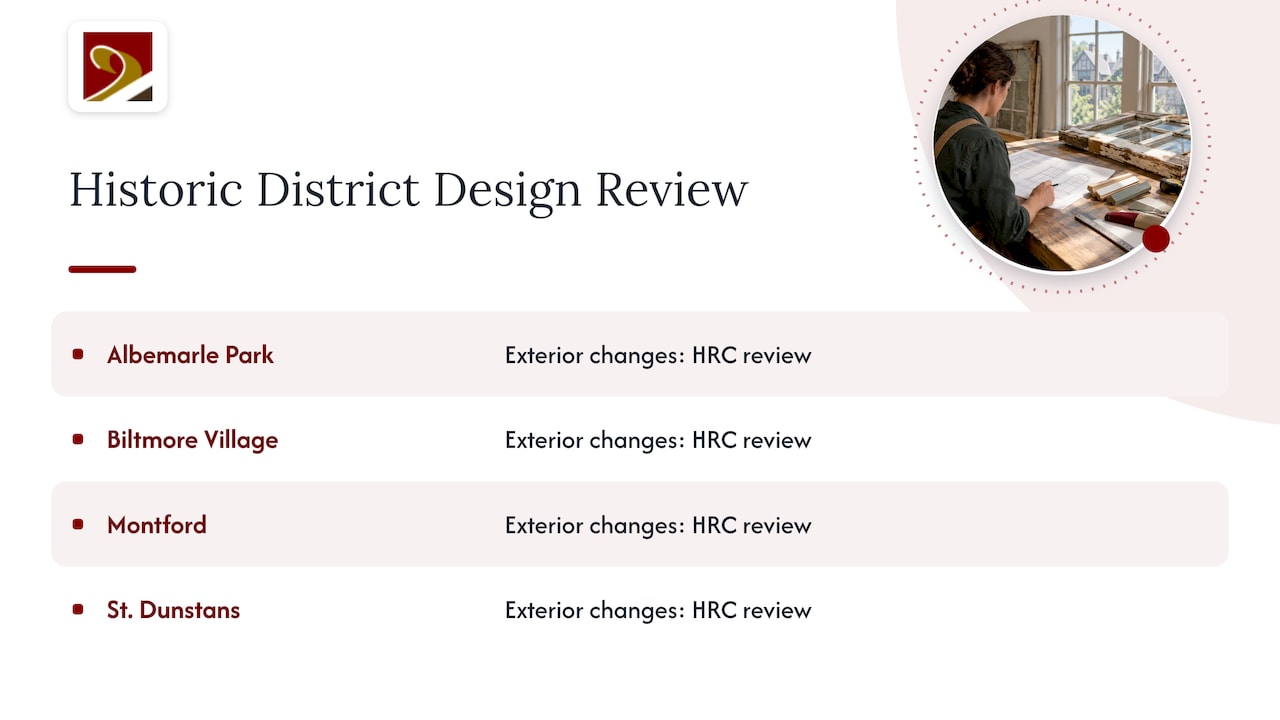
Being in a National Register district is a different matter. That designation affects tax-credit eligibility more than day-to-day approvals, and the same source notes that contributing structures in National Register districts are not subject to HRC design review. Confirm which designation applies to your address with the city before you plan.
A Certificate of Appropriateness is not a building permit
The City of Asheville states that a Certificate of Appropriateness covers design review only and does not include required building, zoning or other permits. The city’s development services office has also announced that for qualifying work costing $40,000 or less in a single-family residence, no permit is required if it complies with the current State Building Code, unless a listed exception applies. Window replacement is exempt from the load-bearing-structure exception. Read the notice for the current conditions, and confirm with the city before work begins.
Free technical help for owners
The Preservation Society of Asheville and Buncombe County offers free technical support to owners of Buncombe County properties fifty years old or older, with guidance on maintenance, restoration and rehabilitation. It is a sensible first call before any scope is written.
Tax credits and why window decisions matter
A federal credit of 20 percent for qualifying rehabilitation of income-producing historic properties has existed since 1976, and North Carolina has offered a state credit for rehabilitations as well, including a credit for non-income-producing historic homes. State program terms have changed over the years, so confirm current availability and percentages with the North Carolina State Historic Preservation Office before you budget around them.
What does not change is the importance of windows to the review. The Asheville flood-response plan for Biltmore Village warns that permanent alterations to windows may destroy character-defining features and that such changes could jeopardize state and federal rehabilitation tax credits. A tax-credit project therefore needs windows that are repaired where possible and, where not, replicated precisely, with documentation of the existing condition at each step.
What drives cost
No honest figure can be quoted for a window before it has been seen, because condition governs everything. The DOE guideline observes that retrofit cost depends on current window conditions, the extent of work and energy-performance goals. The NPS adds that repair may remain cost-effective even when some parts need replacement, and that on larger projects economies of scale can reduce the per-unit cost of custom components.
For an owner or contractor, the variables worth discussing are:
- Number of units and their repetition. Twenty identical double-hung sash are cheaper per window to reproduce than four unrelated ones, since tooling and setup are shared.
- Complexity. Curved heads, leaded or divided lights, and tracery cost more than a simple two-over-two.
- Condition of frames and sills. Sound frames keep the scope at sash level.
- Glazing and storm systems. Retained original glass, new insulated glazing where the profile permits, and the choice of storm windows each change the total.
- Site access and sequencing. Occupied houses, scaffolding and weather windows influence the schedule.
Be cautious with online ranges for new replacement windows; they describe stock products rather than conservation work, and they are a poor guide to the cost of matching a historic sash.
Perspective: what we see on historic window projects
We approach every window as evidence. Before we recommend a scope, we want to know what the original looked like, what has been altered, and which parts of the existing unit still carry the builder’s hand. That discipline is why we can say, after many projects, that the choice is rarely repair or replace for an entire house. It is almost always a sequence of smaller decisions: save this sash, splice that sill, reproduce the missing transom, rebuild the lower rails and leave the upper ones alone.
Our own work is built on exact historic replication with authentic materials and techniques, and that is what keeps a project eligible for historic tax credits. We also take on complex, architecturally significant work and unusual custom requests that others may decline. For architects and contractors, we find the most useful thing we can offer early is a candid assessment: what is worth keeping, what must be remade and what the reviewing body is likely to expect.
To owners of Asheville houses we would say this: do not let a sales appointment for replacement windows be the first professional opinion you receive. Ask for a survey of what you have.
— Gepetto
Working with Gepetto Millworks
Gepetto Millworks designs, fabricates and restores wood windows, doors, trim, staircases and architectural millwork for historic buildings, including replication of period features and matching for historic tax credit eligibility. Our historic window restoration service covers survey, repair and the fabrication of replacement sash where repair is no longer reasonable, and our page for Asheville window restoration describes how we approach projects in the area.
Where a project needs new work, our wooden windows line and our custom fabrication shop produce matching doors, casework, stair components and trim, so the window package and its surrounding millwork can be specified together. Architects and general contractors are welcome to send drawings or photographs at the schematic stage, when profile and species decisions cost the least to change.
How to brief a restoration and fabrication project
- Document first. Photograph every elevation and every window, inside and out, before any work, and keep the record for reviewers.
- Commission a condition survey that rates each window as maintain, repair, splice or fabricate.
- Confirm designation and approvals with the city, including whether a Certificate of Appropriateness is needed, and with the state office if tax credits are involved.
- Decide the energy strategy alongside the repair: weatherstripping, air sealing and storm windows.
- Fix the water source before any new paint or glazing goes on.
- Sequence the work so that windows leave the house for the shop in batches, with temporary protection installed in the openings.
FAQ
Can wood-framed windows be repaired?
Yes, in most cases. The National Park Service guidance says old wood windows can often be repaired, and recommends testing the wood with an awl to judge soundness. Localized rot is typically spliced or patched rather than prompting full replacement.
Do I need approval to restore windows in an Asheville historic district?
Exterior alterations in a local historic district generally require design review and a Certificate of Appropriateness from the city. The certificate does not replace building or zoning permits, so ask the city about both. Check your property’s designation first, since National Register districts are treated differently from local ones.
Will restored old windows be energy efficient?
They can be made much more efficient. The Department of Energy’s guideline finds that almost any retrofit strategy can give a cost-justifiable improvement over single-glazed wood windows, and weatherstripping, air sealing and storm windows are the usual measures. These preserve the original sash and, with it, historic character.
When is custom-fabricated replacement justified?
When a sash or unit is deteriorated beyond a practical level of repair, or when it is missing. The replacement should match the original in design, color, texture and, where possible, material. For tax-credit projects, document the condition that justified the replacement.
Sources
- Preservation Briefs 9: The Repair of Historic Wooden Windows (National Park Service)
- Evaluating Historic Windows for Repair or Replacement (National Park Service)
- Measure Guideline: Wood Window Repair, Rehabilitation, and Replacement (U.S. Department of Energy)
- Windows Number 9: Interior Storm Windows, Magnetic Seal (National Park Service)
- Repair of Wood Windows (SPAB technical advice note)
- Technical Support (Preservation Society of Asheville & Buncombe County)
- Design Review and Certificate of Appropriateness (City of Asheville)
- Biltmore Village Emergency Flood Response Plan (City of Asheville)
- Latest News (City of Asheville Development Services)
- The Historic Resources Commission of Asheville & Buncombe County
- Tax Credits (Preservation North Carolina)