
A historic wood window can be brought close to the performance of a modern replacement without losing its muntins, its old glass or its sightlines. The method is a three-part one: repair the sash and frame, seal the air leaks, and add a tight, well-made storm window, preferably with a low-e coating. The sections below cover what each step recovers, where the pitfalls lie, and how the work fits a historic tax credit review.
TL;DR
- Most heat loss in an old window comes from air leaking around the sash and frame, not only from the single pane of glass, so repair and weatherstripping come first.
- Low-e storm windows cut whole-house heating energy by 19-27% in the Chicago winter study cited below, against 8-18% for clear storms, at a fraction of the cost of replacement.
- Replacement units rely on sealed glass that can fail, while a restored wood sash can be repaired indefinitely.
- Under the Secretary of the Interior’s Standards, energy upgrades are permitted when they do not destroy historic character, which is why early consultation with the reviewing office matters.
- Interior storm windows must be the tighter layer, or condensation will form in the cavity and damage the historic frame.
Table of Contents
- What Actually Makes an Old Window Lose Energy
- Why Replacement Rarely Delivers the Promised Savings
- The Three-Step Upgrade: Repair, Seal, Add a Storm
- Comparing the Options
- Avoiding the Condensation Trap
- Historic Tax Credits and Energy Upgrades
- Perspective: What We See at the Bench
- Working With Us on Historic Windows
- FAQ
- Sources
What Actually Makes an Old Window Lose Energy
The common assumption holds that the single pane is the culprit, and the glass does contribute. Yet practitioners working with the National Park Service point out that in historic buildings the loss is frequently tied more to air leakage around frames and sash pockets than to the glass itself (NPS, Weatherization of Historic Buildings). A sash that has shrunk with age, a failed glazing putty line, a parting bead that no longer seats, and cord pockets open to the wall cavity together admit far more cold air than a clear pane can radiate away.
The Department of Energy’s expert meeting report adds a useful discipline: window performance is an interaction of thermal conductance (U-factor), air leakage and solar heat gain (SHGC), and the best answer depends on climate and orientation. An improvement that saves energy in January can produce overheating in July (DOE, Windows Options for New and Existing Homes). The report encourages diagnostic work, such as a blower door test, to locate real sources of heat loss before assuming that new windows are the only remedy.
The National Park Service guidance on energy efficiency makes the same point at the scale of the building: assess the existing energy-saving characteristics first, because buildings are more than the sum of their components (Preservation Brief 3). Many historic structures were designed with operable windows, generous daylight and high thermal mass, qualities that whole-unit replacement tends to overlook (NPS Tax Incentives, Energy Efficiency and Sustainability).
Why Replacement Rarely Delivers the Promised Savings
The claim that new windows will cut energy bills in half is widely repeated. The National Park Service characterizes it as inaccurate, and the studies it cites show far more modest whole-house figures from storm windows alone, which already close much of the gap (NPS, Weatherization of Historic Buildings).
Two further considerations belong in any honest comparison.
Service life. Insulated glass units depend on a perimeter seal. NPS practitioners note that seals on replacement windows may fail in as little as 25 years, at which point the assembly is discarded; a restored wood window, by contrast, can be maintained indefinitely (NPS). Researchers at the Politecnico di Milano, writing on heritage buildings, argue that retrofit planning should account for the decay of performance over time, and that repairable components tend to deliver more operating-energy savings across their life than mass-produced units (Lavagna et al., life cycle operating energy saving).
Embodied impact. Manufacturing, shipping and installing a full replacement unit consumes materials and energy that restoration avoids, which is why NPS treats restoration as the preferred sustainability path.
A Boston study of a pre-1940 house compared the life-cycle costs of two residential window systems over time (Shirley, comparative study of cumulative energy use), and the broader literature keeps arriving at the same conclusion: the repaired original window with a storm is competitive on energy and superior on longevity.
The Three-Step Upgrade: Repair, Seal, Add a Storm
NPS recommends that code compliance in a historic rehabilitation can be reached without replacing the windows, through professional restoration of frames and glazing, weatherstripping to eliminate infiltration, and custom, tight-fitting storm windows that follow the profile of the primary sash (Preservation Brief 3).
Step 1: Restore the sash and frame
Restoration here means more than paint. A competent shop will remove the sash, strip failed finishes, consolidate or splice decayed rails and stiles in matching species, reglaze with new putty, rebalance the sash and re-seat the stops. Each of these closes a path for air. Where a sash is beyond repair, an exact replica with the same muntin profiles, glass thickness and joinery preserves the appearance and the tax credit position.

Step 2: Weatherstrip for air tightness
Spring-bronze or compression weatherstripping along the jambs, meeting rail and head addresses the leakage that the single pane never causes. This step is inexpensive relative to its effect, and it is invisible once installed.
Step 3: Add a low-e storm window
The Department of Energy webinar material reports Chicago results for whole-house heating energy over a winter: 8-18% for clear storm windows and 19-27% for low-e storms, with a simple payback of 4-5 years for low-e coated storms (DOE, Cost Effective Triple Pane and Low E Storm Windows). A DOE success story describes low-e storm windows as a cost-effective efficiency measure whose performance has been validated for market acceptance (EERE success story). NPS notes that high-performance attachments can approach the thermal savings of double-pane replacements at under one-third of the cost (NPS).
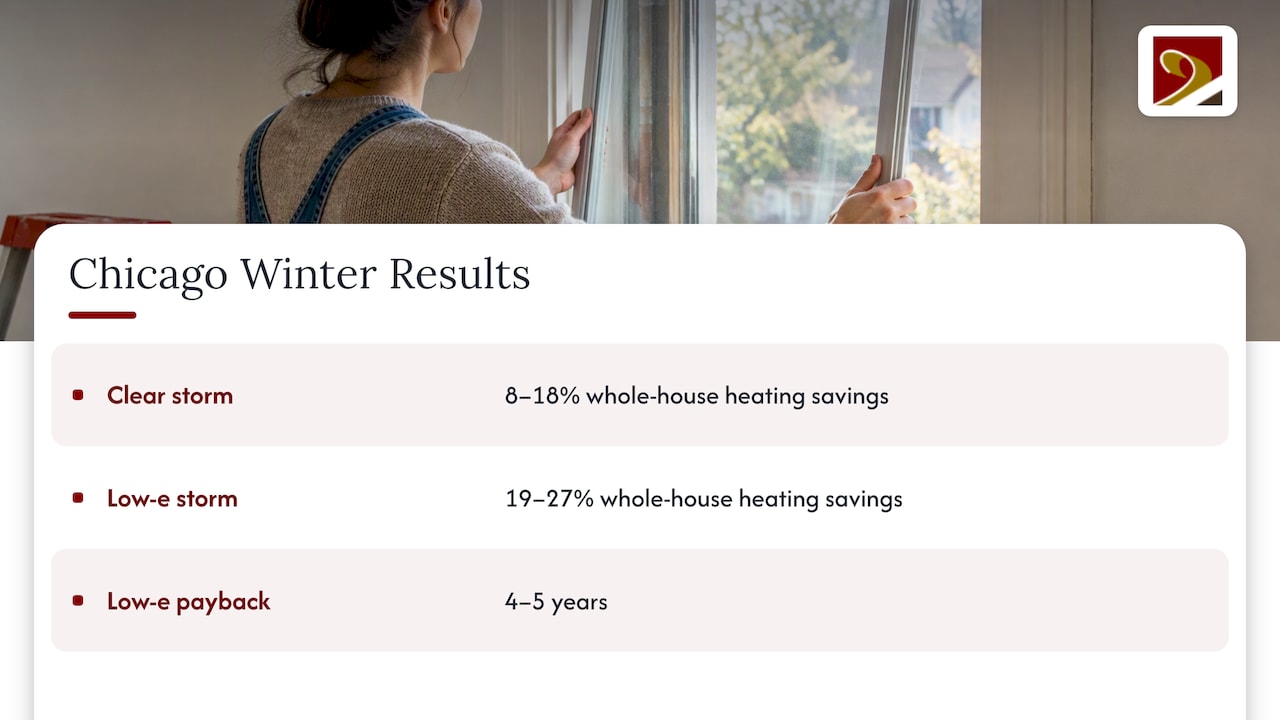
These figures come from cold-climate testing in Chicago. In the Mid-Atlantic and Carolinas, where our work concentrates, heating loads are lower and cooling matters more, so the solar heat gain of any low-e coating deserves attention on south and west elevations.
Comparing the Options
| Approach | Typical effect on air leakage | Effect on historic fabric | Repairable later? |
|---|---|---|---|
| Restoration plus weatherstripping | Large reduction | Original sash retained | Yes |
| Restoration plus low-e storm | Largest reduction in conductance and leakage | Original sash retained; storm is reversible | Yes, both layers |
| Clear storm window only | Moderate | Reversible | Yes |
| Full replacement with insulated glass | Low leakage when new | Original sash and often glass lost | Generally not once seals fail |
The table is qualitative. Actual savings depend on the condition of the existing window, the building envelope and the climate, which is why a diagnostic assessment should precede any specification.
Avoiding the Condensation Trap
Adding an interior storm window improves thermal performance considerably, but it changes how moisture moves. If the interior unit leaks, humid room air enters the cold cavity between storm and sash and condenses on the historic glass and frame. Preservation Brief 3 addresses this directly: in cold climates the interior storm should be the tighter of the two units, with gaskets maintained (NPS Preservation Brief 3).
Three practical rules follow. Gasket the interior storm so that it seals completely. Allow the exterior sash a small path to vent moisture outward where an exterior storm is used. Inspect the gaskets each autumn before the heating season.
Bathrooms and kitchens deserve particular care. A wood window set in a shower wall or beside a tub is exposed to constant moisture, and its sill and surround must be detailed to shed water. A practical guide to shower window waterproofing explains how the surrounding assembly can be sealed so that a restored sash survives in a wet room.
Historic Tax Credits and Energy Upgrades
Owners of income-producing properties and, in Virginia, of qualifying owner-occupied homes often pursue rehabilitation tax credits. The Secretary of the Interior’s Standards for Rehabilitation do not forbid energy improvements. They require that the work not destroy historic character. Solutions that tend to pass review include painting storm windows to match the sash color, aligning the storm’s meeting rail with the historic sash, and choosing unobtrusive interior units (NPS Tax Incentives).
The Virginia Department of Historic Resources notes that the Part 2 application asks for each significant architectural feature and the specific work planned on it, to certify that the proposal appears consistent with the Standards (Virginia DHR, Historic Rehabilitation Tax Credits). Windows are among the features most often scrutinized, so the Part 2 narrative should describe the repair of each sash, the profile of any storm window and the weatherstripping method.
The cost evidence from a steel-window case is instructive. In the Lippincott Press Building rehabilitation, window repair and interior storm installation cost $708,800 within a $12.1 million total budget, and the project met both energy code and the Standards (NPS Preservation Brief 3). The example concerns steel, not wood, but it shows that repair with interior storms is a workable path to code in a certified project.
Perspective: What We See at the Bench
We build and restore windows for historic buildings across Virginia, West Virginia, the Carolinas, Maryland and the District of Columbia, and the pattern in our shop is consistent. A window arrives or is surveyed in place, and the owner is convinced it must go. After the sash is opened, the glass is usually sound and the trouble sits in the joinery, the stops and the weatherstripping, all of which can be corrected with the original wood.
We approach energy performance as part of the restoration drawing rather than as an afterthought. Where a sash is too far gone, we replicate it with authentic materials and techniques, matching the muntin profile and the glazing so that the result satisfies a preservation reviewer. Where an architect needs a storm window detailed to sit behind the original rails, we would rather resolve that at the design stage than at the submission stage.
Our view is that the most energy-efficient window is one that remains in service for another century, and that the most responsible upgrade is the smallest one that achieves the target.
— Gepetto
Working With Us on Historic Windows
If you are an architect, contractor or owner planning window work on a historic building, our historic window restoration service covers repair, reglazing and weatherstripping of existing sash. Where new units or exact replicas are required, our wooden windows are fabricated to period profiles. Bring us in early, ideally before the Part 2 narrative is drafted, so that the window scope, the storm detail and the energy goal are settled together. Our energy efficiency archive collects further notes on the subject.
FAQ
Are historic windows really that inefficient?
A single pane does conduct heat readily, but much of the loss in historic buildings comes from air leaking around frames and sash pockets. Once that leakage is sealed and a storm window is added, the gap to a new window narrows considerably, as the NPS material cited above explains.
Is a low-e storm window worth the cost?
In the DOE’s Chicago figures, low-e storms saved 19-27% of whole-house heating energy over a winter, with a simple payback of 4-5 years. Your own result depends on climate, window condition and fuel cost, so a blower door test or an energy audit will give a sounder estimate than any average.
Will adding storm windows affect historic tax credit approval?
Not if the work respects the building’s character. Reviewers look at whether storm windows align with the sash, match its color and remain unobtrusive. Discussing the proposal with the state historic preservation office before submission reduces the risk of changes later.
Can I install double-pane glass in a historic sash?
Sometimes, but the heavier insulated unit may require wider muntins or a modified sash, which can conflict with the Standards. It is a decision to take with your preservation reviewer and a millwork specialist, not a default.
How long will a restored wood window last?
With regular painting, glazing upkeep and gasket checks, a restored wood window can be maintained indefinitely, according to NPS practitioners, whereas sealed glass units in replacements can fail in as little as 25 years.
Sources
- NPS: Weatherization of Historic Buildings, Windows and Doors
- NPS: Preservation Brief 3, Improving Energy Efficiency in Historic Buildings
- NPS Tax Incentives: Energy Efficiency, Sustainability, and Green Building Practices
- DOE: Windows Options for New and Existing Homes
- DOE: Cost Effective Triple Pane and Low E Storm Windows
- DOE: Performance Validation of Low-e Storm Windows
- Lavagna et al.: Life cycle operating energy saving from windows retrofitting in heritage buildings
- Virginia DHR: Historic Rehabilitation Tax Credits