
The Architectural Woodwork Institute (AWI) sorts millwork into three aesthetic grades, Premium, Custom and Economy, and each grade describes how tightly materials, workmanship and manufacture are controlled. Premium is the highest level of control, Custom a high degree, and Economy the minimum. Choosing among them is one of the earliest and most consequential decisions in a trim, door, window or casework package, because the grade written into the specification governs cost, appearance and the arguments that may follow at inspection.
TL;DR
- AWI’s three aesthetic grades are Premium, Custom and Economy. They measure the degree of control over materials, workmanship and manufacture, not the species of wood or the price of a single piece.
- Custom is the default when a specification names no grade, and it suits most visible work. Premium is reserved for high-visibility areas, and Economy for spaces the public never sees.
- Aesthetic grades are separate from Performance Duty Levels, which describe structural strength and come from laboratory testing.
- Historic restoration has its own AWI standard, so a preservation project should not rely on the millwork grades alone.
- Name the grade, the governing edition and the party responsible for humidity control in the spec, and most disputes never begin.
Table of Contents
- What AWI standards are, and where millwork sits
- The three aesthetic grades
- What “inconspicuous” means in practice
- Aesthetic grades and Performance Duty Levels are different things
- How to specify an AWI grade
- Historic restoration needs more than a grade
- Grade, certification and the QCP
- Where our work meets the grades
- Perspective: grade the work by what the building asks of it
- FAQ
- Sources
What AWI standards are, and where millwork sits
AWI Standards are best practices for architectural woodworking, with requirements covering materials, construction, installation and performance. They are developed under American National Standards Institute (ANSI) procedures, which demand openness, balance, consensus and due process. The committee behind the requirements is made up of volunteer professionals, and their task is to keep the content aligned with current industry practice.
For millwork specifically, the current document is ANSI/AWI 0622.0646-2024, which covers catalog and made-to-order millwork and succeeds Section 6 of the 2014 edition, effective November 15, 2024. Its scope includes products specified under MasterFormat 06 20 00 (Finish Carpentry) and 06 40 00 (Architectural Woodwork). That answers a question architects and estimators often raise: millwork lives in Division 06, Wood, Plastics and Composites, not in a separate trade division of its own.
The grading language will be familiar to anyone who has worked from older editions of the Architectural Woodwork Quality Standards. The terms persist because they work: three tiers, defined in plain words, applied to everything from baseboard to a library wall.
The three aesthetic grades
Each grade is a promise about how closely a piece has been controlled from raw lumber to finished assembly. The wording of the standard is deliberately comparative, which is why the table below reads as a ladder rather than as three unrelated products.
| Grade | Degree of control | Typical use | Viewing distance for “inconspicuous” |
|---|---|---|---|
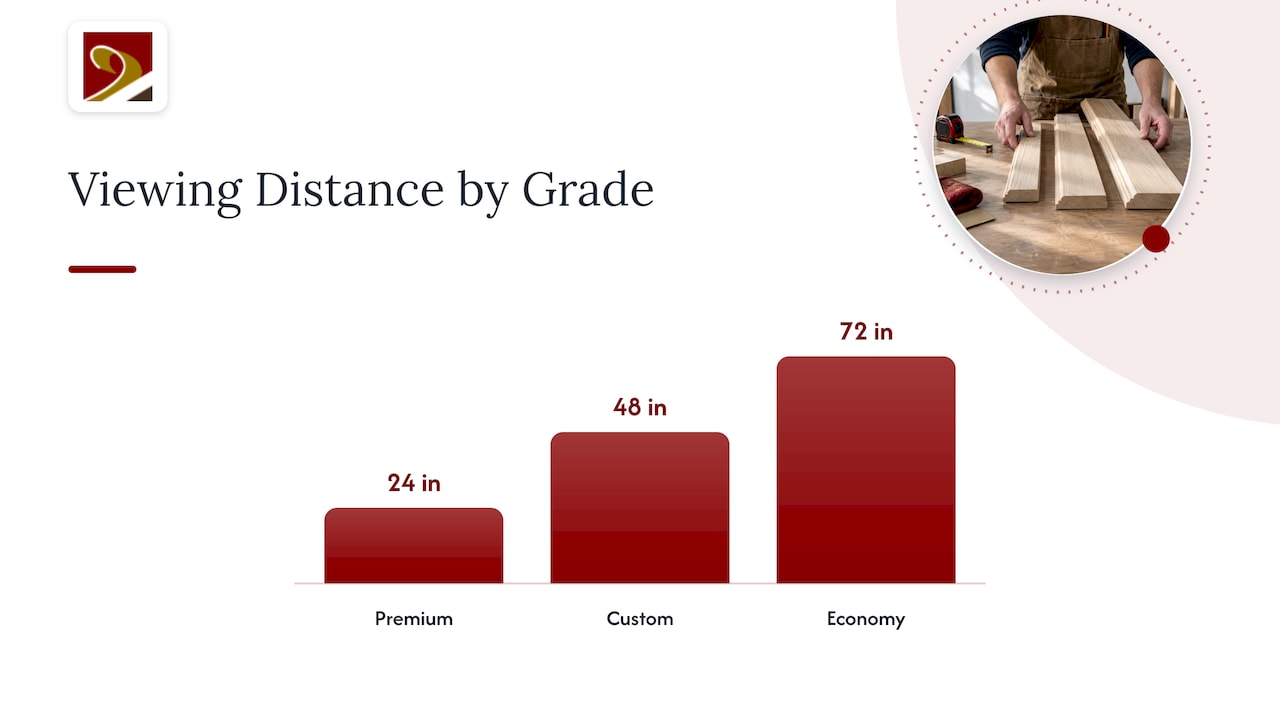
| Premium | Highest | High-visibility areas such as boardrooms and reception counters | 24 in. (610 mm) |
| Custom | High | The default grade for most visible architectural woodwork | 48 in. (1,219 mm) |
| Economy | Minimum | Non-public utility or mechanical spaces | 72 in. (1,829 mm) |
The usage column draws on AWI’s own guidance on what the grade requirements mean, which describes Premium as typically reserved for high-visibility areas and Economy as generally used where the public does not go. The distances come from the general requirements of the millwork and wood trim standard.
Premium
Premium demands the tightest tolerances on material selection, matching of grain and color, joinery, gaps and finish. It is the grade for the stair hall, the lobby, the principal parlor: places where light rakes across a surface and the eye is invited to linger. It is also the grade that most fully rewards a shop’s skill, since a defect that Custom would tolerate will not survive a Premium inspection.
Custom
Custom sits where most architectural interiors belong. AWI treats it as the default grade in its Standards, so a specification silent on the matter is generally read as calling for Custom. Its standard of control is high, and the finished work is entirely appropriate for residences, offices, schools and most public rooms.
Economy
Economy defines the minimum degree of control. It is a legitimate grade, not a flaw: a mechanical room shelf or a back-of-house cabinet gains nothing from Premium matching. The limits matter, however. Economy is the grade on which a project is least protected against visible variation, and it should be applied deliberately to places that are genuinely out of sight.
What “inconspicuous” means in practice
The standard permits certain characteristics in areas that are inconspicuous, and it defines that word by distance rather than opinion. Because the viewing distance is 24 inches for Premium, 48 inches for Custom and 72 inches for Economy, the same board face may be acceptable in one grade and rejected in another. A knot-free requirement that matters at arm’s length on a Premium mantel matters far less on a Custom pantry shelf seen from across a room.
For the design team, this has a practical corollary. Walk the drawings and mark where a viewer will stand. A closet interior, a toe space, or the back of a bookcase can often be specified to a lower grade than the visible face, provided the specification says so explicitly and does not leave the shop to guess.
Aesthetic grades and Performance Duty Levels are different things
A frequent confusion is to treat the grade as a statement of strength. It is not. Aesthetic grades govern control over materials, workmanship and manufacture, while Performance Duty Levels indicate structural performance and are determined through laboratory testing. The duty levels are numbered 1 through 4 in the current standards family, and they apply chiefly where casework and shelving carry loads.
Two points deserve emphasis for anyone writing a spec:
- A Performance Duty Level is set by the lowest tested value from the AWI test methodologies for the joinery method, material or component in question.
- The load values are derived from specific laboratory tests and do not represent standard service loads or normal usage loads. They are a comparison tool, not a rating to be read as a weight limit on a shelf.
A Premium bookcase and an Economy bookcase may carry the same duty level, and a Custom cabinet may be built to a heavier duty level than a Premium one. Specify the two independently.
How to specify an AWI grade
A clear specification does four things. It names the grade, it names the governing edition, it assigns the environmental responsibilities, and it states what the shop may substitute.
- Name the grade for each element or area. Do not write “AWI Premium” once at the top of Section 06 40 00 and assume it covers everything. Separate public rooms from service rooms, and say so.
- Cite the edition. The millwork document changed in November 2024, and an older reference can create a mismatch between what the shop builds to and what the inspector measures against.
- Settle who controls humidity. The standard’s dimensional, warp, flushness and gap requirements are contingent on proper interior environmental controls before, during and after installation. AWI also assigns responsibility: the design professional answers for dimensional change resulting from improper design, the general contractor for improper humidity exposure in site storage and installation, and the owner for humidity extremes after occupancy. Wood moves, and a plan that ignores this ends in a gap that nobody agrees to own.
- Say what the manufacturer may choose. Where several wood species or trim profiles are permitted, the choice rests with the manufacturer or supplier. If a particular species or profile matters to the design, and on any historic job it will, restrict the list.
A short worked example
Imagine a three-story brick townhouse converted to professional offices. The entry hall, stair and conference room receive Premium: matched veneer or solid stock, tight reveals, a carefully controlled finish. The private offices and corridors receive Custom. The records room and the janitor’s closet receive Economy. The architect has now shaped cost where it matters, and the shop knows exactly where its finest labor belongs. The grade map, drawn once, can then be repeated in the bid documents.
Historic restoration needs more than a grade
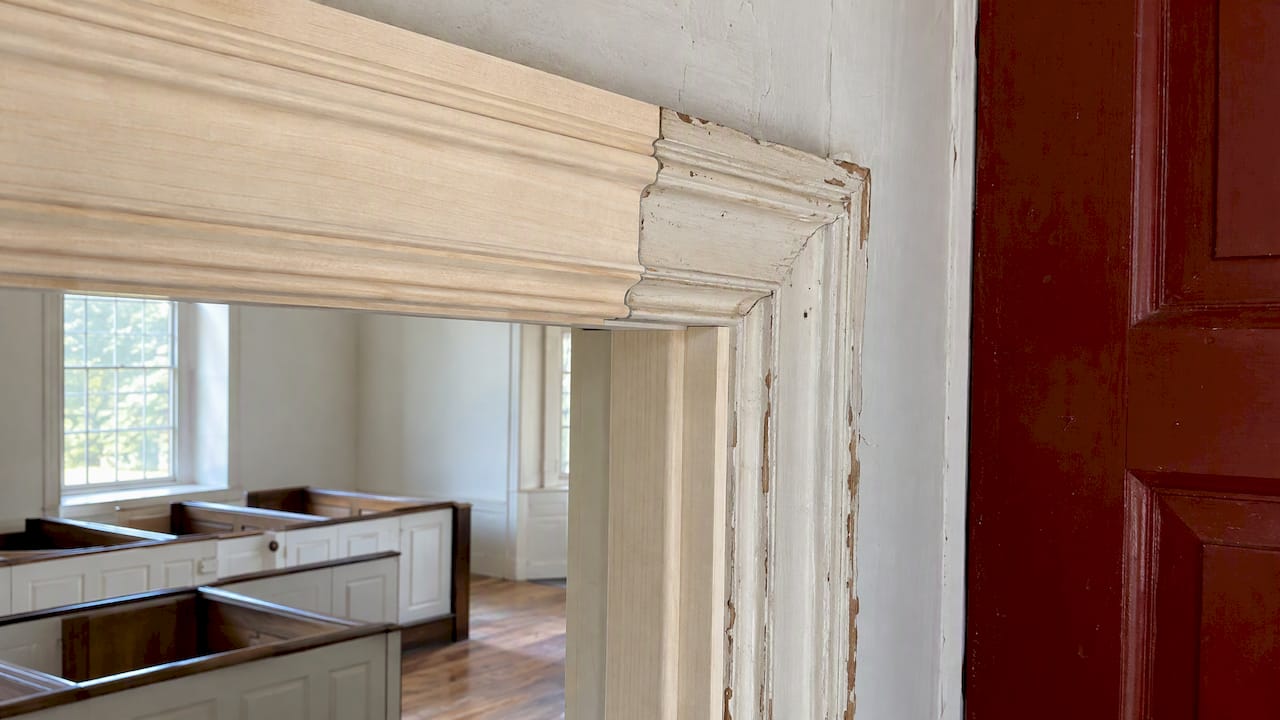
The three grades were written for new fabrication and for standard installation practice. A building with original sash, hand-planed casings or a turned newel presents a different problem: the goal is not a controlled new product but a faithful continuation of an old one. For that reason AWI publishes AWI 0601-2024, the standard specifically intended for the historic restoration of architectural woodwork. Teams working on a preservation project should read it alongside the millwork standard, not instead of it.
In practice, a historic specification often combines instruments. The restoration standard governs how existing fabric is documented, conserved and repaired. The millwork grade governs the quality of any new replica pieces. Preservation authorities, and in tax credit work the reviewing office, will judge the result against the historic record: profile, species, joinery and glazing details, not against a grade label. A Premium grade does not make a casing historically accurate, and a historically accurate casing is not automatically Premium.
For owners pursuing credits, the practical consequence is to supply the reviewer with evidence early. We describe how shop samples fit into that process in our guide on millwork shop samples to secure West Virginia historic tax credits.
Grade, certification and the QCP
An AWI grade describes the work. Certification describes the shop. The AWI Quality Certification Program (QCP) verifies conformance with the standards, and the two should not be confused. Under the program, firms may be licensed to Custom or Premium grade, and Economy-grade projects are not eligible for QCP certification. The same source reports that roughly 80% to 90% of QCP-licensed firms are licensed to work to Premium requirements.
Three implications follow for a project team. First, if the specification requires QCP certification, Economy cannot be the grade on that scope. Second, a firm’s license level tells you what grade it is verified to deliver, which is a useful prequalification question. Third, a certification requirement and a grade requirement are separate lines in the spec, and each needs to be written out.
Where our work meets the grades
Our shop fabricates and restores windows, doors, trim, casework, staircases and other architectural millwork for historic buildings, and we replicate period features using authentic materials and techniques so that projects can satisfy historic tax credit review. When an architect brings a historic scope, we usually begin by separating what must be matched to the building from what can be built to a clean grade. If your drawings include restored sash, new wooden windows or a mix of casework, stairs and doors, send them to us early, and we will help you decide where each treatment belongs.
Perspective: grade the work by what the building asks of it
We come to the grades from the restoration side of the bench, and our view is shaped by it. A grade is a useful shorthand, but a historic building keeps its own standard, and it is stricter than any table. A hand-molded profile in a Richmond rowhouse or a Tidewater farmhouse is judged by whether it reads as original, not by whether its joints meet a tolerance, though we expect it to meet both.
So we advise teams to think in two layers. The first layer is fidelity: species, profile, proportion, glazing bar section, the way a stile meets a rail. The second is workmanship: how well the piece is made and finished. The AWI grades speak to the second layer with great clarity, and they should be written in once the first layer is settled by documentation and samples.
We also ask projects to treat humidity as a design input, not an afterthought. Old-growth and new stock alike move, and a building closed up for years behaves differently once the mechanical system is running. Agree on conditions before delivery, and the finest grade will hold.
— Gepetto
FAQ
What is the difference between AWI Custom and Premium grade?
Both are high-control grades, but Premium carries the highest degree of control over materials, workmanship and manufacture, while Custom carries a high degree. Premium is typically reserved for high-visibility areas such as boardrooms and reception counters. Custom is the default grade in the AWI Standards and serves most other visible work.
Is architectural woodwork the same as millwork?
The terms overlap heavily. The AWI millwork standard covers catalog and made-to-order millwork, including products specified under MasterFormat 06 20 00 (Finish Carpentry) and 06 40 00 (Architectural Woodwork). In everyday use, millwork usually means trim, doors, windows and similar items, while architectural woodwork also takes in casework and paneling.
What grade applies if the specification does not name one?
Custom is considered the default grade in the AWI Standards, so silence is generally read as Custom. Relying on that reading is risky, though. Write the grade for each area into the specification so that the architect, contractor and shop all work from the same expectation.
Does an AWI grade tell me how strong a cabinet or shelf is?
No. The aesthetic grade describes control over materials, workmanship and manufacture. Structural performance is expressed as a Performance Duty Level determined by laboratory testing, and those values are not service loads. Specify the grade and the duty level separately.
Is there an AWI standard for historic restoration?
Yes. AWI publishes AWI 0601-2024, intended specifically for the historic restoration of architectural woodwork. It addresses work on existing fabric, which the new-fabrication millwork grades do not fully cover, so a preservation project should consult it alongside the millwork standard.
Sources
- How AWI Standards Work
- 3.4 Aesthetic, Architectural Woodwork Institute
- 3.1 General, millwork and wood trim requirements
- 3.1 General, care and storage requirements
- 3.3 Structural, specialty casework
- Introduction, Foreword, 1.0 Purpose and 2.0 Scope, millwork and wood trim
- What Do the Grade Requirements in the AWI Standards Mean?