
Lead paint rules for renovation apply whenever a paid contractor disturbs painted surfaces in housing or child-occupied facilities built before 1978. If your project meets that threshold, your firm must hold EPA certification and assign a certified renovator to the job. Absent test results showing otherwise, assume the paint contains lead, follow lead-safe work practices, and complete the required cleaning verification before you call the job finished.
TL;DR:
- The minor work exemption covers 6 square feet or less indoors per room, or 20 outdoors per project, but never window replacement or prohibited methods.
- Keep written test results for three years, and check HUD funding requirements first because some projects require a certified risk assessment rather than a renovator’s test kit.
- Never use open flame, heat guns above 1,100 degrees Fahrenheit, or power tools without HEPA dust collection; use HEPA vacuums for interim and final cleanup.
- OSHA separately requires an initial exposure assessment; if airborne lead exceeds 50 micrograms per cubic meter over eight hours, employers must add controls and respiratory protection.
- Firm certification costs $300, recertification should be filed about 90 days before expiration, and firms working across state lines may need separate state certifications.
Table of Contents
- The EPA RRP Rule: Scope, Firm and Renovator Responsibilities
- Lead-Safe Work Practices and Prohibited Methods
- Testing, Exemptions, and Documenting a Lead-Free Determination
- How OSHA and HUD Interact With EPA Requirements
- Jobsite Compliance: A Step-By-Step Checklist for Pre-Job Through Closeout
- Firm Certification, Fees, Timelines, and Recordkeeping
- Gepetto Millworks: Preserving Historic Millwork While Meeting Lead-Safe Standards
- A Preservation-Minded Option for Historic Window Restoration
- FAQ
- Sources
The EPA RRP Rule: Scope, Firm and Renovator Responsibilities
The EPA Renovation, Repair, and Painting Rule governs paid work in “target housing,” meaning residences built before 1978, and in child-occupied facilities such as schools and daycare centers of the same vintage. Firms that disturb painted surfaces in these settings for compensation must be EPA-certified under the RRP program, and every covered job needs a certified renovator either performing or directly supervising the work.
Certification follows a layered structure. The firm obtains certification first, then at least one individual completes an accredited renovator training course, and any additional on-the-job workers receive informal training from that certified renovator before touching painted surfaces. Before work begins, the firm must distribute the EPA’s “Renovate Right” pamphlet to owners and occupants and document that distribution.
The paperwork trail matters as much as the training itself:
- Firm certification confirmed and current for the job’s jurisdiction
- A certified renovator assigned and present or reachable throughout the project
- Renovate Right pamphlet delivered to occupants with signed or documented acknowledgment
- Training records for any workers who were not individually certified
Lead-Safe Work Practices and Prohibited Methods
Once a job is confirmed or presumed to involve lead paint, the RRP Rule dictates how the work area gets contained and how debris gets handled. Interior work requires plastic sheeting extended well beyond the work zone, with doors sealed and HVAC vents covered to stop dust migration. Exterior work demands ground-level containment and signage warning occupants and passersby to stay clear.
Certain methods are flatly prohibited because they aerosolize lead at dangerous concentrations:
- Open-flame burning or torching of painted surfaces
- Using a heat gun above 1,100 degrees Fahrenheit
- Operating power sanders, grinders, or planers without HEPA-filtered dust collection attached
- Using a heat gun or power tool in a manner EPA has not reviewed for lead-safe performance
HEPA vacuums are required for interim and final cleaning, and some renovators add negative-pressure containment on larger jobs even though the rule’s work practices don’t universally mandate it. Waste must be contained and transported in a way that prevents dust or debris release.
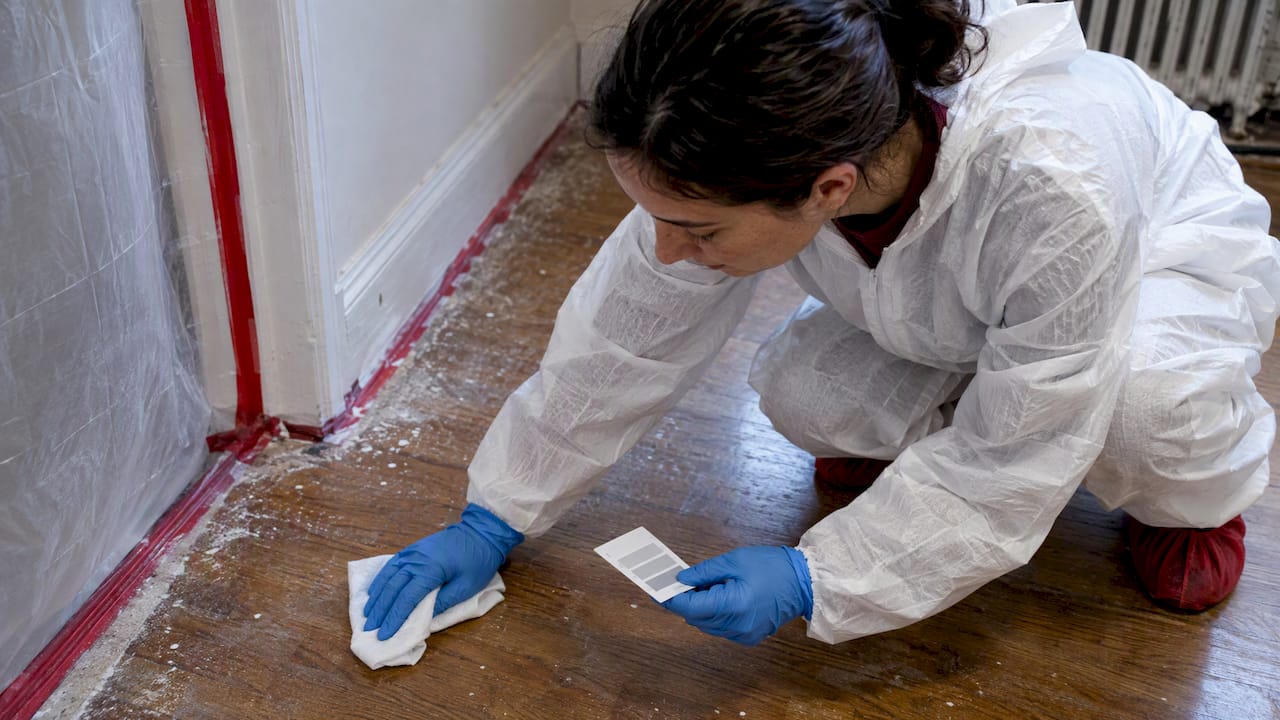
Pro Tip: Run the cleaning verification card test on a sacrificial section of flooring before you break down containment. It catches missed dust pockets before an inspector or client does.
Cleaning verification, a wipe test against a white cloth compared to EPA’s verification card, confirms the surface is clean enough to remove containment. Some jurisdictions require dust-lead sampling in addition to the card method, particularly for larger or HUD-funded projects.
Testing, Exemptions, and Documenting a Lead-Free Determination
Not every paint disturbance triggers full RRP obligations. The rule exempts minor repair and maintenance activities disturbing 6 square feet or less of interior painted surface per room, or 20 square feet or less on the exterior, per project. That exemption disappears for window replacement and for any work using the prohibited practices described above, regardless of surface area.
Determining whether lead is actually present comes down to two accepted routes:
- A certified inspector or risk assessor performs lab analysis or XRF testing and issues a formal report
- A certified renovator uses an EPA-recognized test kit or paint-chip sampling to establish a lead-free finding for specific components
HUD-funded projects often hold a stricter line, sometimes requiring a certified risk assessment rather than accepting a renovator’s test-kit determination, so confirm funding source before relying on the lighter-touch option. Whichever route applies, the lead-free determination must be documented in writing and retained for three years alongside the testing method, results, and the certification number of whoever performed the test.
How OSHA and HUD Interact With EPA Requirements
EPA’s RRP Rule protects occupants and the surrounding environment. It does not replace the separate worker-safety obligations under OSHA’s lead in construction standard, 29 CFR 1926.62. Firms that satisfy EPA requirements can still face OSHA citations if they skip exposure monitoring.
- OSHA requires an initial exposure assessment for construction activity that may disturb lead, establishing whether workers face airborne concentrations above the permissible exposure limit of 50 micrograms per cubic meter as an eight-hour time-weighted average
- When exposure exceeds that limit, employers must implement engineering controls, provide respiratory protection, and in some cases offer medical monitoring
- HUD’s Lead Safe Housing Rule imposes additional testing or clearance procedures on federally assisted housing, layered on top of EPA’s baseline requirements
- Fifteen states and one tribal program run their own EPA-authorized RRP programs, including Alabama, Delaware, Georgia, Iowa, Kansas, Massachusetts, Mississippi, North Carolina, Oklahoma, Oregon, Rhode Island, Utah, Vermont, Washington, Wisconsin, and the Bois Forte Tribe, so firms working across state lines may need separate certifications in each
Treat these three frameworks as overlapping rather than redundant. A contractor renovating a HUD-funded rowhouse in the District of Columbia, for instance, answers to EPA’s work practices, OSHA’s exposure rules, and HUD’s housing-specific clearance standards simultaneously.
Jobsite Compliance: A Step-By-Step Checklist for Pre-Job Through Closeout
A disciplined sequence keeps a lead-disturbing renovation defensible from the first client call to final invoice.
- Confirm the structure’s year of construction and whether it qualifies as target housing or a child-occupied facility
- Provide written disclosure to the client and distribute the Renovate Right pamphlet with documented acknowledgment
- Schedule a certified renovator for the job, or arrange testing if the client wants to rule out lead rather than presume it
- Set up containment matching the EPA’s recommended job flow: sheeting, sealed HVAC returns, exterior signage, and PPE staged before the first cut is made
- Stage HEPA-equipped tools and sealed waste containers on-site before work begins rather than mid-job
- Execute the work under certified renovator oversight, avoiding every prohibited method regardless of how much faster it would be
- Run cleaning verification once containment comes down, and complete dust-lead sampling where the jurisdiction or funding source requires it
- Hand the owner a complete documentation packet: pamphlet acknowledgment, test results or presumption notice, and verification records
Pro Tip: Photograph containment setup and cleaning verification results before and after. A dated photo record settles disputes faster than a filled-in checklist ever will.
Firm Certification, Fees, Timelines, and Recordkeeping
Firms apply for EPA certification directly through EPA’s portal unless their state runs an authorized program, in which case the state process governs instead. Renovation firm certification and recertification costs $300, a flat fee regardless of firm size, and a replacement certificate costs $15 if the original is lost. Tribal programs sometimes set different fee structures, so confirm the applicable schedule before submitting payment.
Recertification should be filed roughly 90 days before the current certificate expires to avoid a lapse that would make the firm ineligible to legally take on new covered work. Any change to the firm’s name, address, or ownership structure must be amended within 90 days of the change.
- Pre-renovation testing results or lead-free determinations
- Signed Renovate Right pamphlet acknowledgments
- Training records for on-the-job trained workers
- Cleaning verification results and any dust-lead sampling reports
All of the above must be retained for three years from the job’s completion date.
Gepetto Millworks: Preserving Historic Millwork While Meeting Lead-Safe Standards
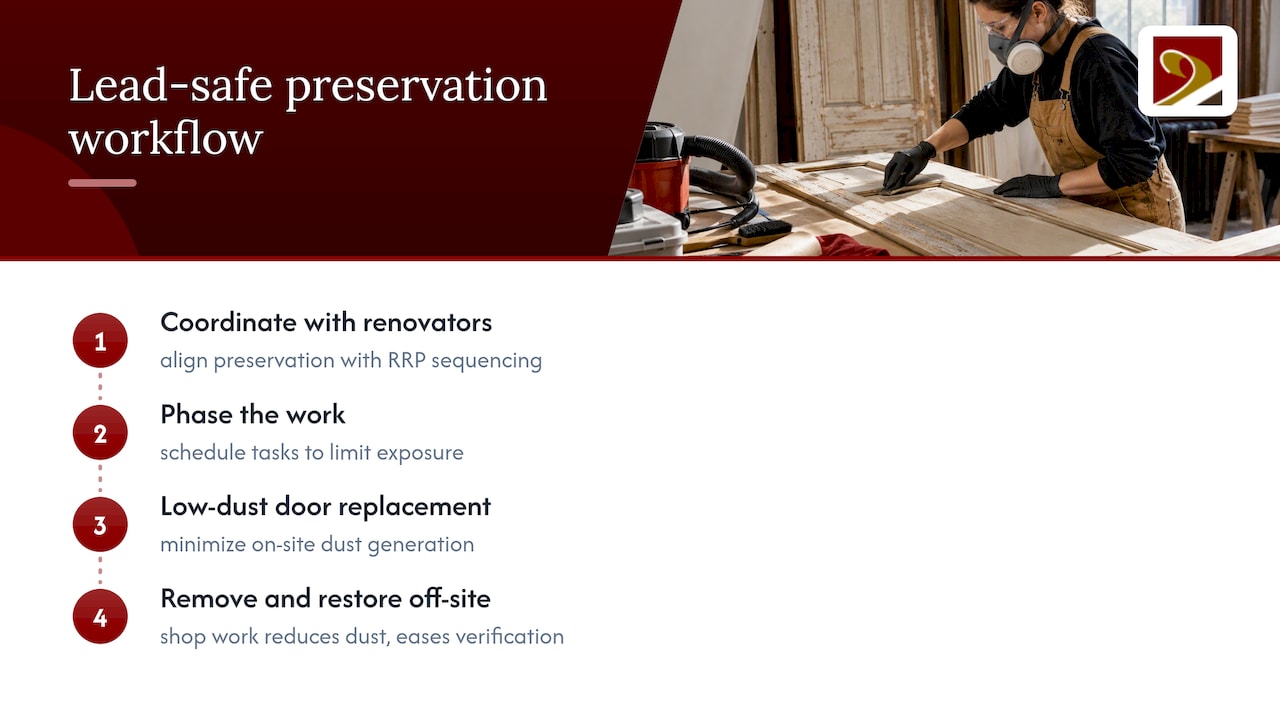
Historic window and trim restoration sits at an uncomfortable intersection with lead-safe work practices: the components most worth saving, original sash, carved casings, hand-planed panel doors, are also the ones most likely to carry decades of lead-based finish. We coordinate closely with certified renovators on these projects, because preserving original fabric and meeting RRP requirements are not competing goals when the sequencing is right.
Phasing the work helps considerably, especially when combined with a low-dust door replacement process that minimizes dust generation on-site. Removing sash or trim intact and restoring it off-site, in a controlled shop environment away from occupied space, reduces on-site dust generation and simplifies cleaning verification once containment comes down. Our historically accurate window projects and work documented in the Jamestown, Virginia archives reflect this approach: delicate joinery stays protected, and the active jobsite stays easier to clean and verify.
— Gepetto
A Preservation-Minded Option for Historic Window Restoration
For property owners weighing how to handle lead paint on original windows, replacement is not the only path, and it is often not the one that protects a building’s character or its eligibility for historic tax credits. We offer Historic Window Restoration built around removing sash and components for off-site repair, then returning them once the work is complete, a sequence that fits naturally alongside a certified renovator’s containment and cleaning verification schedule.

- Components are restored off-site, reducing the lead-dust footprint of the active jobsite
- Original material, moldings, glazing, and joinery are retained rather than discarded, supporting historic tax credit eligibility
- Work is coordinated with the project’s certified renovator so lead-safe practices and preservation goals proceed together
This is one option among several for owners managing lead paint on historic properties, not a substitute for the certified renovator’s compliance role. When restoration rather than replacement fits your building’s history and your project’s goals, reach out to discuss your windows and we’ll walk through how the timeline fits around your renovation schedule.
FAQ
Can you renovate a house with lead paint?
Yes. Renovating a home with lead paint is legal when the work follows the EPA RRP Rule’s lead-safe work practices, including firm certification, a certified renovator on the job, containment, and cleaning verification. The rule governs how the work is done rather than prohibiting the renovation itself.
Is it legal to sell a house with lead paint?
Yes, selling a home with lead-based paint is legal in the United States, but federal law requires sellers of pre-1978 housing to disclose known lead hazards and provide buyers with an EPA-approved pamphlet before the sale closes. The disclosure requirement applies regardless of whether any renovation work is planned.
How much lead in paint is acceptable?
Current regulations treat any paint in pre-1978 target housing as potentially lead-based unless testing proves otherwise, so the practical answer for renovation purposes is to presume lead is present and follow lead-safe practices rather than rely on a numeric threshold. A certified inspector or risk assessor, or a certified renovator using an EPA-recognized test kit, can establish a documented lead-free finding for specific surfaces.
What are the OSHA lead paint requirements?
Under 29 CFR 1926.62, employers must conduct an initial exposure assessment for construction work that may disturb lead and keep worker exposure below the permissible exposure limit of 50 micrograms per cubic meter as an eight-hour time-weighted average. When exposure exceeds that limit, employers must add engineering controls and provide respiratory protection as needed.
Sources
- EPA — Lead Renovation, Repair and Painting Program
- OSHA — Lead in construction standard (29 CFR 1926.62)