
For most budget-focused remodels, vinyl is the practical choice. For historic homes, luxury renovations, or any project where repairability and period authenticity matter, wood or wood-clad is the correct answer. The wood-clad window, which pairs a paintable wood interior with an aluminum- or vinyl-exterior, is the single best compromise when you want the warmth of wood inside without the exterior maintenance burden.
Quick scenarios:
- Starter home or rental property: Vinyl, installed cost $150–$550 per window, low maintenance, acceptable performance with a quality glass package.
- Historic or architecturally significant home: Wood or custom wood-clad. Off-the-shelf vinyl cannot replicate original muntin profiles, and most preservation boards will not accept it.
- Coastal or high-humidity climate: Wood-clad with aluminum exterior cladding, which resists moisture intrusion while preserving interior finish options.
- Luxury remodel with long ownership horizon: High-quality wood or wood-clad; the total cost of ownership can be competitive with budget vinyl once you account for replacement cycles.
Table of Contents
- How do wood and vinyl windows compare across every decision axis?
- What actually drives energy performance in windows?
- What maintenance schedule should you follow for wood vs vinyl windows?
- How do upfront costs and total cost of ownership compare?
- What breaks, and can it be repaired?
- What finish and profile options does each material offer?
- How does installation quality affect long-term performance?
- Are fiberglass and composite windows worth considering?
- How should you decide? A practical checklist
- When custom wood windows are the right choice: Gepettomillworks restoration work
- Key Takeaways
- The tradeoffs most homeowners don’t see until it’s too late
- Gepettomillworks: custom wood window restoration for historic projects
- Useful sources and further reading
How do wood and vinyl windows compare across every decision axis?
The table below maps each material against the criteria that most directly affect a purchase decision. Glass package and installation quality cut across every row, a point worth holding in mind before the frame material debate consumes the conversation.
| Decision axis | Wood | Vinyl |
|---|---|---|
| Best for | Historic homes, luxury remodels, cold climates | Budget remodels, rentals, humid/coastal climates |
| Upfront installed cost | $240–$880 per window | $150–$550 per window |
| Maintenance frequency | High: inspect every 3–6 months, repaint/restain every 3–7 years | Low: annual cleaning, occasional hardware check |
| Energy performance | Good; thermal mass helps in very cold climates | Good; depends heavily on glass package |
| Repairability | High: individual components can be milled and replaced | Low: serious frame damage typically requires full-unit replacement |
| Aesthetics | Broadest customization; stainable, paintable, custom profiles | Limited profiles; simulated wood finishes available at higher price tiers |
| Lifespan | 30–100+ years with proper maintenance | 10–20 years; quality varies widely |
| Environmental | Renewable resource; repairable; embodied energy lower for long-lived units | Petroleum-based; difficult to recycle; shorter replacement cycle |
The frame is not the energy story. Consumer testing shows that top-rated vinyl and top-rated wood windows can perform similarly in laboratory conditions when both are equipped with equivalent glass packages. The glass specification and installation quality are the primary performance drivers; frame material is secondary except in extreme climates.
The Energy Star program reinforces this consistently: the largest efficiency gains come from replacing single-pane units with Energy Star-qualified windows, regardless of whether the frame is wood or vinyl. A homeowner who selects a premium wood frame but pairs it with a mediocre glass package will underperform a vinyl window fitted with a proper low-e, argon-filled insulating unit.
What actually drives energy performance in windows?
Glass and installation explain the majority of a window’s thermal performance. Frame material is a secondary variable, though not an irrelevant one in climates with sustained temperature extremes.
Three metrics govern window energy performance, and every reputable manufacturer publishes them on the National Fenestration Rating Council (NFRC) label:
- U-factor: The rate of heat transfer through the entire window assembly. Lower is better. Look for 0.30 or below in cold climates; Energy Star’s northern zone threshold is 0.27.
- Solar Heat Gain Coefficient (SHGC): The fraction of solar radiation admitted through the window. In hot climates, a lower SHGC (0.25 or below) reduces cooling loads. In cold climates, a higher SHGC on south-facing windows can contribute passive solar gain.
- Air leakage: Measured in cubic feet per minute per square foot of frame area. The NFRC certifies air leakage at 0.30 cfm/ft² or less; the best units achieve 0.10 or lower. A poorly detailed installation can negate a certified air leakage rating entirely.
Climate guidance by frame material:
- Very cold climates (IECC zones 5–7): Wood’s natural thermal mass provides a marginal insulating advantage over vinyl, and its dimensional stability at sustained low temperatures is well established. Pair with a triple-pane or high-performance double-pane unit and a warm-edge spacer.
- Hot-humid and coastal climates: Vinyl or aluminum-clad wood is preferable. Unclad wood exposed to sustained humidity and salt air requires aggressive maintenance to prevent finish failure and rot. Glazing package selection matters more than frame choice here; a low-SHGC, low-e coating does more for cooling loads than any frame material decision.
- Mixed climates: The frame material distinction narrows further. A quality glass package with a U-factor below 0.30 and a balanced SHGC will serve most mixed-climate homes well in either wood or vinyl.
Energy Star guidance is unambiguous: replacing single-pane windows with Energy Star-qualified units yields the largest measurable savings, and that benefit applies regardless of frame material when the installation prevents air leakage.
Older homes with original single-pane sash are losing a disproportionate share of their conditioned air through the glass itself, not the frame. Addressing that gap with a properly specified replacement, whether wood or vinyl, is the intervention that moves the energy bill. According to Lowe’s buying guidance, older windows can account for a notable portion of a home’s heat loss, a figure that underscores why the glass upgrade matters far more than the frame debate.
Pro Tip: When reviewing NFRC labels, compare the whole-unit U-factor, not the center-of-glass figure manufacturers sometimes lead with. The whole-unit number includes the frame and edge effects and reflects real-world performance more accurately.
What maintenance schedule should you follow for wood vs vinyl windows?
Vinyl is genuinely low-maintenance. Wood requires a disciplined inspection and finish maintenance routine to reach its potential lifespan. The gap is real, but manageable for owners who understand what they are committing to.

Practical maintenance schedule
| Task | Wood | Vinyl | Frequency | DIY or Pro | Typical cost |
|---|---|---|---|---|---|
| Exterior cleaning | ✓ | ✓ | Twice yearly | DIY | Minimal |
| Hardware lubrication | ✓ | ✓ | Annually | DIY | Under $20 |
| Weatherstripping inspection | ✓ | ✓ | Annually | DIY | $10–$40 to replace |
| Caulk/sealant inspection | ✓ | ✓ | Every 1–2 years | DIY | $10–$30 per window |
| Caulk replacement | ✓ | Rarely | Every 3–5 years | DIY/Pro | $30–$100 per window |
| Paint or stain refresh | ✓ | — | Every 3–7 years | Pro recommended | $50–$150 per window |
| Glazing bead inspection | ✓ | ✓ | Every 3–6 months | DIY | — |
| Rot repair | ✓ | — | As needed | Pro | $150–$550 per window |
| Full sash replacement | Rare | Common | As needed | Pro | Varies widely |
Routine inspection every 3–6 months is the single most important habit for wood window owners. Catching a hairline paint crack before moisture infiltrates the joint is a $15 fix; discovering rot after a season of unchecked water intrusion is a $300 repair or a full replacement.
Inspection checklist (every 3–6 months):
- Check paint or stain for cracking, peeling, or bare wood exposure at joints and sill ends.
- Press the sill and bottom rail for soft spots that indicate early rot.
- Inspect sealant at the frame-to-wall junction for gaps or separation.
- Operate each sash through its full range; binding or sticking can signal moisture swelling or finish buildup.
- Examine glazing beads and putty for cracking or separation from the glass.
- Check weatherstripping for compression set or tears.
Pro Tip: Always caulk before you paint, not after. Applying paint over a fresh caulk bead seals the joint and extends the caulk’s service life significantly. Reversing the sequence leaves the caulk edge exposed and accelerates failure.
Wood-clad windows change the maintenance equation meaningfully. The aluminum or vinyl exterior cladding eliminates most exterior painting obligations, reducing the routine to cleaning, hardware lubrication, and periodic sealant checks. The interior wood surface still requires attention, but the total maintenance burden drops to something closer to vinyl than to unclad wood.
How do upfront costs and total cost of ownership compare?
Vinyl is cheaper to buy and install. Whether it is cheaper to own depends on the quality tier selected and how long you plan to stay in the home.
Installed price ranges
| Material | Low end (per window) | High end (per window) | — |
|---|---|---|---|
| Vinyl | $150 | $550 | — |
| Wood | $240 | $880 | — |

Price data from RemodelCostCalc. Figures reflect installed cost including labor; glass package upgrades, custom sizes, and historic profiles add to both columns.
The total cost of ownership calculation shifts when you account for lifespan. Budget vinyl units at the lower end of the quality spectrum may require replacement in 10–15 years. A quality wood or wood-clad window, properly maintained, can serve 40–80 years or longer. Over a 40-year ownership horizon, the vinyl window may be purchased and installed twice or three times, while the wood window is refinished periodically at a fraction of the replacement cost.
What drives price differences:
- Material and species: Clear vertical-grain Douglas fir or old-growth pine commands a premium over finger-jointed pine composites.
- Customization: Non-standard sizes, custom profiles, true divided lites, and period muntins all add fabrication cost.
- Glass package: Low-e coatings, argon fill, triple pane, and warm-edge spacers add $50–$200 per unit regardless of frame material.
- Installation complexity: Retrofit installations in historic masonry or plaster-wall construction require more labor than new-construction rough openings.
- Finish: Factory-primed wood costs less than factory-painted; custom exterior colors on clad units add a surcharge.
Tax incentives and rebates can affect the math. The federal Residential Clean Energy Credit and the Energy Efficient Home Improvement Credit (25C) have covered qualifying window replacements in recent years; eligibility and credit amounts depend on the specific product’s Energy Star certification and the homeowner’s tax situation. Confirm current thresholds with a tax professional or the Energy Star website before building incentives into a budget.
What breaks, and can it be repaired?
The repairability gap between wood and vinyl is one of the most consequential differences for long-term owners, and it is almost entirely overlooked in price-focused comparisons.
Vinyl windows fail in predictable ways: seal failure between the insulating glass panes (visible as fogging or condensation inside the unit), hardware wear, and, in lower-quality products, frame warping or corner joint separation over time. Most of these failures require full-unit replacement because vinyl extrusions cannot be milled, spliced, or refinished. A vinyl sash with a failed seal is a disposal item.
Wood fails differently. Rot at the sill or bottom rail, paint failure at joints, glazing putty separation, and hardware wear are the common failure modes. Each of these can be addressed incrementally. A rotted sill section can be cut out, treated, and spliced with new wood. A failed glazing bead can be replaced. A warped sash can sometimes be planed and re-hung. Wood window components can be repaired and profiles can be milled to match originals, which is precisely why preservation professionals favor the material.
Expected lifespans under typical care:
- Vinyl: 10–20 years, with quality varying significantly across price tiers. Premium welded-corner vinyl units outperform budget extruded units, but the ceiling is lower than wood.
- Wood (unclad, well maintained): 30–100+ years. Original wood windows in well-maintained historic structures routinely outlast multiple generations of vinyl replacements installed in the same era.
- Wood-clad: Comparable to unclad wood for the interior; the exterior cladding extends the maintenance-free exterior life to 20–30 years before refinishing or re-cladding becomes necessary.
On historic preservation: Repairability is not merely a convenience. For properties subject to local historic district review or eligible for federal historic tax credits, the ability to repair and replicate original components is often a regulatory requirement. A vinyl replacement that alters the fenestration pattern or profile geometry can jeopardize tax credit eligibility and trigger a preservation board objection. Wood, precisely because it can be worked, remains the material of record for serious restoration work.
What finish and profile options does each material offer?
Wood provides the broadest customization of any window frame material. That said, wood-clad units and high-end vinyl with factory-applied wood-grain finishes can approximate the visual result at lower cost, depending on the architectural context.
Customization options by material:
- Paint: Both wood and vinyl accept paint, but wood accepts any paint system and can be stripped and repainted indefinitely. Vinyl is factory-colored and can be painted with adhesion-promoting primers, though the finish is less durable and the color palette is constrained by the extrusion.
- Stain: Wood is the only frame material that accepts a penetrating stain, which reveals grain and is the appropriate finish for Craftsman, Mission Revival, and Arts and Crafts interiors. Vinyl cannot be stained.
- Custom profiles: Wood can be milled to any profile, including historically accurate ovolo, ogee, or cyma recta muntins. Vinyl profiles are limited to what the manufacturer’s extrusion dies produce.
- Divided lites: True divided lites (TDL), where each pane is individually glazed, are a wood-only option and the standard for authentic period restoration. Simulated divided lites (SDL), where a grille is applied to the interior and exterior of an insulating glass unit, are available in both wood and vinyl and approximate the look at lower cost. Snap-in interior grilles, common in budget vinyl, read as decorative rather than architectural.
- Hardware: Wood windows accept a wider range of hardware finishes and styles, including period-appropriate cast brass, bronze, and iron. Most vinyl windows are limited to the manufacturer’s hardware program.
- Exterior cladding colors: Clad wood units offer a broad factory color palette on the aluminum exterior, often with custom color matching available at a surcharge.
For historic homes, the question is rarely whether wood looks better. It is whether the profile geometry, muntin proportions, and glass type can be replicated with sufficient fidelity to satisfy a preservation board or maintain the architectural character of the structure. Custom millwork for historic replication requires measured drawings of surviving original windows, knowledge of period joinery conventions, and access to appropriate glass, including restoration glass or antique glass where specified. Off-the-shelf products, in any material, rarely meet that standard.
How does installation quality affect long-term performance?
A poorly installed window, regardless of frame material or glass specification, will underperform its rated values and may fail prematurely. Installation is where the energy performance story is either confirmed or undone.
Wood movement requires explicit installation clearances. Installers who do not account for seasonal dimensional change in wood frames will produce windows that bind in summer, develop sealant gaps in winter, and fail at the glazing bead over time. This is not a defect in the material; it is a consequence of installing wood without understanding its behavior.
The installer is often the largest determinant of whether a window reaches its expected lifespan. Correct flashing, thermal-bridge detailing at the rough opening, and proper clearance for wood movement are skills that separate a competent installation from one that voids the manufacturer warranty within five years.
Questions to ask any installer before signing a contract:
- What is your experience with retrofit versus new-construction installation in this wall assembly?
- How do you detail the flashing at the head and sill? Can you show me a cross-section drawing?
- What clearance do you allow for wood movement, and how do you seal the gap?
- How do you address thermal bridging at the rough opening framing?
- What does the manufacturer warranty cover, and what installation practices void it?
Warranty checklist: what to verify before purchase:
- Frame coverage: duration and what defects are included (warping, delamination, finish failure).
- Glass and seal failure: most manufacturers cover insulating glass seal failure for 10–20 years; confirm the term.
- Labor coverage: some warranties cover materials only; labor for reinstallation is a separate negotiation.
- Transferability: a transferable warranty adds resale value; confirm whether it transfers automatically or requires registration.
- Void conditions: improper installation, field modifications, and painting over vinyl are common void triggers.
For retrofit versus new-construction installation methods, the choice of installation type affects flashing detail complexity and the degree to which the existing wall assembly is disturbed. Historic masonry buildings often require custom sill and jamb extensions that a standard retrofit kit does not accommodate.
Are fiberglass and composite windows worth considering?
Fiberglass and composite materials occupy the space between vinyl and wood in both price and performance, and they are worth a brief evaluation before committing to either primary option.
Fiberglass frames are manufactured from pultruded glass-fiber-reinforced polymer, which gives them dimensional stability superior to both vinyl and wood across temperature extremes. They accept paint, resist moisture, and carry lifespans comparable to well-maintained wood. The trade-off is cost: fiberglass typically falls in the upper range of wood pricing or above, making it a premium option rather than a budget alternative.
Composite materials, including products built from wood fiber and PVC or other polymer binders, sit between vinyl and wood in price and performance. They resist rot and moisture better than solid wood, accept paint, and offer more profile variety than standard vinyl extrusions. Fibrex, a wood-fiber-and-polymer composite, is one recognized example of this category.
Where fiberglass and composite fit best: coastal and high-humidity climates where wood’s moisture sensitivity is a liability but vinyl’s limited profile options are architecturally insufficient; luxury new construction where dimensional stability and paint-holdout are priorities; and retrofit projects in historic districts where a preservation board accepts composite but the budget does not support custom wood millwork.
For strict historic replication, neither fiberglass nor composite can match the workability of wood. Profiles can be approximated but not milled to the precision that period restoration demands, and neither material accepts antique or restoration glass in the same way a custom wood sash does.
How should you decide? A practical checklist
Work through these questions in order. The answers will narrow your choice faster than any specification sheet.
Prioritized decision questions:
- Does your home fall under historic district review, landmark designation, or federal historic tax credit eligibility? If yes, wood or custom wood-clad is almost certainly required. Confirm with your preservation board before specifying anything else.
- What is your ownership horizon? Under 10 years, vinyl’s lower upfront cost is difficult to argue against. Over 20 years, the total cost of ownership calculation favors quality wood or wood-clad.
- What climate zone are you in? Sustained humidity or salt air exposure argues for clad or vinyl exteriors. Very cold climates favor wood’s thermal properties when paired with a high-performance glass package.
- What is your maintenance tolerance? Vinyl requires minimal ongoing effort. Wood requires a disciplined inspection and finish maintenance schedule.
- What are your aesthetic requirements? If the interior finish, profile geometry, or divided-lite pattern matters architecturally, wood is the only material that delivers full customization.
- What is your glass specification? Confirm U-factor, SHGC, and air leakage rating before comparing frame prices. A budget frame with a quality glass package will outperform a premium frame with a mediocre one.
Red flags in contractor quotes:
- No glass performance specification (U-factor, SHGC, air leakage) listed in the proposal.
- Vague or absent flashing detail (“we’ll flash it per standard practice” is not a specification).
- No written warranty documentation provided before contract signing.
- Installer cannot explain the difference between retrofit and new-construction installation methods.
- Quote does not distinguish between frame cost and glass package cost.
Questions to ask suppliers during the quoting process:
- What is the whole-unit U-factor and SHGC for this window as specified?
- What is the certified air infiltration rate?
- Is the glass package Energy Star certified for my climate zone?
- What installation method do you recommend for my wall assembly, and why?
- What does the manufacturer warranty cover, and what voids it?
When custom wood windows are the right choice: Gepettomillworks restoration work
For strict historic replication, antique glass handling, or complex period profiles, custom wood millwork is the correct path. Off-the-shelf products in any material cannot replicate the dimensional precision, joinery conventions, or glass character that a preservation board or a discerning owner requires.
Gepettomillworks works on projects where the architectural record demands fidelity: a Federal-period fanlight whose elliptical tracery cannot be approximated by a stock unit, a Craftsman bungalow whose divided-lite pattern and interior stain grade must match surviving originals, or a Prairie School structure whose art-glass panels require custom sash fabrication around existing glazing. In each case, the starting point is the surviving physical evidence, measured drawings, and, where available, historic photographs.
The case for custom millwork is not aesthetic preference alone. Properties seeking federal historic tax credits under the Historic Tax Credit program must demonstrate that rehabilitation work meets the Secretary of the Interior’s Standards for Rehabilitation. Window replacement that alters original profile geometry, muntin proportions, or glass type can disqualify a project from credit eligibility. Custom wood millwork, fabricated to match the original, is the documented path to compliance.
The qualified restoration craftsmen at Gepettomillworks bring experience with period joinery, handmade window fabrication, and antique glass sourcing to projects where those skills are not optional. The work encompasses not only the window unit itself but the surrounding trim, glazing details, and hardware selection that complete the architectural composition.
When to commission custom millwork rather than buy off-the-shelf:
- The original window profiles are documented and a preservation board requires near-exact replication.
- The project involves antique, restoration, or art glass that must be set into new sash.
- The fenestration pattern includes non-standard shapes: elliptical, circular, or polygonal units.
- The interior finish requires a specific species and grain orientation for staining.
- The project is seeking historic tax credit eligibility and documentation of material compliance is required.
For owners at the beginning of a restoration project, the first step is gathering physical evidence: rubbings or tracings of surviving muntin profiles, measurements of existing rough openings, and any available historic documentation. Gepettomillworks can work from that evidence to produce fabrication drawings and cost estimates before any commitment to a scope of work.
Key Takeaways
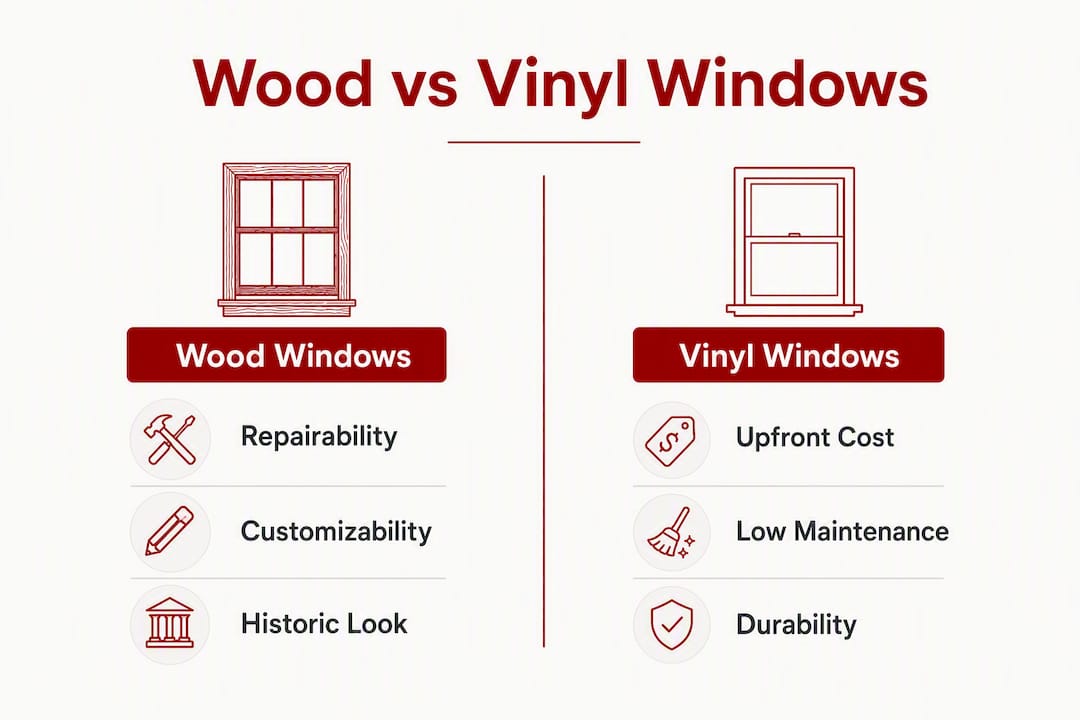
Wood wins on repairability, customization, and historic authenticity; vinyl wins on upfront cost and low maintenance; the wood-clad window is the most practical compromise for owners who want both.
| Point | Details |
|---|---|
| Glass and installation matter most | Frame material is secondary; U-factor, SHGC, and air leakage rating drive real energy performance. |
| Vinyl costs less upfront | Installed at $150–$550 per window versus $240–$880 for wood; lifespan of 10–20 years versus 30–100+ for maintained wood. |
| Wood-clad is the best compromise | Aluminum or vinyl exterior cladding reduces maintenance while preserving interior wood finish and profile options. |
| Historic projects require custom millwork | Preservation boards and Historic Tax Credit eligibility often demand near-exact profile replication, which only custom wood fabrication can deliver. |
| Gepettomillworks for restoration work | Custom wood window fabrication, antique glass handling, and period profile replication for historic and architecturally significant projects. |
The tradeoffs most homeowners don’t see until it’s too late
The conversation about wood versus vinyl windows almost always starts with price and ends with maintenance. Those are real considerations, but they miss the variable that most often determines whether a window project succeeds or fails over time: the quality of the installation and the specificity of the glass package.
A homeowner who spends $800 per window on a premium wood unit and then has it installed by a crew unfamiliar with wood movement clearances will have a binding, leaking window within three years. A homeowner who specifies vinyl but insists on a documented U-factor below 0.28 and a certified air infiltration rate will have a genuinely efficient window regardless of what the frame is made of. The frame debate is real, but it is downstream of those two decisions.
The second thing most homeowners underestimate is the cost of profile replication in historic work. Custom millwork is priced by complexity, species, and fabrication time, not by the linear foot of a catalog item. A window with a cyma recta ovolo muntin, a true divided lite configuration, and a specific glass type costs more to fabricate than a standard double-hung, and that cost is justified by what it preserves: the architectural integrity of a building that took generations to produce. The alternative, a stock vinyl unit that approximates the look, is a decision that compounds over time as the building’s character erodes incrementally with each substitution.
Gepettomillworks: custom wood window restoration for historic projects
When a project demands more than a catalog can offer, Gepettomillworks fabricates custom wood windows, doors, and architectural millwork to the dimensional and material standards that historic preservation requires.

The work begins with the physical evidence: measured profiles of surviving original windows, documentation of muntin patterns and joinery details, and, where required, coordination with preservation board specifications. From that foundation, Gepettomillworks produces custom sash, frames, and trim that replicate original profiles with the precision that both architectural integrity and tax credit compliance demand. Antique glass, restoration glass, and period-appropriate hardware are sourced and integrated as part of the fabrication scope.
For owners working on restoration millwork projects, whether a 19th-century row house, a Craftsman bungalow, or a Prairie School residence, the starting point is a conversation about what survives and what the project requires. Gather photographs of existing windows, any available historic documentation, and the rough opening dimensions before reaching out. Contact Gepettomillworks to discuss your project scope and request a fabrication estimate.
Useful sources and further reading
The sources below informed this article and offer additional depth on the topics covered.
A note on research quality: the most authoritative guidance on window energy performance comes from the Energy Star program and the NFRC. Cost data is inherently regional and should be verified with local contractors; the figures cited here are national ranges intended for planning purposes, not binding estimates.
Energy Star — 2025 Windows Messaging Document
The primary federal guidance document on window energy performance. Covers the case for replacing single-pane windows, the role of glass versus frame in energy savings, and the repairability advantages of wood for historic preservation. The most authoritative source in this article.
National Fenestration Rating Council (NFRC)
The organization that certifies and publishes U-factor, SHGC, and air leakage ratings for windows. Use the NFRC label as the baseline for any window comparison; manufacturer marketing figures are not a substitute.
RemodelCostCalc — Vinyl vs Wood Windows Cost Comparison
The most detailed publicly available cost breakdown for installed vinyl and wood windows, including per-window price bands and project-level estimates. Useful for budget planning; verify with local contractor quotes.
Consumer Reports — Replacement Windows Buying Guide
Independent testing data showing that frame material alone does not determine performance. Particularly useful for understanding how glass package and build quality interact with frame choice.
J&L Building Materials — Best Window Material Options
Practical overview of vinyl lifespan variability and the factors that separate quality tiers within the vinyl category. Useful context for the durability section.
ViewLux Windows — Energy Efficient Glazing Options
Detailed guidance on glazing packages, low-e coatings, and how glass selection affects whole-unit performance. Recommended reading before finalizing any glass specification.
Lowe’s — Vinyl vs Wood Windows Buying Guide
Accessible overview of the heat-loss impact of older windows and the resale value considerations associated with window replacement. Useful for homeowners early in the decision process.