
Historic window restoration involves a broad range of costs per window, varying widely depending on project scope and condition. Small projects involving a few windows can range significantly in total cost before optional upgrades are considered. The single decision that moves that number most is scope: mechanical restoration, full glass-out restoration, or historically accurate replica replacement each occupy a distinct cost tier and carry different implications for preservation compliance, lead-safe work, and tax-credit eligibility. Gepettomillworks, which works to National Park Service and State Historic Preservation Office (SHPO) standards, structures every estimate around that scope decision first.
Table of Contents
- What does historic window restoration cost by scope?
- Per-window and per-project cost ranges
- What factors affect the cost to restore old windows?
- How do you get an accurate restoration estimate?
- Gepettomillworks project examples from the archives
- What is the typical timeline from survey to installation?
- How do preservation rules and tax credits affect cost?
- When does replica replacement make more sense than restoration?
- Key Takeaways
- The case for letting preservation set the budget, not the other way around
- Gepettomillworks: custom restoration and replica work, documented for preservation compliance
- Useful sources and preservation references
What does historic window restoration cost by scope?
Scope is the controlling variable in any wood window restoration cost estimate, and conflating the three primary categories is the most common source of bid confusion.
Mechanical restoration
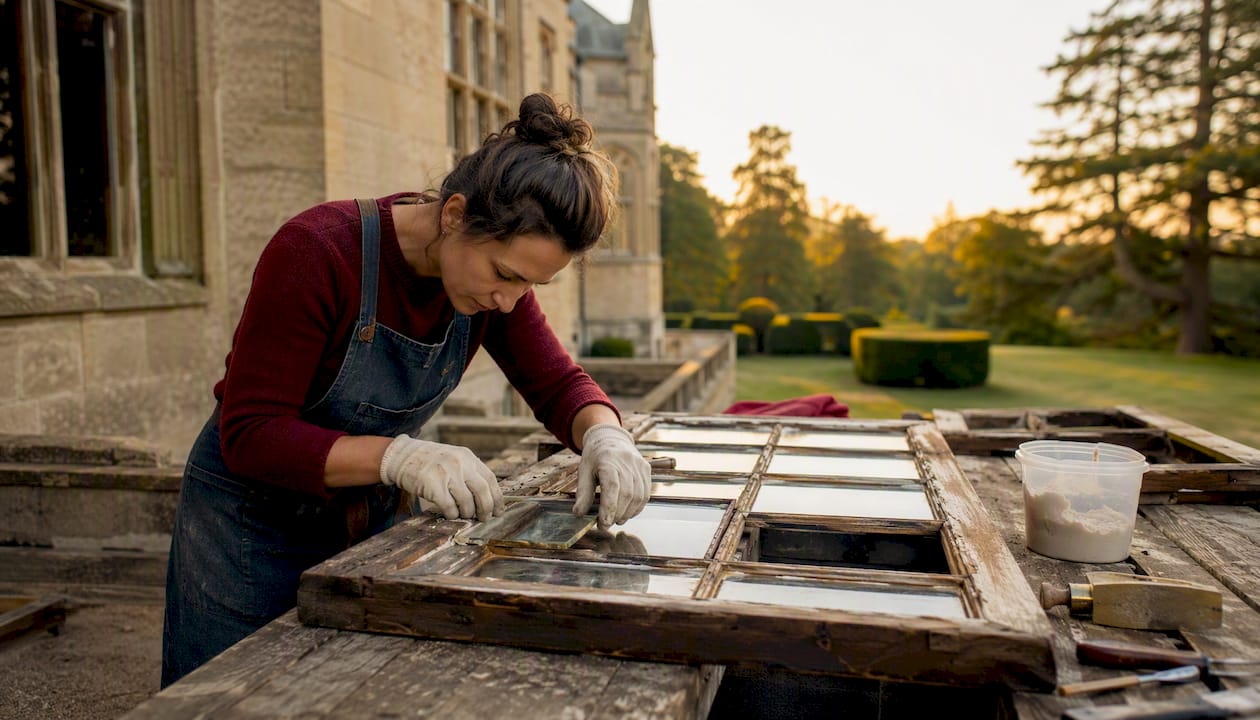
Mechanical restoration addresses operability without removing the sash from the frame. Work typically includes planing sticking sashes, replacing weatherstripping, re-glazing individual cracked panes, and repairing sash cords. Mechanical restoration for a standard double-hung window generally involves moderate cost, depending on extent of work. Hardware is usually retained and cleaned rather than replaced, and lead paint is managed in place rather than stripped.
Full glass-out restoration
Full glass-out restoration involves comprehensive sash removal and refinishing, with costs typically higher than mechanical restoration, reflecting added shop hours, lead-safe containment, and finish curing time.
Historically accurate replica replacement
When structural deterioration is severe, a shop-fabricated replica in matching species and profile can approach or undercut the cost of full glass-out work on a lifecycle basis. Historically accurate replica replacement costs vary widely but can be comparable to full glass-out restoration for severely deteriorated windows.
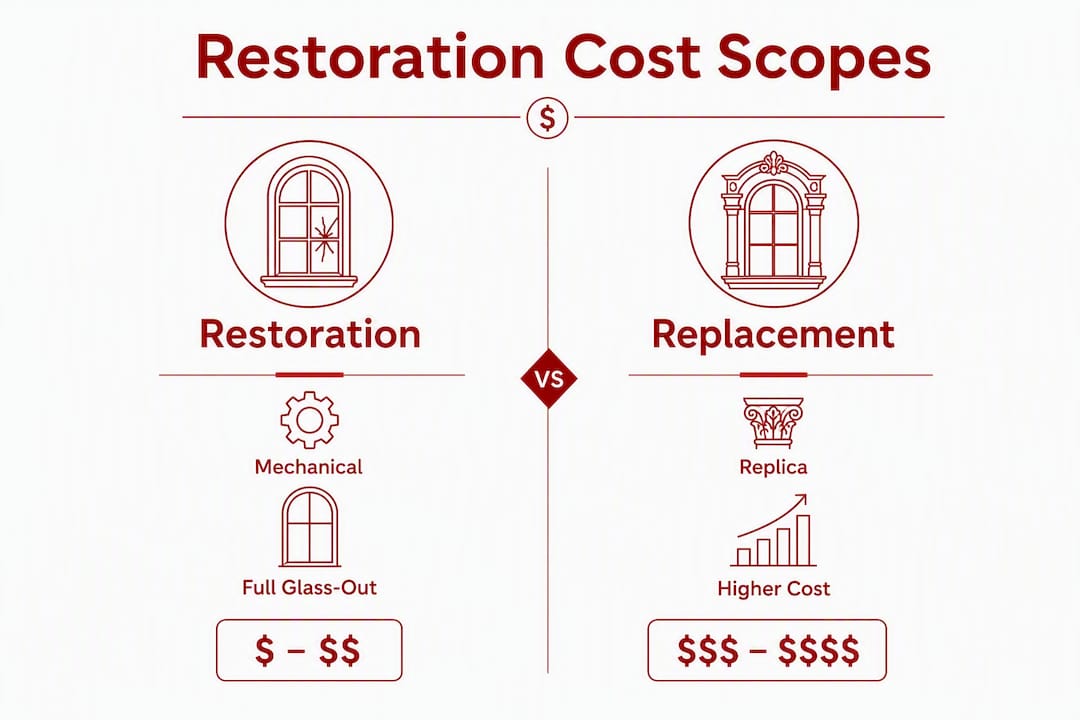
| Line Item | Mechanical Restoration | Full Glass-Out | Replica Replacement |
|---|---|---|---|
| Labor (shop + site) | Minimal shop | Significant shop | Full shop fabrication |
| Glazing | Spot re-glaze | Full re-glaze | New glazing throughout |
| Lead-safe containment | In-place management | Full containment protocol | Shop-controlled |
| Hardware | Clean/retain | Repair or replace | New or period-matched |
| Finish | Touch-up | Full strip and refinish | New prime and finish |
| Tax-credit eligibility | Often qualifies | Qualifies with documentation | Qualifies if in-kind |
Pro Tip: Request a condition survey before committing to scope. A sash with 30% rot in the lower rail almost always costs less to replicate than to restore to glass-out standard, and knowing that before bidding prevents the most common budget overrun.
Per-window and per-project cost ranges
Typical costs include materials, labor, and hardware, with additional modest surcharges for lead containment and permits. The table below shows how those components assemble across common project scenarios.
| Scenario | Scope | Per-Window Range | Project Total | Key Assumptions |
|---|---|---|---|---|
| 2 small 6-over-6 sash | Mechanical | $400–$600 | $800–$1,200 | No lead abatement; minor glazing |
| 3 medium 6-over-6 sash | Full glass-out | $1,000–$1,400 | — | Lead containment; shop refinish |
| 5 large 12-over-12 sash | Full glass-out + frame work | — | — | Multi-lite; partial frame repair |
| 4 deteriorated sash | Replica replacement | — | — | Custom profile match; new glazing |
Regional labor rates and lead-safe work protocols can increase costs in some markets. As a regional reference point, an Atlanta market survey shows tune-up work at $180–$450, standard restoration at $450–$850, and full glass-out at $1,100–$1,800 per window. Mid-Atlantic and Northeast urban markets tend toward the upper end of those bands.
Labor rates across U.S. restoration contractors run $40–$95 per hour, with four to twelve hours typical per window depending on condition and lite count. Batching windows from the same elevation into a single shop run meaningfully reduces per-window overhead.
What factors affect the cost to restore old windows?
Scope level is the dominant driver, but several secondary variables can shift a line item by hundreds of dollars per window.
- Lite count: Each lite requires its own glazing and muntin work, so a 12-over-12 sash carries roughly four times the glazing labor of a 6-over-6. Multi-lite configurations drive cost more than overall sash area.
- Rot severity: Isolated sill rot may add $150–$300 per window; widespread rail and stile deterioration can push a repair past the cost of replication.
- Wood species: Old-growth longleaf pine and white oak command premium material costs; matching species for patches or replicas in those materials adds to both material and sourcing time.
- Lead paint: Containment and disposal under EPA RRP protocols typically adds $75–$250 per window in labor and materials.
- Hardware: Retaining and cleaning original sash lifts and locks costs little; sourcing period-matched replacements or commissioning reproductions can add $40–$120 per window.
- Glazing type: Standard single-strength glass is the baseline; restoration glass, wavy antique glass, or decorative leaded glass each carry significant premiums.
- Site access: Upper-story windows requiring staging or lift equipment add mobilization costs that are best amortized across a full-elevation batch.
- Scheduling: Rush delivery or out-of-sequence installation breaks the shop’s batching efficiency and typically adds a premium.
Statistic: Labor typically makes up the majority portion of per-window restoration costs, often well over half the total, which is why batching windows and minimizing remobilization are the most reliable ways to control project spend.
Pro Tip: Schedule all windows on a single elevation in one shop run. The per-window overhead for setup, containment, and finish drops substantially when a craftsman processes six sashes in sequence rather than returning to the same wall three times.
How do you get an accurate restoration estimate?
Reliable bids require specific documentation. Providing the following before soliciting quotes reduces scope ambiguity and prevents change orders.
What to provide to bidders:
- Measured elevations with rough opening dimensions for each window
- Photographs of each sash face, sill, and frame condition (interior and exterior)
- Lite count per sash and glazing type (clear, restoration glass, decorative)
- Lead paint assessment or XRF test results if available
- Existing hardware inventory and condition notes
- Interior and exterior access conditions (staging required, occupied space)
- Desired finish standard (paint species, sheen, number of coats) and material preferences
Questions to ask every bidder:
- Which scope are you pricing: mechanical, full glass-out, or replica?
- Do you hold EPA RRP lead-safe certification for the work as described?
- What portion of the work is performed in-shop versus on-site?
- How do you handle hardware: retain, repair, or reproduce?
- What warranty do you offer on glazing and finish?
- What are your maintenance recommendations post-restoration?
Pro Tip: Request a line-item estimate that prices both full glass-out and replica replacement for any sash flagged as severely deteriorated. Locking in both fallback paths before work begins lets the contractor make the right call on-site without triggering a change order.
Gepettomillworks project examples from the archives
The Restoration Virginia Archives and Richmond Restoration Archives document Gepettomillworks’ completed projects with condition photographs, scope decisions, and material specifications. Three representative project profiles illustrate how scope, condition, and preservation goals interact with final cost.
| Project Profile | Scope Chosen | Condition at Survey | Approach | Ballpark Range |
|---|---|---|---|---|
| Richmond Federal-style townhouse, 8 sash | Full glass-out | Moderate rot, original wavy glass intact | Repair and re-glaze; retain glass | — |
| Virginia coastal cottage, 6 sash | Replica replacement | Severe lower-rail deterioration | Shop-fabricated replicas in longleaf pine | — |
| Jamestown-area historic structure, 12 sash | Mixed: 8 glass-out, 4 replica | Variable; 4 sash beyond repair | Hybrid approach per condition survey | — |
The Historically Accurate Windows Archives and Jamestown VA Archives show photographic documentation of profile matching, muntin detailing, and finish standards that support historic tax-credit applications. Where original glass survived, Gepettomillworks retained it; where it did not, restoration-grade glass was specified to preserve the visual character of the fenestration.
What is the typical timeline from survey to installation?
A well-sequenced restoration project moves through five phases, each with its own cost implications.
- Initial survey and condition report (1–2 weeks): Field measurements, photographic documentation, lead assessment, and scope recommendation. This phase produces the specification that all bids should price against.
- Shop restoration or fabrication (3–8 weeks): Sash removal, steam stripping, wood repair or replication, glazing, and priming. Batch size and profile complexity drive duration.
- Finish curing (1–2 weeks): Paint systems on restored or new wood require full cure before reinstallation to prevent adhesion failure at the sash-to-frame interface.
- Site removal and reinstallation (1–3 days per elevation): Temporary weather protection, sash swap, hardware fitting, and perimeter sealing.
- Final adjustments and touch-up (1–2 days): Operational tuning, glazing inspection, and finish touch-up.
Common causes of schedule slippage and added cost:
- Lead assessment results arriving after shop work begins, requiring scope revision
- Undiscovered frame rot found only after sash removal
- Custom hardware reproduction with long lead times from specialty suppliers
- Finish incompatibility between existing frame paint and new sash finish system
Pro Tip: Build a two-week buffer between shop completion and scheduled reinstallation. Finish curing is non-negotiable, and compressing it produces callbacks that cost more than the time saved.
How do preservation rules and tax credits affect cost?
Working to National Park Service and SHPO standards shapes both method selection and material specification in ways that directly affect the estimate.
- In-kind material requirements: NPS guidance generally requires that replacement elements match original species, profile, and glazing type. Substituting modern materials, even high-performance ones, typically disqualifies a project from federal historic tax credit consideration.
- Federal Historic Tax Credit: The federal program offers a 20% credit on qualified rehabilitation expenditures for certified historic structures. Window work must meet the Secretary of the Interior’s Standards for Rehabilitation to count as a qualified expenditure.
- State programs: Many states layer additional credits on top of the federal program. Virginia’s Historic Rehabilitation Tax Credit, for example, has supported numerous projects documented in the Gepettomillworks archives.
- Documentation requirements: SHPO applications require before-and-after photographs, material specifications, and contractor certifications. Building that documentation into the project scope from the start avoids retroactive cost.
The Secretary of the Interior’s Standards for Rehabilitation state that historic materials and features shall be retained and preserved, and that deteriorated historic features shall be repaired rather than replaced — a principle that directly governs scope decisions on tax-credit projects.
Pro Tip: Confirm SHPO pre-approval of your scope before committing to a replica approach. Documented replication of a deteriorated original typically qualifies; substitution with a non-matching profile or material does not.
When does replica replacement make more sense than restoration?
Replication is not a concession to deterioration. For severely compromised sashes, it is often the more responsible and cost-effective path.
Consider replica replacement when:
- Structural rot affects more than 30–40% of a sash’s cross-section
- Prior repairs have already been attempted and failed
- The existing sash profile cannot be made weathertight without intrusive alteration that would compromise historic character
- Full glass-out restoration cost approaches or exceeds the cost of a shop-fabricated replica in matching species
For severely deteriorated sashes, a historically accurate reproduction is often cost-competitive with, or cheaper than, full glass-out restoration when evaluated as lifecycle spend. Planning for replication during the condition survey prevents over-investing in sashes that will require replacement within a decade regardless.
A short decision checklist:
- Has a qualified craftsman assessed rot extent by probing, not visual inspection alone?
- Does the sash retain any original glass worth preserving?
- Is the project subject to tax-credit review that requires documented justification for replacement?
- Has the cost of full glass-out been compared against a shop replica quote for the same unit?
The Replica Wooden Windows Archives at Gepettomillworks document cases where replication produced equal or lower lifecycle cost than restoration, with profile-matching photographs and material specifications on record.
Key Takeaways
Historic window restoration cost is controlled primarily by scope: mechanical restoration, full glass-out, and replica replacement each occupy a distinct cost tier with different preservation and tax-credit implications.
| Point | Details |
|---|---|
| Per-window cost range | Costs vary depending on scope and condition. |
| Scope is the controlling variable | Mechanical restoration runs $180–$450; full glass-out $1,100–$1,800; replica replacement varies but is often cost-competitive for severely deteriorated sashes. |
| Regional and lead-paint premiums | Coastal and metro markets can increase base costs; lead containment typically adds $75–$250 per window. |
| Tax-credit compliance | NPS and SHPO standards require in-kind materials and documented methods; non-compliant scope disqualifies expenditures from the federal 20% Historic Tax Credit. |
| Gepettomillworks archives | Project case studies in the Restoration Virginia and Richmond Restoration Archives provide documented scope, condition, and cost examples for reference. |
The case for letting preservation set the budget, not the other way around
The most persistent mistake in historic window procurement is treating restoration as a line item to be minimized rather than as a preservation act with long-term architectural and financial consequences. When an owner or contractor selects mechanical restoration on a sash that genuinely requires full glass-out work, the savings are real for perhaps three years. After that, the callbacks, the re-glazing, and the eventual full restoration cost more in aggregate than the correct scope would have cost at the outset.
The more consequential error is choosing a non-compliant scope to save money on a tax-credit project. A 20% federal credit on qualified rehabilitation expenditures is a substantial offset. Disqualifying window work by substituting a non-matching material or skipping the SHPO documentation process forfeits that offset entirely, often for a per-window saving of a few hundred dollars.
Gepettomillworks’ position is that the condition survey is not overhead. It is the document that aligns scope to preservation goals, supports tax-credit applications, and prevents the two most expensive outcomes in historic window work: under-scoping a deteriorated sash and over-investing in one that should have been replicated from the start.
Gepettomillworks: custom restoration and replica work, documented for preservation compliance
Gepettomillworks brings custom millwork fabrication, shop-grade restoration, and archival documentation to historic window projects across the region. Where other approaches offer a single scope, Gepettomillworks prices mechanical restoration, full glass-out, and historically accurate replica replacement side by side, so architects and contractors can make the scope decision with real numbers in hand.
The process begins with a condition survey that produces the specification your bids should price against. From there, Gepettomillworks’ qualified restoration craftsmen handle shop fabrication and site installation, with photographic documentation built in for SHPO and tax-credit applications. Period-specific work, from Bungalow supplier profiles to historic replica sash fabrication, is documented in the project archives and available for reference before you commit to a scope.
Request a condition survey, provide your window count and photographs, and ask for line-item quotes across all three scope levels. Contact Gepettomillworks at gepettomillworks.com to start the estimate process.
Useful sources and preservation references
The following resources support project preparation, tax-credit applications, and scope documentation.
- National Park Service — Historic Preservation Tax Incentives: Primary authority on the federal 20% Historic Tax Credit, the Secretary of the Interior’s Standards for Rehabilitation, and qualified expenditure definitions.
- Restoration Virginia Archives — Gepettomillworks: Photo-documented Virginia restoration projects with scope and material specifications.
- Richmond Restoration Archives — Gepettomillworks: Richmond-area project case studies with condition surveys and cost context.
- Historically Accurate Windows Archives — Gepettomillworks: Portfolio of historically accurate reproduction windows with profile-matching documentation.
- Jamestown VA Archives — Gepettomillworks: Preservation-grade restoration work at Jamestown-area structures, useful as high-trust documented examples.
- R. J. Aley — Old Wood Windows FAQ: Contractor-level specification examples distinguishing mechanical restoration from full glass-out, with cost comparisons.
- Current Cost — Historic Window Restoration Cost: Per-window cost ranges, component breakdowns, and regional multiplier data for U.S. projects.
The Secretary of the Interior’s Standards for Rehabilitation remain the governing framework for any window work intended to qualify for federal historic tax credits. Consulting NPS guidance and your State Historic Preservation Office before finalizing scope is the single most reliable way to protect both the building’s integrity and the project’s tax-credit eligibility.