by Matthew Wiley | Oct 3, 2026 | Architectural Millwork
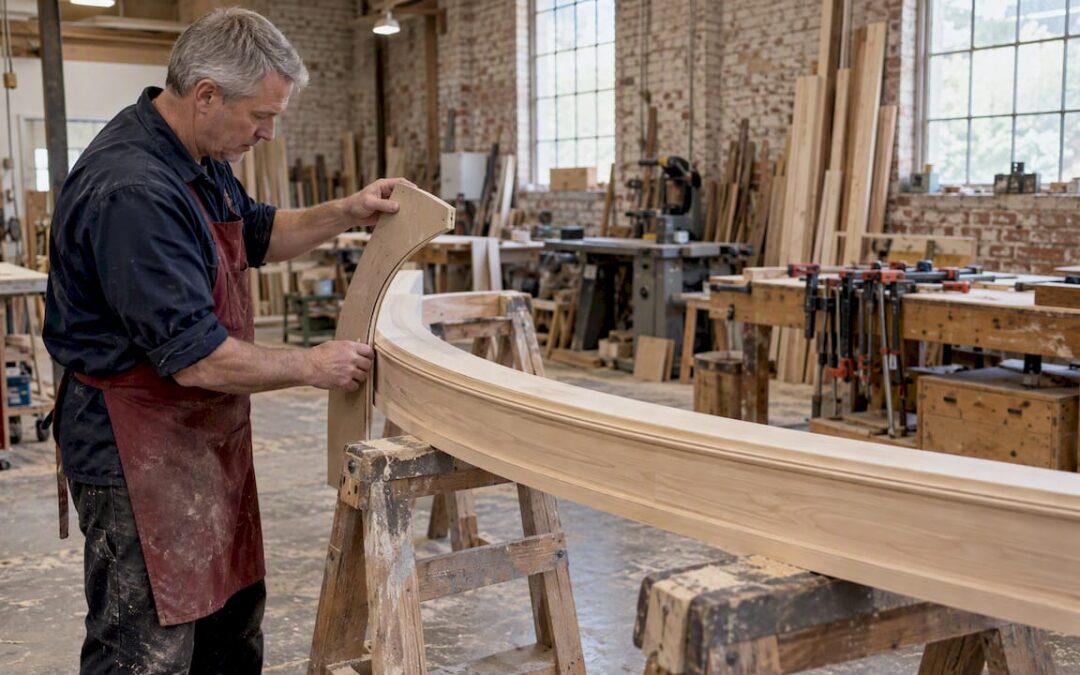
Five fabrication families govern nearly all radius millwork: solid machining (nested band-sawing), block-lamination, ply-lamination, core-veneering, and kerfing. The governing rule is simple: ply-lamination and core-veneering suit tight radii and continuous grain, solid machining and block-lamination suit gentler curves and longer runs, and kerfing serves field bends where the specification permits it. Preservation projects add a further demand: matching material, full-scale templates, and approved mock-ups before anything leaves the shop.
TL;DR:
- Ply-lamination and core-veneering are best suited for tight radii on curved profiles, while solid machining and block-lamination work better on gentler curves and longer runs.
- Full-scale templates and mock-ups are essential for preservation projects and when matching original grain and material in historic replication.
- Material species, ply thickness, and moisture conditioning directly impact achievable radius, with thinner plies and proper prep enabling tighter bends.
- Shop schedules depend heavily on form production, custom knife grinding, and adhesive curing times, which influence costs and delivery timelines.
- Concealing glue lines requires careful sanding, color-matched fillers, and proper staining, with verification protocols to ensure consistent appearance and quality.
Gepettomillworks
gepettomillworks.com
Bring Historic Curves Into Focus
Gepettomillworks creates custom millwork for historic building projects, including radius work and historic replication for approval.
Discuss your millwork project
Table of Contents
Fabrication methods explained: strengths, limits, and visual outcomes
Solid machining, or nested band-sawing, cuts the curve directly from solid stock, following the arc’s layout on a bandsaw before final shaping. It gives continuous grain and a clean, traditional appearance, but stock width limits the length of any single piece without a joint, which matters on wide elliptical heads or long sweeping casings.
Block-lamination glues smaller blocks together before bandsawing the curve from the built-up mass. It extends beyond what a single board can offer and suits moderate curves where some glue-line visibility on the face is acceptable.
Ply-lamination bends thin plies around a form, letting the curve take shape without external bracing once cured. The AWS standard notes that this method keeps glue lines running with the edge grain and the curve itself, which makes them far less conspicuous than a kerfed or segmented joint.
Core-veneering wraps a veneer face over a shaped substrate, giving the fabricator close control over figure and color on visible surfaces while the substrate handles structure.
Kerfing saws a series of closely spaced cuts into the back face of a board, allowing it to flex into a curve on site. It is fast and economical for gentle, non-structural bends, but it tends to leave flats on the face in tighter radii, a tradeoff worth weighing before specifying it for decorative work.
How to choose a method: decision criteria and quick rules of thumb
Method selection comes down to a handful of axes: how tight the radius is, whether the profile face is simple or deeply molded, how much grain continuity the design demands, how long the run is, whether the piece carries structural load, and what the budget and schedule allow.
- Tight radius with visible grain flow: specify ply-lamination or core-veneering.
- Gentle curve, long run, cost-sensitive: solid machining or block-lamination.
- Non-structural field bend where flats on the back face are acceptable: kerfing.
- Deeply molded decorative profile on a tight arc: ply-lamination with custom knife work.
- Historic replication where original material and grain pattern must match: solid machining or segmented lamination, confirmed by mock-up.
Specifications should mandate a method outright when grain continuity or historic accuracy is non-negotiable. Where appearance tolerance is looser, “manufacturer’s option with approved mock-up” gives the shop latitude without risking an unacceptable result on a finished building.
Materials and grain: species selection, ply thickness, and moisture prep
Species choice balances workability against figure. Mahogany, white oak, and sapele machine and bend predictably and take stain evenly, while figured woods like curly maple offer striking grain but complicate bending and glue-line concealment.
Grain orientation controls how continuous the curve reads to the eye. Selecting veneer faces with matching grain direction, and sequencing them around the form in order, keeps the arc looking like one continuous sweep rather than a patchwork.
Ply thickness and species set the practical radius limit for lamination work: thinner plies bend tighter but require more laminations and longer clamp cycles to build the same finished thickness. Moisture conditioning before bending reduces springback once the piece leaves the form and lowers the risk of delamination at the glue line, a failure that shows up months later as a visible crack rather than at the bench.
Templates, shop drawings, and field measurement best practices
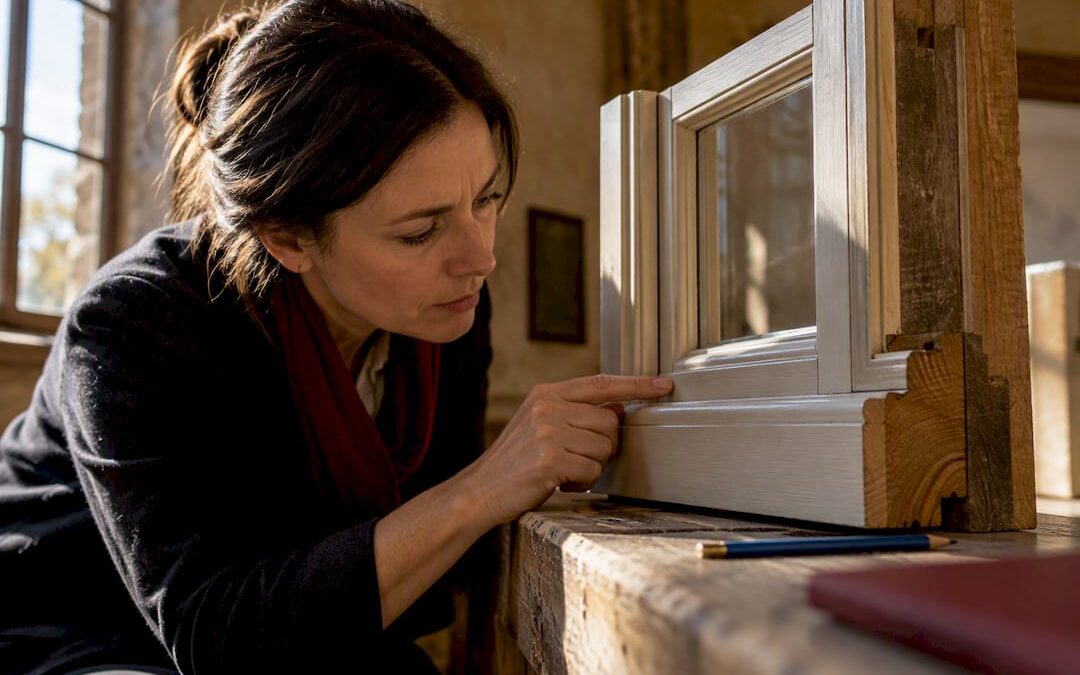
Full-scale templates and scribed arcs remain standard practice for radius elements because a drawing at reduced scale cannot reliably capture a curve’s true geometry. Shops typically transfer the template directly to the layout stock, eliminating the compounding error that comes from scaling up a small drawing.
- Produce a full-scale template or scribed arc from field measurements before cutting any stock.
- Draft shop drawings showing profile, sightlines, tolerances, blocking, and installation notes consistent with AWI submittal requirements, which call for drawings per AWI 100 submittal practices and field verification where applicable.
- Verify field dimensions against the original opening or existing fabric before committing to final production.
- Build and submit a mock-up for review and sign-off before full production begins.
On preservation projects, this sequence also satisfies the documentation that review agencies expect to see before approving replacement work.
A radius shop runs on a defined set of equipment: bandsaws for rough curves, vacuum or clamp-up forms for lamination, routers and trammel jigs for profiling, and custom-ground molding knives for matching historic sections. The Popular Woodworking guide to routing arches describes trammel jigs and progressive shallow routing passes as the standard approach to shaping curved panels without tear-out, a technique that scales directly to arched casings and moldings.
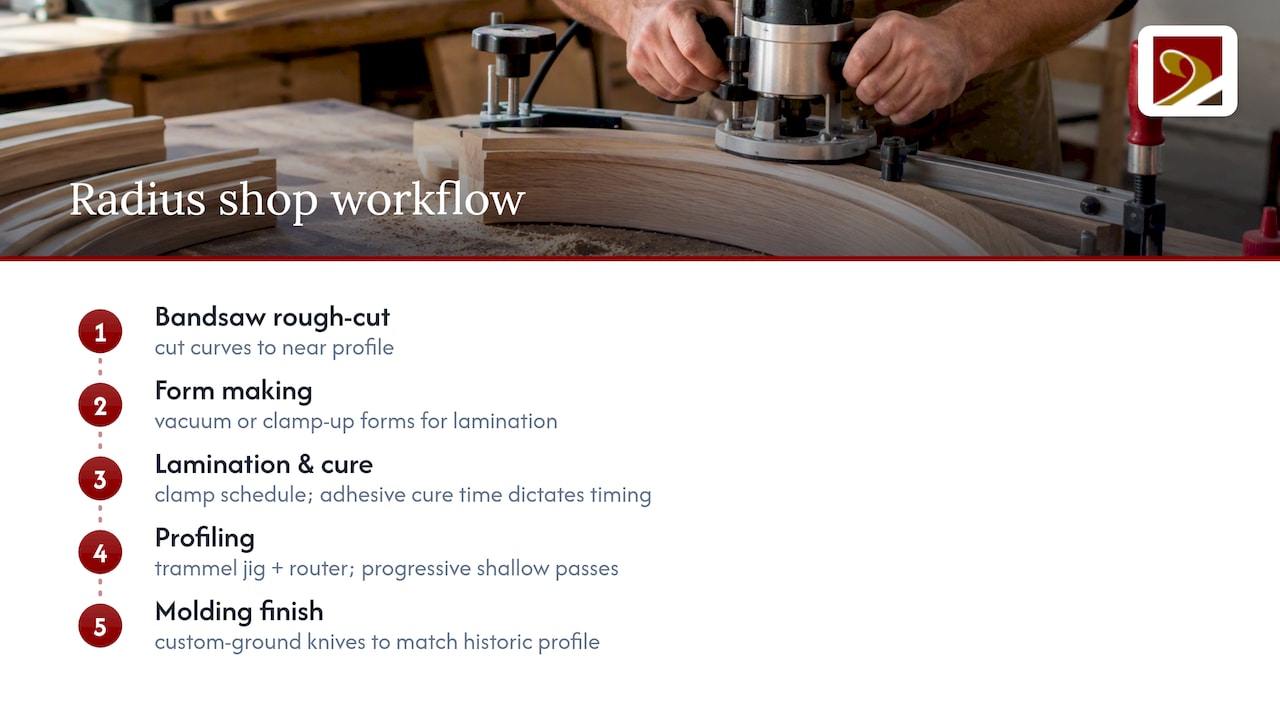
Form production and clamp schedules drive much of the timeline on laminated work, since adhesive cure times cannot be compressed without risking a weak glue line. Custom knife grinding, often needed to replicate a historic profile exactly, adds its own lead time before a single foot of molding runs. These production realities, more than the cost of raw material, typically set the schedule and the price on a radius order.
Finishing and quality control: concealing glue lines and verifying appearance
Sanding progression matters more on curved work than on flat stock, since tool marks and glue-line ridges catch light differently along an arc. A graduated sequence, moving through successively finer grits, removes machine marks and blends laminated joints before any filler or stain goes on.
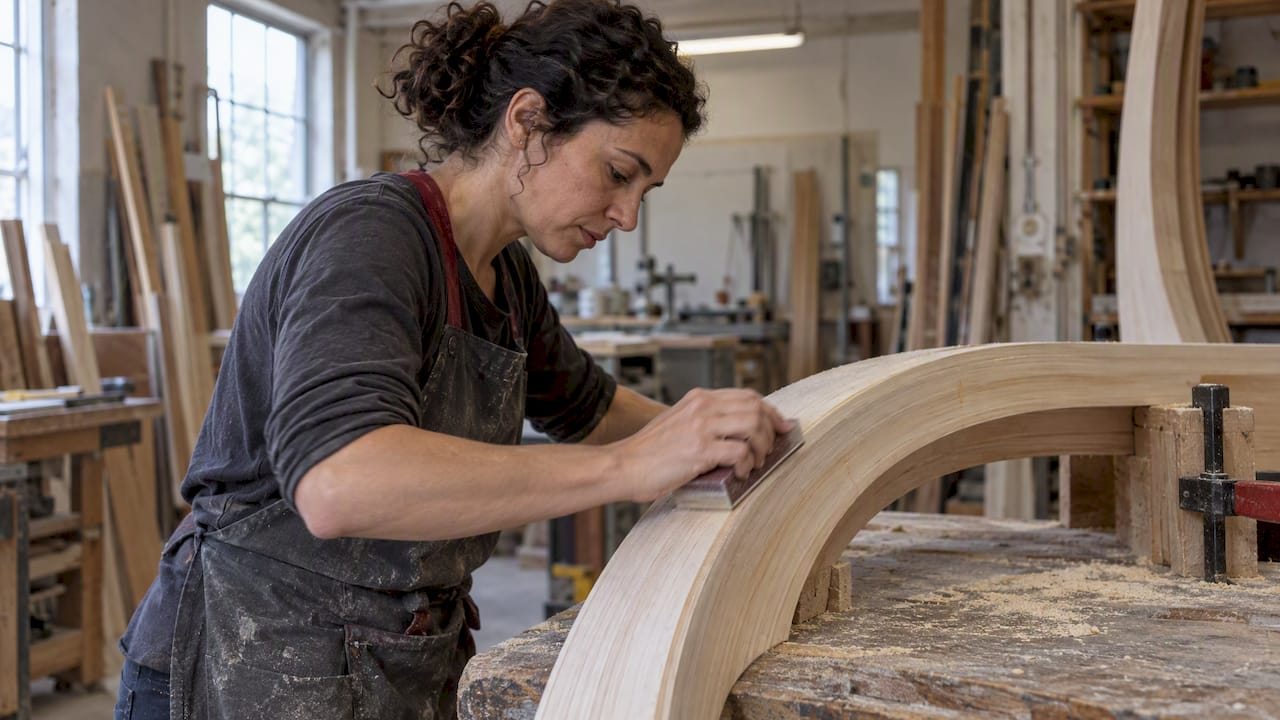
Color-matched fillers and careful staining sequence conceal glue lines on ply-laminated and block-laminated pieces, particularly where edge-grain lines follow the curve and sit less conspicuously than a kerfed flat. Pre-finishing or back-priming faces that become hard to reach after assembly, such as the inner easements of a narrow arched sash, protects the finish and avoids rework once the piece is installed.
Quality control on radius work should include a sightline check against the template, an adhesion test on sample laminate, and, for performance-critical assemblies, a prototype sent for independent verification before full production proceeds.
Historic preservation considerations: matching originals and review approval
The Secretary of the Interior’s Standards for Rehabilitation call for replacement work to match the original in design, material, and visual quality, reserving full replacement for elements too deteriorated to repair. The NPS technical note on replacement wood sash describes shops building full-scale templates, grinding custom knives, and producing a prototype window before committing to a production run. Preservation Brief 9 adds that splicing, custom milling, and economies of scale on larger projects are standard tools in this kind of work.
- Match original material species and grain character, not just the visible profile.
- Submit templates and mock-ups for agency review before production begins.
- Document the approval record carefully, since tax-credit projects depend on it.
When original stock dimensions fall short, segmented laminations and bandsawn sections joined with custom knife work let a shop hold the sightline and strength the design calls for.
Pro Tip: Run a sanding and stain trial on a sample laminate before committing to full production. It catches glue-line visibility problems while they are still cheap to fix.
Gepetto’s checklist for specifying radius millwork in contract documents
A short checklist for specifying radius millwork in contract documents includes requiring full-scale templates and an approved mock-up before production, clarifying ownership of custom-ground knives, and explicitly setting installation tolerances.
Build knife-grinding and form-construction time into the schedule from the start, and phase a mock-up approval before committing to final runs. Proper documentation from template to installed piece and coordination with preservation review bodies helps ensure the paper trail matches the work on the wall.
— Gepetto
Gepetto services: custom radius millwork and historic replication

Radius work rewards a shop that treats templates, knife work, and mock-ups as standard practice rather than an upcharge. Custom radius millwork often includes arched sash, curved casings, and replicated historic profiles, typically accompanied by documentation suitable for preservation review and tax-credit projects.
Architects and contractors working on a radius element now, whether new construction or a historic facade, can start with a shop drawing request through either page above.
Sources
FAQ
What is millwork fabrication?
Millwork fabrication is the shop process of designing, machining, and finishing custom wood elements such as windows, doors, trim, moldings, and staircases for a specific building rather than pulling stock parts off a shelf. It typically moves from shop drawings and templates through machining, assembly, and finishing before installation.
What is a millwork manufacturer?
A millwork manufacturer is a shop that designs and produces custom wood building components, often working from architect drawings, field measurements, and, on preservation projects, matching samples of the original material. Many millwork manufacturers also handle restoration and replication work alongside new fabrication.
Is millwork custom?
Millwork can be either custom-fabricated to a specific building’s dimensions and profiles or sourced as stock trim and molding. Radius elements like arched casings and curved sash are almost always custom, since a standard stock profile cannot follow a bespoke curve or match a historic original.
What is custom architectural millwork?
Custom architectural millwork refers to wood building elements, trim, cabinetry, windows, doors, and staircases among them, designed and fabricated for a particular project rather than selected from a catalog. On historic buildings, it often includes matching an original profile in material, grain, and visual quality under standards such as the Secretary of the Interior’s Standards for Rehabilitation.
How tight a radius can millwork be fabricated to?
The achievable radius depends on the method and species: ply-lamination with thin plies and a bendable species like mahogany can follow a tighter curve than solid machining or block-lamination allow. The AWS standard notes that ply thickness and species set the practical limit, and a sample laminate test is the reliable way to confirm a given radius before committing to production.
Recommended
by Matthew Wiley | Oct 2, 2026 | Architectural Millwork
The federal historic rehabilitation tax credit delivers a 20% income tax credit for the certified rehabilitation of income-producing historic buildings in the District of Columbia, but it demands formal certification from the DC State Historic Preservation Office and the National Park Service, along with rigorous adherence to the Secretary of the Interior’s Standards for Rehabilitation. Primary residences do not qualify. Every eligible dollar of qualified rehabilitation expenditure must be documented and defensible.
TL;DR:
- The property must be listed individually on the National Register or part of a registered historic district recognized by DC SHPO to qualify for the federal historic tax credit.
- Eligible uses are limited to income-producing functions such as commercial leasing, rental apartments, or mixed-use development, excluding primary residences.
- Qualified rehabilitation expenditures include structural repairs, window restoration, roof replacement, and mechanical upgrades, but exclude soft costs like landscaping or new additions beyond the historic footprint.
- Projects must complete a three-part application process with approved design prior to any irreversible work, with detailed documentation of all work and costs supported by precise shop drawings and photographs.
- Pairing the federal historic credit with other tools like LIHTC is common for larger projects, but early coordination is essential to optimize financial benefits and avoid recapture risks.
Gepettomillworks
Support Historic Millwork Projects
Gepettomillworks creates custom millwork for historic building projects involving architects, builders, contractors, and restoration professionals.
Table of Contents
Who and what qualifies for the federal rehab tax credit in DC
Eligibility for the federal credit rests on four pillars, and each one carries its own documentation burden. The property must first achieve certified historic structure status: listed individually in the National Register of Historic Places, or recognized as a contributing building within a registered historic district, a designation that in DC often overlaps with local landmark status administered through the DC Historic Preservation Office. NPS eligibility guidance confirms this certification step as foundational: without it, no amount of sensitive rehabilitation work earns the credit.
The second pillar concerns use. The building must generate income, whether through commercial leasing, rental apartments, or mixed-use development that combines ground-floor retail with upper-floor housing. A rowhouse converted entirely to an owner-occupied primary residence forfeits eligibility, a distinction that surprises many DC homeowners drawn to the credit by neighborhood rehabilitation stories that actually involved investment properties.
Third comes the substantial rehabilitation test, a formula rather than a judgment call. Qualified rehabilitation expenditures must exceed the greater of $5,000 or the building’s adjusted basis, a threshold DC’s Office of Planning applies consistently across the District’s inventory of contributing structures. For a modest rowhouse with a low adjusted basis, this bar can be cleared quickly; for a larger commercial building, the rehabilitation must be genuinely extensive. Projects phased over multiple years face additional timing rules governing when expenditures count toward the same rehabilitation period.
Fourth, the completed work must meet the Secretary of the Interior’s Standards, a subject significant enough to warrant its own treatment later in this guide.
A handful of edge cases complicate otherwise straightforward applications:
-
A campus of multiple buildings under common ownership may need separate certifications unless treated as a single coordinated project.
-
A building moved from its original site can lose contributing status unless the move itself was historically documented and approved.
-
Loss of historic integrity, whether from prior insensitive alterations or from demolition of character-defining features, can disqualify a structure even within an otherwise certified district.
-
Partial demolition during rehabilitation, even when well-intentioned, invites the closest scrutiny from reviewers.
Each of these scenarios benefits from early consultation with DC SHPO before design work advances too far to adjust.
Step-by-step HPCA application workflow in DC
The Historic Preservation Certification Application unfolds in three distinct parts, and sequencing matters as much as content. Filing out of order, or beginning construction before the right approval lands, is the single most common way a DC project forfeits its credit.
- Part 1, Evaluation of Significance, establishes or confirms certified historic status. This step is required whenever a building’s individual listing or contributing status has not already been established through the National Register nomination itself, and DC SHPO reviews the submission before forwarding a recommendation to NPS.
- Part 2, Description of Rehabilitation, is the design review stage, and it is the one developers most often rush. Applicants submit existing-condition photographs, architectural drawings, a detailed scope of work, and a narrative explaining how proposed interventions meet the Secretary’s Standards. NPS and DC SHPO review this package before approving the plan, and that approval should arrive before any irreversible work begins.
- Part 3, Request for Certification of Completed Work, closes the loop. Applicants submit post-construction photographs, final invoices documenting actual expenditures, and confirmation that the completed scope matches what Part 2 described.
Filing tips that save months of back-and-forth: DC’s planning office recommends electronic submission for HPCA materials, and applicants should establish a point of contact at DC SHPO early rather than submitting cold. Sequencing expectations are worth internalizing up front, since NPS review timelines are not instantaneous and construction schedules built without that buffer routinely stall.
Pro Tip: File Part 2 with enough lead time that a reviewer’s requested revision does not force you to pause active construction.
What counts as QREs and how the Standards govern acceptable work
Qualified rehabilitation expenditures cover the hard costs of bringing a historic structure back into productive use: structural repair, roof replacement, window and door restoration or replication, plumbing and electrical upgrades, and the architectural and engineering fees tied directly to the work. What does not qualify tends to catch first-time applicants off guard. Landscaping, site work outside the building envelope, new additions that expand square footage beyond the historic footprint, and certain soft costs like leasing commissions fall outside the credit.
- Qualifying costs typically include masonry repair, window restoration, roof replacement, and mechanical system upgrades tied to the rehabilitation.
- Non-qualifying costs typically include landscaping, parking lot improvements, and new construction that adds floor area beyond the historic structure.
- Interior work counts alongside exterior work, provided it does not strip character-defining features like plaster cornices, original stair details, or historic floor plans.
- Reviewers evaluate cumulative effect: a series of individually minor changes can collectively compromise historic character even when no single change would.
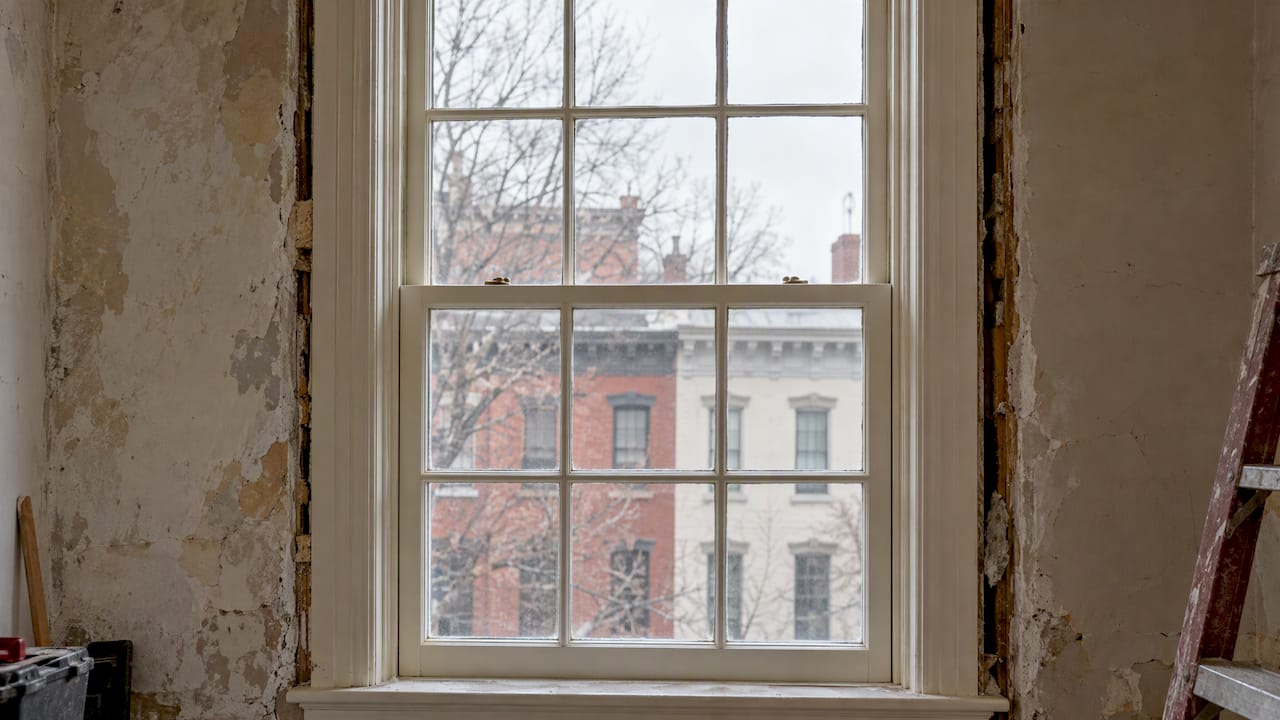
The Secretary of the Interior’s Standards for Rehabilitation shape every judgment NPS and DC SHPO reviewers make, and that scrutiny extends deep into detail work that many owners assume is cosmetic. Window and door assemblies are frequently the most visible test of compliance, since replacing a historic sash with a modern vinyl unit, even one that looks similar from the sidewalk, routinely triggers rejection. Period-accurate millwork, matched in wood species, profile, and glazing pattern to the original fabric, is often what separates an approved Part 2 from one sent back for revision.
More than 20% of eligible rehabilitation cost returns to the owner as a federal tax credit, which is precisely why documentation precision on items like windows carries financial weight, not just aesthetic significance.
A final requirement anchors the whole program: the building must remain in qualified income-producing use for five years after rehabilitation. Selling, converting to owner-occupied use, or otherwise changing that status within the holding period triggers partial recapture of the credit already claimed, calculated on a declining schedule tied to how much of the five years has elapsed.
Larger DC rehabilitation projects rarely rely on the federal historic credit alone. Pairing it with Low-Income Housing Tax Credits is a well-established strategy in the District, particularly for adaptive reuse of institutional buildings, former school buildings, and larger apartment conversions where the combined credits attract equity investors who would not otherwise underwrite a historic rehabilitation on its own.
Scale matters in this calculation. Transaction costs, legal structuring, and the accounting overhead of syndicating tax credits mean smaller rehabilitation budgets often cannot justify the complexity of a paired transaction, while larger commercial or multifamily projects with substantial qualified expenditures can absorb those costs and still come out ahead.
- Pairing HTC with LIHTC typically suits larger, income-restricted housing developments with substantial rehabilitation scope.
- Claiming the historic credit reduces the eligible basis available for LIHTC calculations, a tradeoff that requires early coordination between tax counsel and the development team.
- New Markets Tax Credits sometimes layer into the same capital stack for projects in qualifying census tracts.
- Many developers sell or syndicate the historic credit to a tax-equity investor rather than using it directly, converting a future tax benefit into upfront project capital.
This layering explains why serious DC historic rehabilitation projects assemble their financing and preservation teams simultaneously rather than sequentially.
Common reasons HPCA applications fail and how to avoid them
Most denials and delays trace back to a small set of avoidable mistakes, and nearly all of them are preventable with earlier coordination.
- Starting irreversible work before Part 2 approval. Demolishing a feature, removing a window, or altering a floor plan before DC SHPO and NPS sign off on the design puts the entire credit at risk, since approval cannot retroactively bless work already completed.
- Weak cost documentation. Reviewers and the IRS expect clear allocation between qualified and non-qualified expenditures, supported by invoices, contractor timesheets, and change orders tied to specific scope items rather than lump-sum billing.
- Inadequate millwork and window documentation. Shop drawings, material specifications, and sample mockups submitted with Part 2 give reviewers confidence that a proposed replacement genuinely matches the original, a level of specificity that generic product cut sheets rarely provide.
- Overlooking the recapture period. A sale, refinancing that changes ownership structure, or conversion to non-income use within five years of completion can trigger recapture, so any anticipated ownership change should be reviewed with tax counsel before it happens, not after.
Pro Tip: Photograph every character-defining feature before demolition begins, even features not explicitly discussed in your Part 2 narrative. Reviewers sometimes ask about details you did not think to document.
Gepetto Millworks: practical millwork practices that support HPCA compliance
Historic windows, doors, and trim are frequently the detail on which an HPCA Part 2 review turns, since reviewers judge replication work against the original profile, material, and glazing pattern rather than against a general impression of historical style. A specialized custom millwork provider for historic building projects produces the kind of shop drawings and photographic documentation that HPCA reviewers expect to see alongside a rehabilitation narrative.
Typical deliverables that support a compliant submission include:
- Detailed shop drawings showing exact profiles, joinery, and dimensions matched to the original element.
- A material list specifying wood species, glazing type, and hardware consistent with the building’s period.
- Sample mockups that reviewers or SHPO staff can examine before full fabrication proceeds.
- In-progress and completed photographs documenting the installation for the Part 3 submission.
For DC rowhouses and commercial buildings alike, this level of specificity in window and door replication, drawn from a focus on exact historic replication using authentic materials and techniques, is often what distinguishes a Part 2 narrative that sails through review from one that draws a request for revision. The firm’s work on replica wooden windows illustrates the kind of documentation trail that supports, rather than undermines, a certification application.
When pursuing the DC historic tax credit is worth the effort
A rowhouse conversion to a handful of rental units can qualify, but the paperwork burden scales less gracefully than the credit itself.
Assembling the right team early matters more than any single filing tactic: a preservation architect fluent in the Secretary’s Standards, tax counsel who understands recapture and basis reduction, a historic consultant who has worked with DC SHPO before, a contractor experienced in rehabilitation sequencing, and a millwork specialist who can produce documentation reviewers trust. Expect the certification process to add real lead time to a project schedule, and budget for it accordingly rather than treating documentation as an afterthought once construction is already underway.
— Gepetto
Millwork support for HPCA-compliant DC projects
Meeting the Secretary’s Standards on windows, doors, and trim is often the narrowest part of an HPCA approval, and it is the part Gepetto Millworks works on directly. The firm’s Historic Window Restoration service restores original sash and frames where repair is feasible, while custom fabrication covers replication when replacement is unavoidable.
Beyond the physical work, preparation of shop drawings, material specifications, and in-progress photographs are part of what a Part 3 submission requires, documentation built to hold up under SHPO and NPS review rather than assembled after the fact. Owners and developers planning a DC rehabilitation that depends on window or door replication can review the Historic Window Restoration page to see how that documentation process fits into a broader project timeline.
Sources
Confirming current rules directly with primary sources avoids relying on outdated guidance.
FAQ
What are the DC tax credits and how can I get them?
The primary credit available to DC property owners is the federal 20% rehabilitation tax credit, which applies to certified rehabilitation of income-producing historic buildings. Owners apply by filing the three-part HPCA application with DC SHPO and NPS, documenting qualified expenditures, and completing work that meets the Secretary of the Interior’s Standards.
How does a historic tax credit work?
A qualifying owner completes a certified rehabilitation of an income-producing historic building and claims a credit equal to 20% of qualified rehabilitation expenditures, generally spread ratably over five years under IRS rules. The building must stay in qualified use for five years, or the owner faces partial recapture of the credit already claimed.
What are the downsides of historic preservation?
Preservation requirements can limit design flexibility, since exterior alterations and many interior changes must follow the Secretary of the Interior’s Standards rather than an owner’s original design preferences. The certification process also adds administrative lead time and documentation cost, and starting irreversible work before approval can jeopardize the credit entirely.
How do I know if my house is in a historic district?
DC’s Office of Planning maintains records of designated historic districts and can confirm whether a specific address carries contributing status within one. A property’s certified historic structure status is also confirmed through the National Register listing process if it is not already part of a recognized district.
Recommended
by Matthew Wiley | Oct 1, 2026 | Architectural Millwork
Window restoration or replacement can qualify for the federal 20% rehabilitation tax credit, but only as one component of a certified rehabilitation of an income-producing historic building, never as a standalone contract. The National Park Service favors repair over replacement, and any replacement must be justified and documented under Standard 6. Before finalizing a window order or signing a fabrication contract, engage a preservation consultant and a tax advisor: the sequence in which you make decisions determines whether the work survives review.
TL;DR:
- The rehabilitation credit applies only when window work is part of a certified building renovation that exceeds a minimum expenditure threshold, and it cannot be claimed on standalone window projects.
- Window costs included in qualifying expenditures must relate to repairs, compatible replacements, and installation labor, excluding site work or additions, and require coordination between preservation and tax professionals from the start.
- Replacement windows on prominent elevations must match original profiles, muntin patterns, and reflective qualities to meet Standards, with physical mock-ups preferred for certification.
- Documentation for certification includes detailed window schedules, dimensioned elevations, condition photos, mock-up evidence, and a clear phasing schedule if using a phased measuring period.
- Owners should delay ordering window units until after Part 2 approval and certification, and track the NPS project number to support tax claims and avoid costly changes.
Gepettomillworks
gepettomillworks.com
Historic Window Millwork, Made Carefully
Gepettomillworks creates custom millwork for historic building projects, supporting accurate window restoration and replacement work.
Visit Gepettomillworks
Table of Contents
How the federal rehabilitation tax credit works and who qualifies
The federal rehabilitation credit is generally worth 20% of qualified rehabilitation expenditures on a certified historic structure, an income-producing, depreciable building listed individually in the National Register or located in a registered historic district and certified by the National Park Service as contributing to that district’s significance. The credit is not available for owner-occupied residences; it exists for commercial, rental, and other revenue-generating properties, which shapes every downstream decision about window scope.
Qualification hinges on the substantial-rehabilitation test. Under NPS guidance, expenditures during a 24-month measuring period, or a 60-month period for phased projects, must exceed a minimum value based on either a fixed amount or the building’s adjusted basis. A project that fails this threshold produces no federal credit regardless of how carefully the windows were restored.
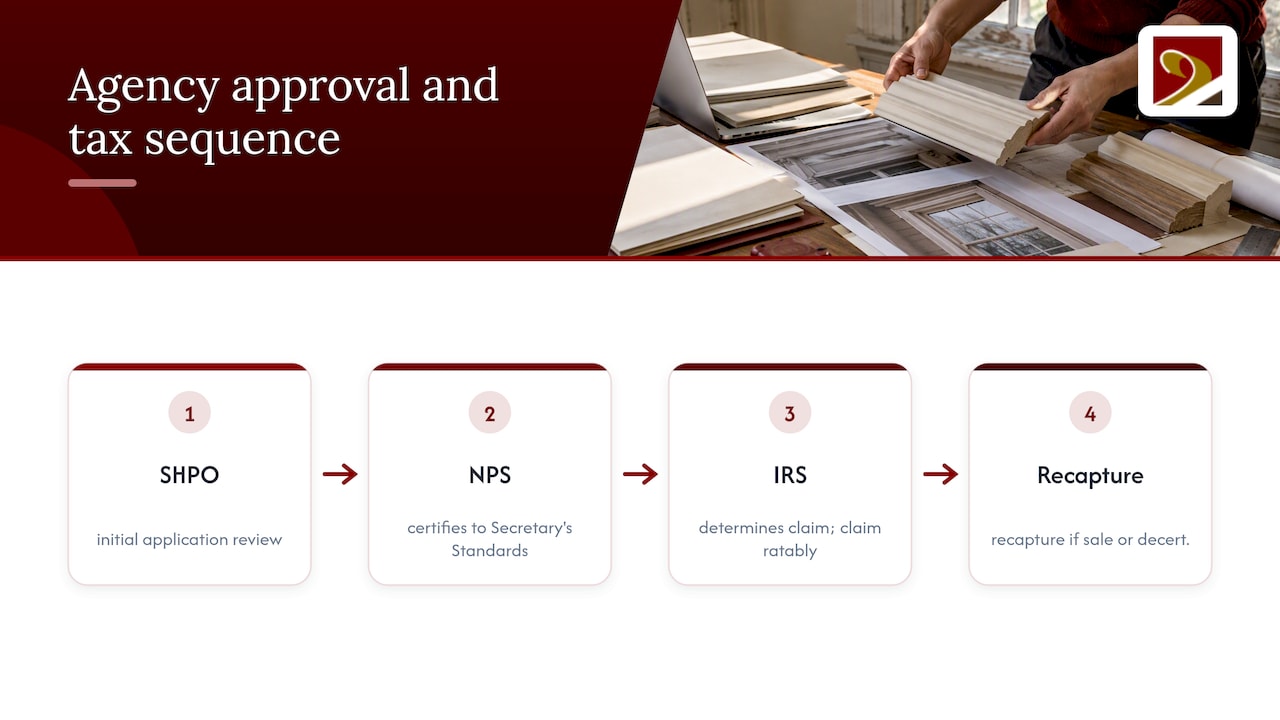
The three agencies play distinct roles. The State Historic Preservation Office conducts the first review of the application, the National Park Service certifies whether the completed rehabilitation conforms to the Secretary of the Interior’s Standards, and the Internal Revenue Service determines when and how the credit is claimed on a tax return. Since 2018, the credit is generally claimed ratably over multiple years rather than in a single year, and early disposition of the property or failure to maintain certified status can trigger recapture of the unused portion. Because window work is often the most visible and most debated element of a rehabilitation, understanding this chain of authority matters before a single sash comes off its frame.
Do windows alone qualify? How window costs fit into qualified rehabilitation expenditures
Window-only projects rarely produce a federal credit on their own. Eligibility is not evaluated window by window; it depends on whether the entire building rehabilitation meets the substantial-rehabilitation test and receives NPS certification. A building owner who replaces forty window units but does nothing else to the structure will likely fall short of the threshold and receive no credit, however well the windows were executed.
When windows are part of a larger certified rehabilitation, qualified rehabilitation expenditures typically include repair labor, historically compatible replacement sash and frames, glazing, weatherstripping, and the installation labor tied to those elements. Costs that usually fall outside QREs include new additions, appliances, site work such as landscaping, and any work unrelated to the historic building’s structure and finishes, as state preservation guidance on project scope makes clear.
Because NPS certification addresses design conformity while the IRS determines tax qualification, allocating window costs correctly requires the preservation consultant and the tax professional to coordinate from the outset, not after invoices arrive.
NPS standards for windows: repair first, then replacement, what reviewers look for
The Secretary of the Interior’s Standards begin from a clear premise: repair and retention of historic windows is preferred over replacement whenever feasible. Reviewers expect documentation showing why repair is not a reasonable option, typically deteriorated wood beyond structural repair, missing or irreparably damaged hardware, or conditions that repair specialists have assessed and rejected. A blanket claim of “beyond repair” without supporting evidence rarely survives scrutiny.
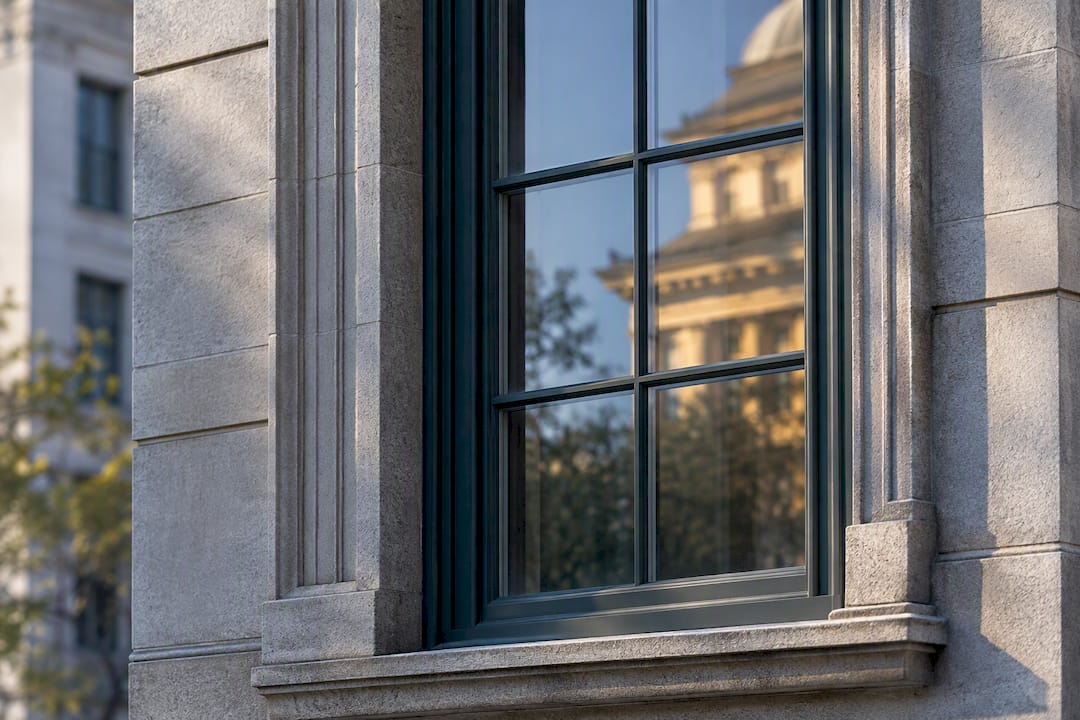
When replacement is justified, the evaluation criteria differ by location on the building. Windows on primary, highly visible elevations face the closest examination: size, sash and frame profile, muntin pattern, glazing configuration, and the reflective and planar qualities of the glass all factor into whether a replacement reads as compatible with the historic fabric. Secondary and rear elevations sometimes allow more flexibility, though NPS still expects the replacement to fill the original opening and match the historic character rather than introduce an unrelated design.
One point trips up many owners: replacing an incompatible nonhistoric window with another incompatible unit does not satisfy the Standards, even if the new window performs better or costs less. NPS’s logic favors retaining original material because a faithful replacement, however precise, is still a replacement, and the agency treats retained historic fabric as inherently stronger evidence of preservation than reproduction.
Mock-ups and three-dimensional samples carry real weight in this evaluation. A profile drawing can misrepresent how a muntin will actually catch light, while a physical sample installed in a test opening lets reviewers judge shadow lines, reflectivity, and depth the way a passerby would. Projects that produce a sample window for SHPO and NPS review before ordering the full run tend to move through certification with fewer amendments.
Exactly what to include for windows in HPCA Part 2 and Part 3
The Historic Preservation Certification Application moves through three parts: Part 1 establishes the building’s significance, Part 2 documents the proposed rehabilitation, and Part 3 certifies the completed work. Part 2 and Part 3 are the parts that determine federal credit eligibility, and windows are frequently the section reviewers scrutinize most closely.
A complete window submission generally includes:
- A building-wide window schedule or key plan identifying every opening, its existing materials and configuration, and the proposed treatment for each.
- Dimensioned existing and proposed elevations, along with vertical and horizontal sections that allow direct, measurable comparison between old and new profiles.
- Condition photographs documenting deterioration, paired with a repair-versus-replacement cost analysis for openings proposed for replacement.
- Photographs of mock-ups or physical test samples where replacement is proposed on visible elevations.
- A clear phasing narrative and schedule when the project elects the 60-month measuring period, since phased-project rules require defined phases and completed architectural plans before physical work begins.
The documentation guidance NPS publishes specifically for windows treats this as a design-review record, not a compliance formality. Submissions that tie each proposed treatment to documented condition evidence and measured comparisons move faster than narrative descriptions asserting general deterioration.
Choosing between the 24-month and 60-month measuring periods shapes both construction scheduling and tax timing. The 60-month phased option requires a defined phasing plan and completed architectural plans before physical work begins on the first phase, a precondition set out in Treasury Regulation § 1.48-12(b)(2)(v) and reinforced in NPS phased-project guidance. Owners who plan to replace windows building-wide over several years, rather than all at once, typically need this election in place from the start rather than added after construction begins.
The credit is claimed in the taxable year the building is placed in service, using Form 3468, with the resulting general business credit generally flowing through Form 3800. Since the current allocation rules take effect, the credit is spread ratably over five years rather than claimed in full at once, and disposing of the property or losing certified status before that period ends can trigger recapture of the unclaimed portion.
Timing mismatches are common. Final NPS certification sometimes arrives after a tax return is due, and the Form 3468 instructions include a 30-month documentation rule addressing exactly this situation. Owners filing before certification is complete should keep the NPS project number, submission dates, and any interim correspondence in their tax records, since that paper trail is what supports the claim if the IRS asks questions before final certification lands.
State credits and coordinating federal and state reviews
Federal certification does not guarantee approval under a state historic tax credit program. States administer their own credits with their own documentation standards, and some expect closer material matching or additional scaled comparisons beyond what NPS requires. Treating the state submission as a copy of the federal package is a common and costly mistake.
The practical fix is sequencing: check the relevant state program’s window-specific requirements early, before finalizing Part 2 documentation, so a single set of drawings and photographs can satisfy both reviews where possible. Some project teams submit to SHPO and the state program simultaneously to shorten the overall timeline, but this only works when the state’s documentation thresholds are known in advance. Owners restoring buildings in Virginia, West Virginia, North Carolina, South Carolina, or Maryland should confirm current state guidance directly with their SHPO rather than assuming federal standards automatically transfer.
Step-by-step checklist for a window-focused HTC project
A window program that survives review usually follows the same sequence, regardless of building size or budget.
- Engage a preservation consultant, a tax advisor, and a qualified millworker before finalizing window specifications or signing a fabrication contract.
- Complete a full window inventory and condition assessment, producing the building-wide key plan reviewers expect.
- Develop dimensioned elevations, sections, and, for visible elevations, a physical mock-up alongside a documented repair-versus-replacement cost comparison.
- Submit Part 2 with a clear phasing narrative if using the 60-month election, then wait for SHPO comments and NPS determination before placing final orders for replacement units.
- Document as-built conditions for Part 3 and retain every invoice, change order, and photograph tying the finished work to the approved design.
- File Form 3468 in the year the building is placed in service and keep the NPS project number attached to the supporting tax records.
Pro Tip: Order long-lead-time window units only after Part 2 comments come back; a rejected profile ordered early becomes an expensive change order later.
How millwork and measured replication support approvals
Gepetto Millworks’ project archives, including Jamestown VA restoration work and historically accurate window reproductions, illustrate what reviewers respond to: measured drawings that match the existing opening exactly, not approximations scaled from a photograph.
A millwork submission that supports an HPCA typically documents sash and frame profiles to the sixteenth of an inch, joinery methods consistent with the original construction, glazing reflectivity and thickness, and the paint or finish specification for both faces of the unit. Installation plane, how far the new sash sits from the exterior wall face compared to the original, matters as much as the profile itself, since a unit set too far forward or back changes the shadow line reviewers evaluate.
Producing a physical sample before committing to a full production run, drawing on the kind of replica sash work documented in Gepetto’s project history, reduces the risk that a rejected detail turns into a formal amendment after fabrication has already begun.
Repair-first thinking is not sentimentality, it is the strategy most likely to clear NPS review and preserve the building’s original material. Owners who treat replacement as a last resort, backed by an honest repair-versus-replacement cost comparison rather than a contractor’s convenience, tend to face fewer amendments and less rework.
The temptation to order windows early, before Part 2 comments arrive, is the single most avoidable risk in this process. Documentation feels like overhead until the moment it is the only thing standing between a project and a rejected certification.
— Gepetto
Gepetto Millworks: historic window restoration and HPCA documentation support
Gepetto Millworks builds custom historic window restoration around the same documentation reviewers expect to see: measured drawings tied to the original opening, physical samples for visible elevations, and finish specifications that match historic sash rather than approximate it.
A millwork provider’s role in a rehabilitation project may include:
- Producing dimensioned profile drawings suitable for Part 2 submission.
- Fabricating mock-ups or test units for SHPO and NPS review before full production.
- Matching joinery, glazing, and finish details to the building’s documented historic condition.
- Coordinating delivery timing with the preservation consultant so units are not ordered ahead of approval.
Owners and architects working through a certified rehabilitation are welcome to start with a consultation on the Historic Window Restoration page before finalizing a window scope.
FAQ
Is there still an energy credit for windows in 2026?
Energy-efficiency window credits are a separate program from the historic rehabilitation credit, with their own eligibility rules and expiration timelines; a breakdown of recent changes to energy-related credits explains what remains available. Owners restoring a certified historic building should evaluate the two programs independently, since qualifying for one does not determine eligibility for the other.
What type of windows qualify for tax credits?
Under the federal historic rehabilitation credit, window work qualifies only as part of a certified rehabilitation that meets the substantial-rehabilitation test, not based on the window type itself. NPS favors repair of original windows, and any replacement must match the historic sash profile, muntin pattern, and materials under Standard 6.
Who gets the new $6000 tax break?
There is no federal historic preservation provision tied to a fixed amount; the federal rehabilitation credit is calculated as 20% of qualified rehabilitation expenditures on a certified historic building. Readers encountering specific dollar figures elsewhere should confirm whether they refer to a different program, such as a state or local incentive, and verify details with the relevant agency.
How does the historic tax credit work?
The federal credit equals 20% of qualified rehabilitation expenditures on a certified historic, income-producing building, claimed ratably over five years after the building is placed in service. The project must pass the substantial-rehabilitation test and receive NPS certification that the completed work conforms to the Secretary of the Interior’s Standards.
Recommended
by Matthew Wiley | Sep 30, 2026 | Architectural Millwork
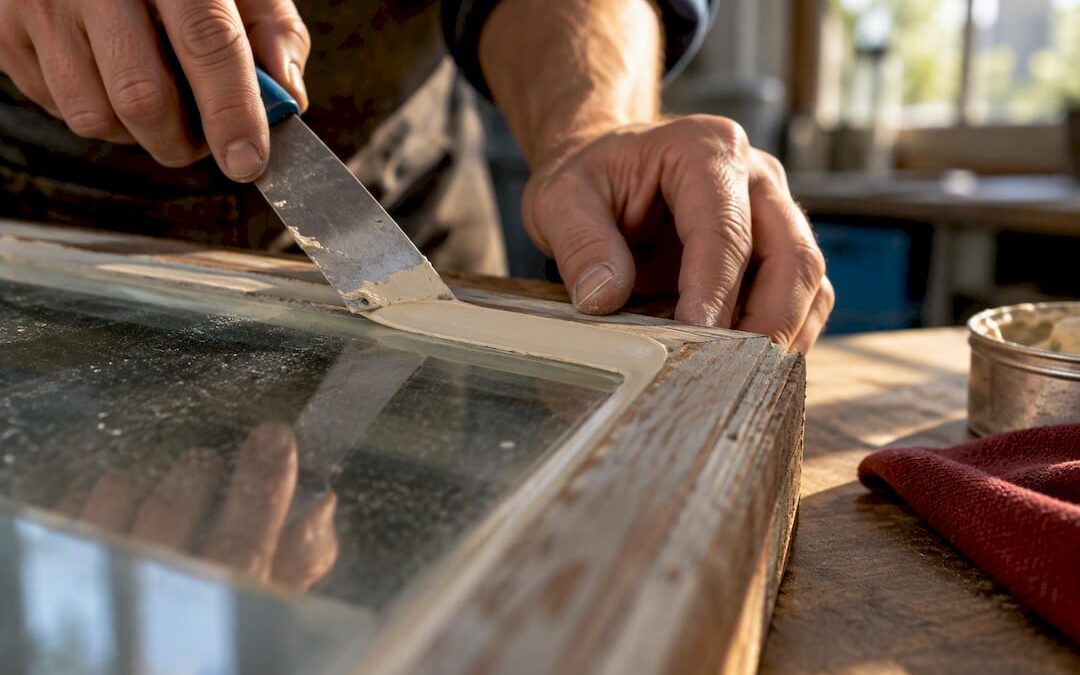
Reglazing is the correct route when a sash retains sound joinery and its wood is free of significant rot, and it should begin only after lead-safe preparation and any necessary structural repairs are complete. Choose a compound suited to the exposure, whether shop-cured or applied on site, and respect its full skin time before priming. Skipping these two conditions, sound sash and lead-safe prep, is the most common reason a reglazing project fails.
TL;DR:
- Proper reglazing requires a sound sash and lead-safe preparation; skipping these steps is the leading cause of project failure.
- Back-bedding the glass with a thin layer of putty before setting it prevents moisture intrusion that causes wood rot.
- Use the appropriate compound for the environment; shop-cured linseed putty indoors and weather-appropriate formulations like Sarco DualGlaze outside.
- Secure the glass with glazing points every 6 to 8 inches and avoid painting until the putty has fully skinned to prevent moisture entrapment.
- For complex repairs or deteriorated sash, professional restoration with documentation and replication often ensures long-term success.
Gepettomillworks
Restore Historic Windows With Care
Gepettomillworks creates custom millwork for historic building projects, supporting careful restoration when sash repairs require professional expertise.
Visit Gepettomillworks
Table of Contents
What glazing is and why it matters for historic windows
Glazing putty is the material that seals glass into its rabbet, the milled recess along the inside edge of a sash. Properly applied, it does more than hold the pane in place: it sheds water away from the joinery, cushions the glass against thermal movement, and forms the final barrier between the elements and the wood beneath. When that seal fails, moisture works its way into the sash corners, and moisture, not age, is the primary force behind wooden window decay, according to the National Park Service’s technical guidance on repairing historic wooden windows.
The preservation case for repair over replacement rests on more than sentiment. The National Park Service notes that windows typically account for only a modest share of a building’s total heat loss, and that a well-maintained original sash paired with weatherstripping and storm windows can match or exceed the long-term performance of a replacement unit, according to its window performance guidance. Original sash were often milled from old-growth timber with a density and stability that modern lumber rarely matches.
- Glazing seals the glass and directs water away from the sash joinery.
- Repair retains historic material that a replacement unit cannot restore once discarded.
- A well-restored sash with storms can meet the performance of new construction.
Inspect and prepare: a checklist, lead-safety triggers, and repairs to complete first
Before any putty comes out, walk each window and record its condition. Preservation Brief 9 recommends a unit-by-unit survey paired with a window schedule and photographic record, a practice that keeps multi-window projects organized and prevents repeated diagnosis of the same problems, according to the National Park Service’s repair guidance.
- Note paint condition, sill slope, and any standing water paths.
- Check sash corners and rails for soft wood, checking, or open joints.
- Record which panes have cracked, missing, or failed glazing.
- Test hardware, sash cord or balance function, and overall operation.
- Measure each opening for the window schedule before starting repairs.
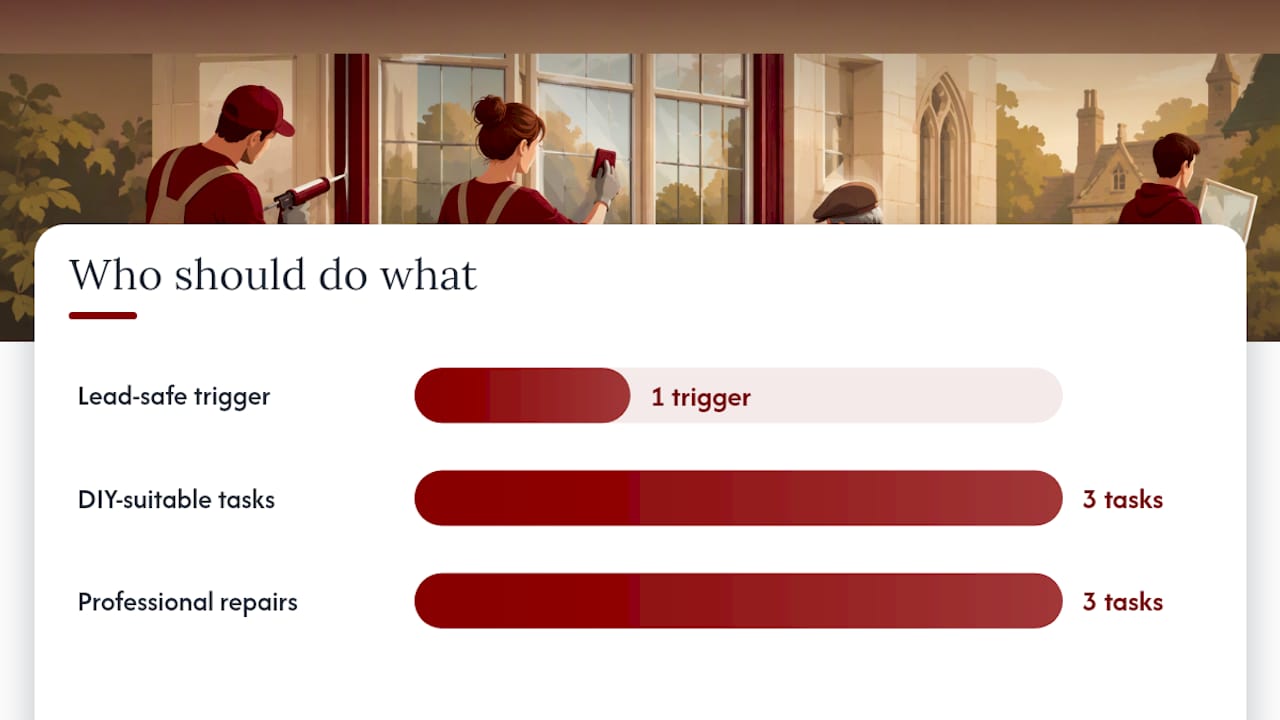
If your house predates 1978, assume lead paint is present until tested otherwise. Under the EPA’s Renovation, Repair, and Painting rule, disturbing painted surfaces on pre-1978 housing triggers lead-safe work practices, including containment and a ban on open-flame burning or uncontrolled high-heat tools, a requirement that applies squarely to window glazing work, according to the EPA’s RRP program details.
Simple tasks, cleaning out old putty, priming bare wood, resetting a loose pane, sit comfortably within DIY reach once lead-safe prep is in place. Consolidating rotted wood fiber, rebuilding a sash corner, or replacing a full rail are different matters. Those repairs demand judgment about load paths and joinery that a professional restorer, rather than a first-time DIYer, is better positioned to make.
Removing old, hardened putty is the first real test of patience. Manual scrapers and hook tools work, but many restorers prefer infrared heat tools because they soften decades-old putty and paint without an open flame, a distinction that matters both for the glass and for lead-safety compliance, a point echoed in trade guidance on reglazing old windows. Whichever method you choose, work in small sections, protect the glass from thermal shock, and contain paint debris under EPA RRP practices throughout.
Once the rabbet is clean and any bare wood is primed with an oil-based primer, the real technique begins.
- Back-bed the glass first. Lay a thin bead of putty into the rabbet before setting the pane; this bedding layer is what keeps condensation from reaching the joinery, a detail restorers consistently flag as the step DIYers skip.
- Set glazing points every 6 to 8 inches around the pane to hold it firmly while the face putty cures, a spacing confirmed in professional glazing workflows described by Fine Homebuilding’s 2026 glazing guide.
- Pack and tool the face putty into a beveled ribbon that sheds water away from the glass, working the putty knife at a consistent angle for a clean line.
Compound choice depends on where the work happens. A controlled shop environment, the kind used for full sash restoration, often calls for a Type M linseed putty formulated for interior glazing conditions. For exterior, on-site work exposed to weather and temperature swings, Sarco DualGlaze is a linseed and soy-based compound that meets federal specifications for glazing compounds and typically forms a paintable skin in 2 to 3 weeks depending on temperature, according to its product documentation.
Pro Tip: Do not prime or paint the putty until it has fully skinned; painting a soft bead traps moisture underneath and shortens the life of the seal by years.
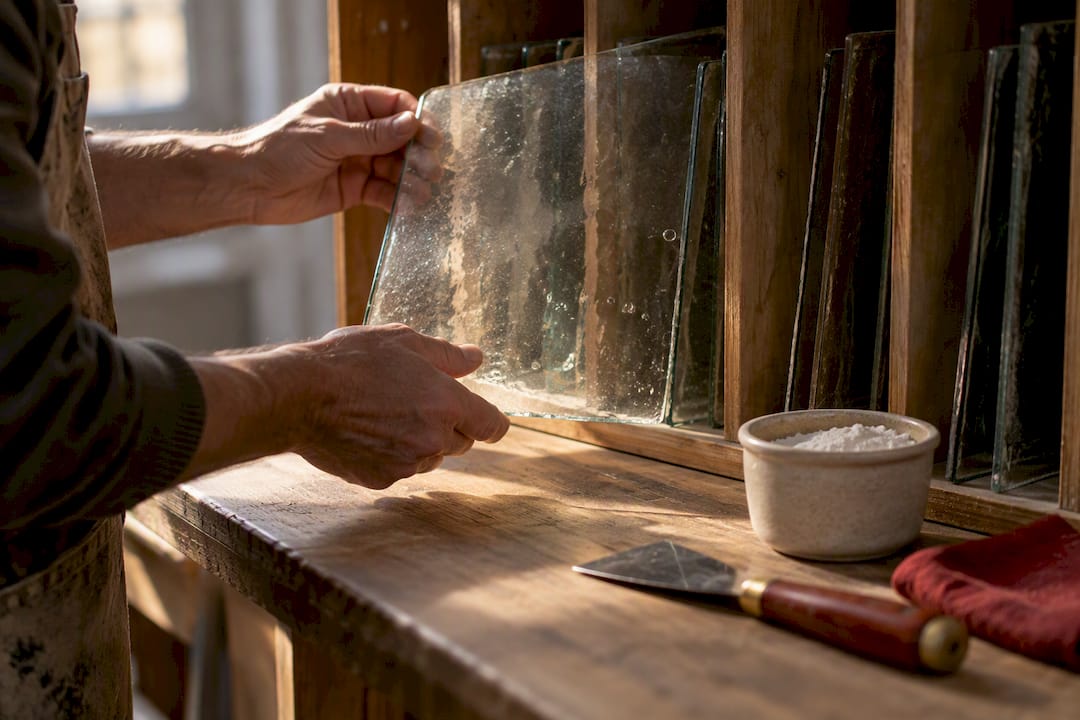
Cleanup is straightforward: whiting powder lifts oily residue from glass, and mineral spirits clean tools before the putty sets. Salvaged old glass, with its faint waves and bubbles, is worth keeping aside for reuse in other sash rather than discarding it with the debris.
Common mistakes, troubleshooting, and quick fixes
Most glazing failures trace back to a handful of repeatable errors, and most are avoidable once you know what to watch for.
- Skipping the back-bed. Glass set directly on bare wood without a bedding layer lets condensation soak into the rabbet, and rot follows even when the exterior bead looks intact.
- Using an interior compound outdoors. A putty formulated for shop conditions can crack or shrink prematurely when exposed to weather it was never designed to handle.
- Spacing points too far apart. Loose glass shifts as the putty cures, opening hairline gaps along the bead.
- Painting before the skin forms. Trapped moisture beneath fresh paint accelerates the very decay the glazing was meant to prevent.
Small voids or a cracked bead section can usually be cut back and repacked without disturbing the whole pane. If the same window keeps failing within a season or two despite correct technique, the problem is often not the putty at all. Sash movement from a swollen or shrinking frame, or a joint that has opened at the corner, will keep breaking the glazing seal until the underlying structural issue is addressed.
Perspective from Gepetto Millworks: planning, documentation, and when to hire a pro
On any project involving more than a handful of windows, the paperwork matters as much as the putty knife. Restorers commonly build a window schedule alongside a photographic record for every opening, a practice that keeps repairs consistent across a whole facade and prevents the same defect from being diagnosed twice. That level of planning is where a full-shop restoration starts to make more sense than in-place patching, particularly on structurally compromised sash. Readers weighing that decision can browse Gepetto Millworks’ restoration projects for a sense of what shop-based work involves.
The gap between what glazing promises and what it actually delivers
The conventional advice on this subject treats glazing as a cosmetic finishing step, something you do after the real repairs are finished. That framing gets the priority backward. The bedding layer under the glass, the part nobody sees once the sash is painted, does more to determine whether a window survives another fifty years than the visible bevel of the face putty ever will. A tidy exterior bead over a bare rabbet is a failure waiting on the next humid summer.
The other overrated idea is that reglazing is either trivial or impossible, with no middle ground. In practice, most competent DIYers can manage inspection, prep, and reglazing on sound sash. What they underestimate is compound selection: treating all glazing putty as interchangeable, when shop-cured and weather-exposed work call for genuinely different formulations. Get the back-bed and the compound right, and the visible tooling technique matters far less than most guides suggest.
— Gepetto
How Gepetto Millworks can help with historic window restoration
When a sash has gone past what a putty knife and patience can fix, split rails, rotted corners, or glazing that keeps failing no matter the compound, that is the point to call in a shop built for it. Specialized restoration shops handle historic window restoration and custom millwork for projects that exceed the scope of a weekend repair, including full sash rebuilding and replication that meets standards for historic tax credit eligibility.
A professional estimate typically starts with an on-site assessment, a window schedule documenting each opening, and a repair plan that separates what can be reglazed from what needs shop rebuilding.
- On-site condition survey of each window opening.
- A written repair plan distinguishing in-place work from shop restoration.
- Replication matched to original profiles to meet eligibility for historic tax credit.
Visit Gepetto Millworks’ Historic Window Restoration page to see project examples and request an estimate.
Sources
For deeper guidance, consult the EPA’s lead-safe renovation rule, the National Park Service’s wood window repair brief, and the Window Preservation Alliance for trade resources and local support.
FAQ
How do you glaze an old window?
Clean the rabbet of old putty and paint, prime bare wood, then back-bed the glass with a thin putty layer before setting it. Secure the pane with glazing points spaced every 6 to 8 inches, then pack and tool the face putty into a beveled, weather-shedding line, as described in Fine Homebuilding’s glazing workflow.
Is reglazing old windows worth it?
Reglazing is generally worth it when the sash itself is structurally sound, since it preserves original wood that modern lumber cannot replicate and, paired with storm windows, can match the performance of new units according to the National Park Service. It also avoids the recurring cost of replacing low-quality units multiple times over a building’s life.
How much does historic window restoration cost?
Cost depends on the scope of repair, from simple in-place reglazing to full sash rebuilding, and pricing for professional work such as Gepetto Millworks’ restoration services is provided after an on-site assessment. There is no single published rate, since material condition and the number of openings both affect the estimate.
What were old windows coated with?
Historic sash were typically painted with oil-based paints and sealed with linseed oil putty, a compound still used in preservation work today. Modern formulations such as Sarco DualGlaze build on that same linseed and soy oil base while meeting current federal specifications for exterior durability.
Recommended
by Matthew Wiley | Sep 30, 2026 | Architectural Millwork
Millwork choices, whether a window sash is repaired or replaced, and whether the shop drawings and sample mockups accompanying that decision meet federal expectations, are among the most decisive factors in HPCA Part 2 acceptance and, by extension, West Virginia credit eligibility. The governing rule is repair first: when a historic window, door, or piece of trim can be stabilized rather than discarded, the Secretary of the Interior’s Standards for Rehabilitation expect that path. When repair truly is not feasible, the replacement must match the original’s design and visual character, and that claim must be proven on paper before a reviewer ever sees the finished work.
TL;DR:
- Meeting detailed measured drawings, photographs, and shop mockups early helps ensure compliance and prevents rejection of certification applications.
- Replacement windows require documented evidence that repair is unfeasible and must match the original profiles exactly, supported by photographic and technical proof.
- A single mismatch or poorly documented feature can jeopardize the entire project’s federal certification and tax credits under the cumulative effect standard.
- Involving a specialized millwork firm during design rather than after demolition allows for accurate field measurements, profile samples, and better review readiness.
- Relying solely on catalog cut sheets or ordering replacement before documentation can result in rejected submissions and certification delays.
Gepettomillworks
Plan Historic Millwork With Confidence
Gepettomillworks creates custom millwork for historic building projects, supporting careful decisions about original details and replacement work.
Explore custom millwork
Table of Contents
Why millwork decisions carry so much certification risk
Two provisions within the Standards do most of the work here. Standard 2 calls for the preservation of distinctive materials and craftsmanship, while Standard 6 governs deteriorated features specifically: repair rather than replace whenever practical, and when replacement becomes necessary, match the old in design, color, texture, and other visual qualities, substantiated by physical, documentary, or pictorial evidence. These are not abstractions for a courthouse in Wheeling or a commercial block in Charleston. They are the yardstick a reviewer applies window by window, door by door.
What makes millwork uniquely risky is the cumulative effect standard: the National Park Service evaluates a project’s rehabilitation work as a whole, and a single feature that fails to conform can jeopardize certification for the entire building, not just that feature.
- A courthouse renovation can restore masonry, roofing, and interior plaster flawlessly and still face denial over mismatched sash profiles.
- Early SHPO and NPS consultation on millwork proposals catches conflicts before construction, not after.
- A denial affects the full rehabilitation tax credit, not a line item.
A recent NPS appeal decision involving 222 Lake Avenue affirmed a denial of certification because replacement windows failed to match the historic originals, despite an otherwise successful redevelopment. That outcome illustrates how one nonconforming window line can undo months of otherwise compliant work.
Documentation you must include in HPCA Part 2 for millwork
Reviewers assessing a West Virginia rehabilitation project need to see, on paper, exactly what existed and exactly what is proposed. NPS guidance on windows documentation for replacement is explicit that manufacturer cut sheets are generally inadequate, since they omit the custom profile and joinery detail a reviewer needs to judge conformance.
A Part 2 submission covering millwork should include:
- Measured elevation drawings of existing conditions, keyed to each opening or unit.
- Full-scale section drawings showing muntin, mullion, sash, and molding profiles for both existing and proposed work.
- Photographs documenting current condition, deterioration, and any features already lost.
- Physical, documentary, or pictorial evidence supporting any proposed replacement.
- Shop drawings and finish mockups submitted early enough for SHPO and NPS review before fabrication begins.
Beyond the drawing set, a few supporting materials strengthen the file:
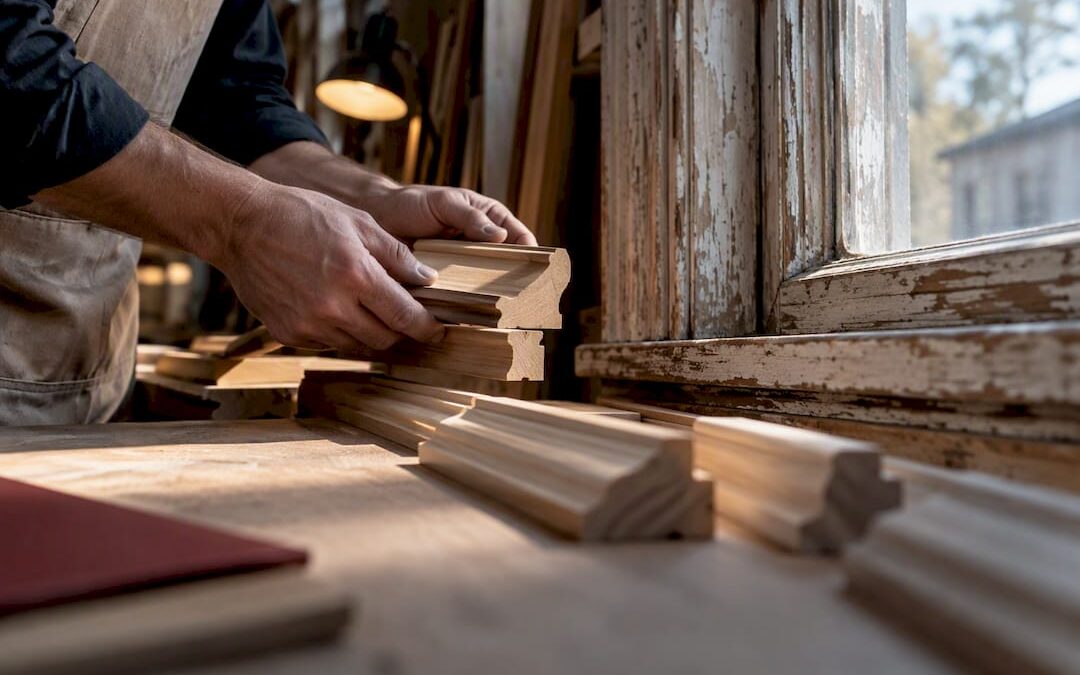
- Sample profile cuttings that let a reviewer handle the proposed molding alongside a photograph of the original.
- Written condition notes tying each photograph to a specific repair or replacement decision.
- A brief narrative connecting the drawings to the applicable Standard, rather than leaving the reviewer to infer the reasoning.
Architects who treat this as a drafting exercise rather than an evidentiary one tend to submit the least persuasive files. The goal is not to describe the work; it is to prove, feature by feature, that the work satisfies Standard 6 before anyone picks up a chisel.
Repair versus replacement: a field checklist for millwork decisions
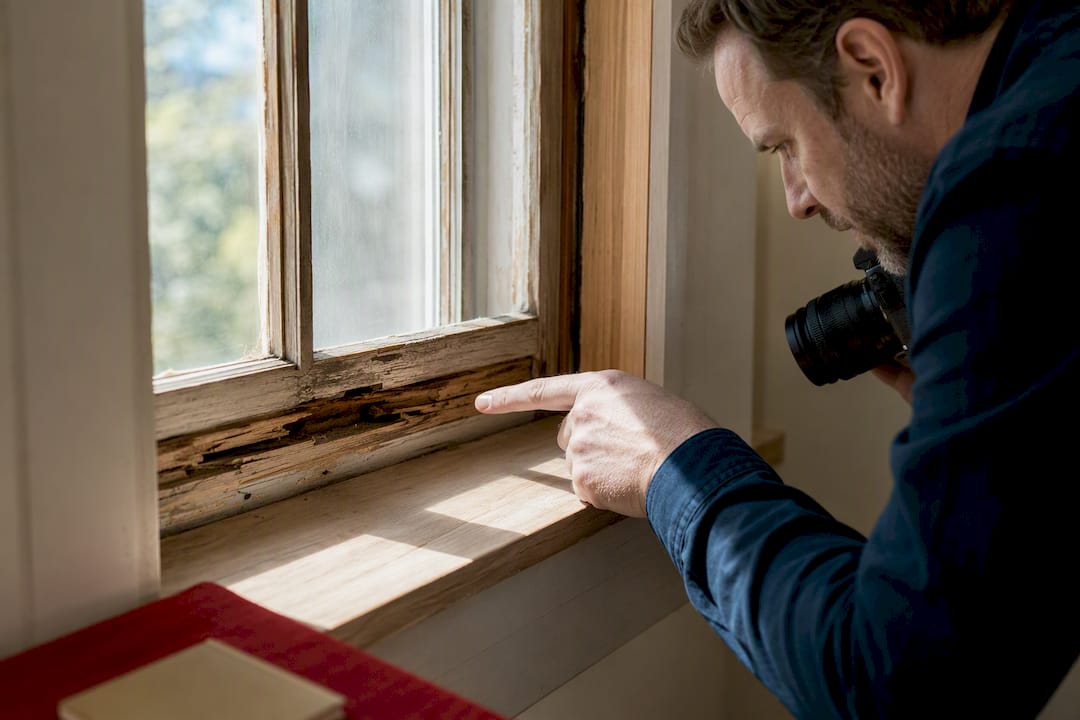
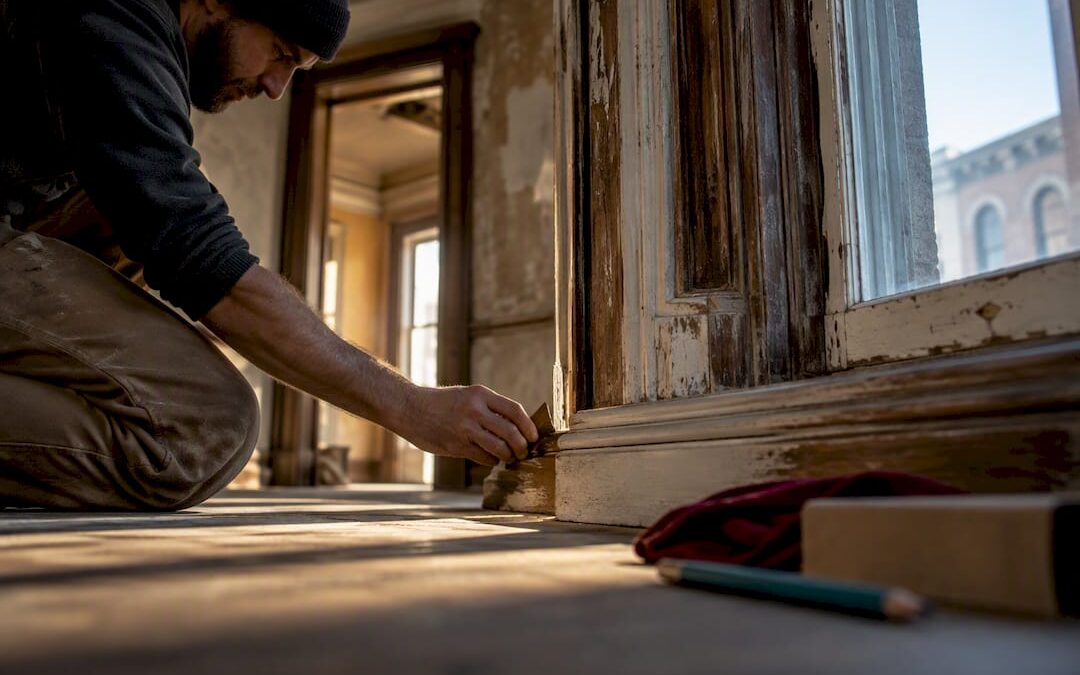
The on-site assessment should happen before a single specification is written. Measure existing profiles with a contour gauge, photograph every face of deteriorated wood, and pull a small sample where rot is suspected so that a millwork shop can assess salvageable stock.
Preservation Brief 9 lays out the repair hierarchy that most West Virginia projects should follow before reaching for wholesale replacement:
- Consolidate sound wood with epoxy where surface deterioration has not compromised structural integrity.
- Splice new wood into a damaged rail or stile rather than discarding the entire sash.
- Replace only the failed component, a sill horn or a single muntin, rather than the whole unit.
- Reserve full sash or door replacement for cases where physical evidence shows repair is genuinely impractical.
Scale matters to the decision. A single Victorian farmhouse window might justify hand-fitted splicing because the labor-to-material ratio favors repair. A commercial block with forty matching openings changes the math: custom knives ground to match the original profile become cost-effective once the setup expense is spread across a full run, an economy of scale Preservation Brief 9 notes directly.
When replacement is the honest answer, the Part 2 narrative should say so plainly and specifically: “The original sash exhibits advanced rot in the lower rail and sill, documented in Photos 4 through 7, and Gepetto Millworks’ shop assessment see internal restoration guidance confirmed repair would not restore structural function; the replacement profile matches the surviving upper sash exactly, per the attached section drawing.”
Pro Tip: Photograph the failure mode, not just the failure, so the Part 2 reviewer sees why repair was ruled out rather than assumed impossible.
Working with a specialized millwork firm: deliverables that satisfy Part 2
A subcontract scope written loosely around “replica windows” invites exactly the kind of vague submission reviewers reject. The scope of work should name each deliverable and tie it to a review checkpoint.
- Field-measured drawings of every existing opening, taken before demolition.
- Full-scale shop section drawings and custom profile knives matched to the historic molding.
- A finish and glazing mockup submitted for SHPO and NPS comment before production begins.
- Performance test reports, air infiltration or structural pressure testing on wooden windows, documented separately from the appearance record so durability claims never get confused with visual conformance.
| Phase |
Deliverable |
Checkpoint |
| Field survey |
Measured drawings, photographs |
Confirms existing profiles before demolition |
| Sample mockup |
Physical profile sample, finish sample |
SHPO and NPS informal review |
| Shop drawings |
Full-scale sections, elevations |
Attached to Part 2 submission |
| Fabrication |
Test reports, final inspection photos |
Closeout documentation for Part 3 |
Where fire codes or accessibility requirements conflict with retaining an original door or window assembly, NPS technical guidance on retaining corridor features points toward compatibility treatments, concealed fire-rated backing or sealed glazing units built behind an unaltered historic face, documented with mockups and test data rather than resolved through wholesale removal.
A practitioner’s view on where millwork submissions go wrong
Four patterns recur across the projects that stumble. Millwork gets specified last, after masonry and mechanical scopes are already locked, leaving no time for profile matching. Drawing sets rely on catalog cut sheets instead of measured sections. Replacement sash gets ordered before anyone photographs what it is replacing. And sample profiles arrive at the SHPO desk without the condition photographs that justify the decision to replace at all.
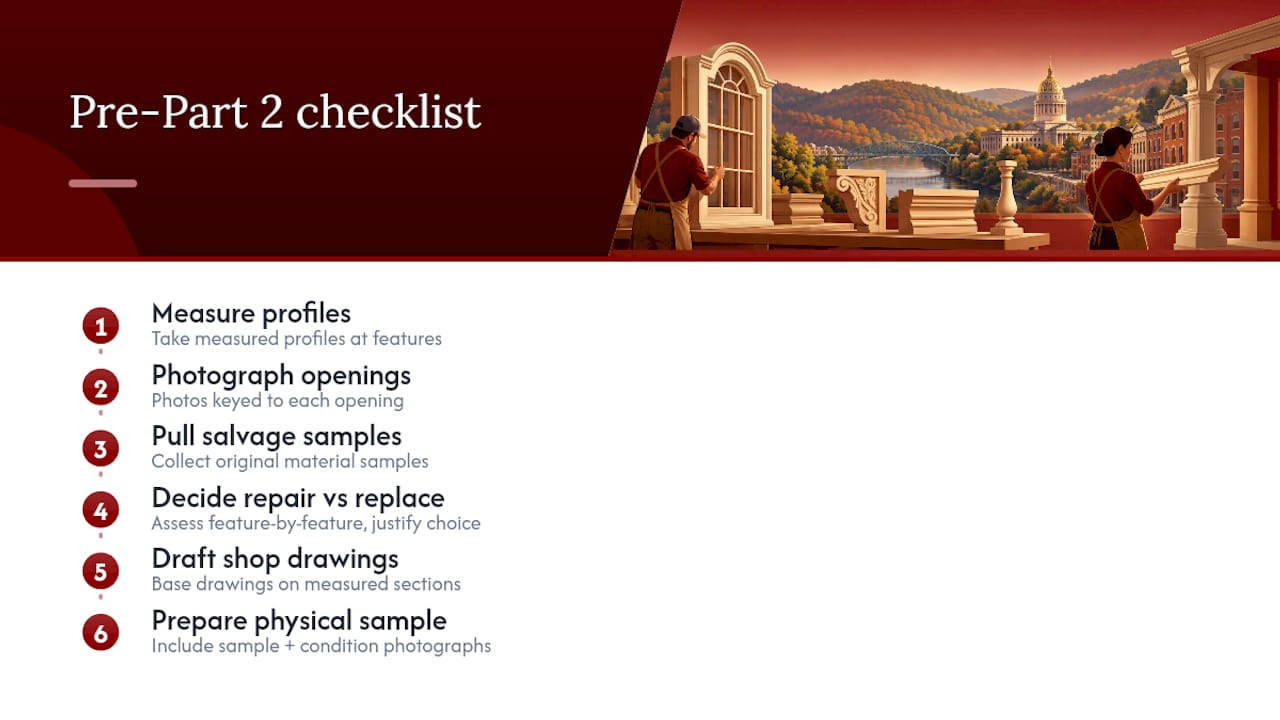
Before filing Part 2, walk the building with a checklist: measured profiles taken, photographs keyed to each opening, salvage samples pulled, repair versus replacement decided feature by feature, a shop drawing set drafted from those measurements, and a physical sample ready for review. Projects that build in mockups and test documentation early rarely face the kind of appeal that undoes an otherwise sound rehabilitation.
— Gepetto
How Gepetto Millworks supports West Virginia rehabilitation projects
A West Virginia rehabilitation moves faster when the millwork subcontractor is brought in during design, not after demolition. Gepetto Millworks works from measured field surveys to produce the shop drawings, profile samples, and finish mockups that a Part 2 submission needs, work that spans historic window restoration, custom replica sash through the Wooden Windows line, and matched doors, casework, and staircases through the firm’s broader custom fabrication services.
When you reach out, come with a starting scope: existing conditions to be surveyed, the profiles you expect to replicate, and the timeline your Part 2 filing is built around.
- Request a field-measured survey before any sash or door leaves the building.
- Ask for a physical profile sample and finish mockup before full production begins.
- Confirm a shop-drawing delivery date that leaves room for SHPO review before fabrication.
Reach Gepetto Millworks through the historic window restoration page to start that conversation.
Keep these on hand while drafting Part 2: the Secretary of the Interior’s Standards for Rehabilitation, the windows documentation guidance, and Preservation Brief 9 for repair technique. For the state side, West Virginia’s Schedule RBIC explains how the state credit ties to federal certification, and the state’s Division of Culture and History is the appropriate first call for SHPO coordination.
FAQ
Can I replace a historic window instead of repairing it?
Only when physical evidence shows repair is genuinely impractical, and the replacement must match the original in design, material, and visual detail. The Secretary of the Interior’s Standards treat repair as the default, so the case for replacement needs documentation, not just a preference.
What drawings does HPCA Part 2 require for millwork?
Reviewers expect measured elevation drawings and full-scale section drawings showing profiles and joinery for both existing and proposed millwork. According to NPS windows documentation guidance, manufacturer cut sheets alone are generally not sufficient evidence.
Can one mismatched window jeopardize an entire tax credit project?
Yes. Under the cumulative effect standard, NPS reviews a rehabilitation’s work as a whole, so a single nonconforming feature can affect certification for the full project rather than just that item.
When should I bring in a millwork subcontractor on a historic project?
Bring in a specialized millwork firm during design, before demolition, so field measurements and profile samples can be taken from the original fabric. Early engagement gives time for shop drawings and mockups to clear SHPO review before fabrication starts.
Does West Virginia’s state credit require federal certification first?
West Virginia’s Historic Rehabilitated Buildings Investment Credit is tied to federal certification, so the Part 2 and Part 3 process described in this guidance applies directly. Details on the state credit are outlined in Schedule RBIC.
Recommended
by Matthew Wiley | Sep 30, 2026 | Architectural Millwork
South Carolina property owners rehabilitating a historic structure may draw on the federal 20% rehabilitation credit for income-producing buildings and, at the state level, a 25% homeowner credit or a 10% (or optional 25%) credit for income-producing projects, the latter capped at $1 million per certified structure. The prudent first step, before a single wall is opened or a window removed, is to contact the South Carolina Department of Archives and History and begin assembling the Historic Preservation Certification Application.
TL;DR:
- The federal rehabilitation credit applies only to income-producing historic buildings, offering a 20% credit, with claims spread over multiple years.
- South Carolina’s owner-occupied homes qualify for a 25% state credit, but only if at least $15,000 is spent within 36 months, and this is claimed over three years.
- Income-producing projects can choose between a 10% or an optional 25% state credit, with the latter capped at $1 million per certified structure.
- Proper allocation of expenses between historic preservation and unrelated upgrades is essential to avoid disqualification or audits.
- Meeting the Secretary of the Interior’s Standards is critical, as even minor deviations can lead to certification denial or recapture of claimed credits.
Gepettomillworks
Preserve Historic Character With Custom Millwork
Gepettomillworks creates custom millwork for historic building projects, supporting careful rehabilitation by architects, owners, and restoration professionals.
Explore custom millwork
Table of Contents
At a glance: which credits apply and who qualifies
The federal and state historic tax credit programs serve overlapping but distinct populations, and matching the right credit to the right project saves both time and money.
- The federal credit offers a 20% rehabilitation tax credit for income-producing historic buildings, such as rental properties, offices, or commercial structures generating income.
- South Carolina’s homeowner credit provides a 25% state credit for owner-occupied historic residences, contingent on spending at least $15,000 within a 36-month period.
- Income-producing projects in South Carolina may instead choose a 10% state credit or an optional 25%, though the 25% option is capped at $1 million per certified historic structure.
- Local governments may also offer special property tax assessments, commonly called Bailey Bill programs, and preservation easements can carry their own tax benefits, both of which operate alongside, not instead of, the state and federal credits.
Each program has its own paperwork, its own review body, and its own tolerance for how much of the building’s historic fabric must survive the process intact.
How eligibility diverges between homeowners and income-producing projects
The line between the homeowner credit and the income-producing credits is not simply about who lives in the building. It is about spending thresholds, review pathways, and how mixed-use structures get divided on paper before they are divided by a contractor’s crew.
- Homeowners must spend at least $15,000 on qualifying rehabilitation within a 36-month window, while income-producing projects generally face a substantial rehabilitation test tied to the building’s adjusted basis.
- Listed status matters differently depending on the path: income-producing projects submit through the full HPCA process with SHPO and National Park Service review, while homeowner applications are reviewed by SHPO alone.
- Mixed-use buildings, such as a structure with ground-floor retail and upstairs apartments, can sometimes use both programs concurrently, provided expenses are allocated clearly between the income-producing and owner-occupied portions.
Getting this allocation wrong early tends to cause more delay than any single construction decision later in the project.
Filing the HPCA: what happens at each stage
The Historic Preservation Certification Application, known as the HPCA, is the backbone of both the federal credit and the state income-producing credit, and it unfolds in three distinct parts that correspond to different moments in the project’s life.
- Part 1 documents the building’s historic significance, establishing that it qualifies as a certified historic structure.
- Part 2 describes the proposed rehabilitation work in detail, submitted before construction begins so SHPO and the National Park Service can weigh in on the plan.
- Part 3 documents the completed work, including photographs and final costs, and is required before the rehabilitation can be certified.
Income-producing applications move through an electronic HPCA system with NPS review built into the process, while homeowner applications typically follow a SHPO-only path that may still involve hard-copy submissions.
Parts 1 and 2 are generally reviewed within 60 days of a completed submission, split roughly evenly between the state’s 30-day review and the federal government’s 30-day review. That timeline assumes the application arrives complete. Starting construction before Part 2 approval carries real risk for income-producing projects and will disqualify a homeowner application outright. One further note for anyone filing soon: SCDAH has suspended preliminary and final review fees for applications received during fiscal year 2025 to 2026, running July 1, 2025 through June 30, 2026.
The financial mechanics: percentages, installments, and caps
Understanding how these credits are actually claimed, rather than simply which percentage applies, determines how a project gets financed and when the benefit shows up on a tax return.
- The federal 20% credit for income-producing properties is generally claimed in equal annual installments over several years.
- South Carolina’s 25% homeowner credit is claimed differently: it is taken in equal installments over three years, filed via Form TC-22, with unused portions carried forward according to state rules.
- The income-producing state credit’s 25% option is capped at $1 million per certified historic structure, which matters most on large adaptive reuse projects where qualified expenses could otherwise push the credit well past that ceiling.
- Because credits offset tax liability rather than generate a refund outright in most cases, owners with lighter tax burdens should plan the installment schedule against their expected liability in each of the claim years.
A project’s financing plan should treat these credits as a multi-year cash flow event, not a lump sum arriving the year the paint dries.
Preservation standards, common mistakes, and red flags
Every certified rehabilitation, whether homeowner or income-producing, is measured against the Secretary of the Interior’s Standards for Rehabilitation, which govern methods and materials across the interior, exterior, and site. Failing to meet the Standards on even one significant element can jeopardize certification for the entire project, not just the offending piece.
The most common disqualifying mistakes are avoidable. Homeowners sometimes begin work before SHPO approval, which forfeits the credit regardless of how sensitively the work was done. Others install incompatible replacement windows or doors, keep insufficient documentation of costs and materials, or fail to separate eligible rehabilitation expenses from unrelated upgrades. Early consultation with SHPO, meticulous cost records, and contractors experienced in historic work all reduce these risks substantially.
Pro Tip: Photograph every stage of demolition and construction, not just the finished result. Part 3 review depends heavily on before-and-after documentation.
What restoration contractors bring to a certification review
The Standards are ultimately judged on physical evidence, and the millwork trades often supply the details that make or break a Part 3 review. Historically accurate window sashes, matched muntin profiles, and doors replicated from original hardware and dimensions demonstrate the kind of fidelity SHPO and NPS reviewers look for, especially on facades where a single mismatched sash can raise questions about the whole project.
Contractors who work regularly on historic structures tend to deliver a specific set of documentation alongside the finished product:
- Detailed material specifications tying each element to a historic precedent or salvaged original.
- Shop drawings keyed to the building’s original profiles and dimensions.
- Before, during, and after photographs organized by location and phase of work.
- Change orders and a cost ledger separating eligible rehabilitation expenses from unrelated work.
Gepetto Millworks builds this kind of record into projects involving historic window restoration and custom replication of historic doors, work that gives owners and their tax preparers a paper trail consistent with what SHPO reviewers expect to see. Photo documentation from past restoration projects illustrates the kind of before-and-after evidence Part 3 submissions require.
What happens when a project falls out of compliance
The consequences of an improperly claimed or non-compliant historic tax credit extend well beyond a denied application. If a project fails to meet the Secretary of the Interior’s Standards, NPS review can withhold certification for the entire rehabilitation, not merely the noncompliant portion, which means the owner loses the credit on qualified work that was done correctly alongside work that was not.
For income-producing projects, credits already claimed can be subject to recapture if the property is sold or ceases to qualify within a set period after the work is certified, effectively clawing back the tax benefit years after it was taken. For homeowners, starting construction before SHPO approves Part 2 forfeits eligibility outright, regardless of the quality of the finished work. Misallocating expenses between eligible rehabilitation costs and ineligible new construction or personal upgrades can also trigger a reduced credit or an audit inquiry from the South Carolina Department of Revenue.
The safest posture is treating the certification process as a binding commitment rather than a formality to satisfy after the fact. Owners who document decisions as they are made, keep contractors informed of what the Standards require, and resist the urge to swap in modern materials for convenience tend to avoid these penalties entirely. Those who do not risk losing a credit that, in many cases, was the financial reason the rehabilitation made sense in the first place.
Building a documentation trail SHPO and NPS will accept
Reviewers cannot certify what they cannot see, and the burden of proof rests entirely with the owner. A rehabilitation that meets every standard in practice but lacks documentation is, for certification purposes, indistinguishable from one that does not meet the standards at all.
The strongest documentation packages share a few habits. They photograph the building comprehensively before any demolition begins, capturing details like trim profiles, hardware, and glazing patterns that reviewers will later compare against the finished work. They maintain a running log of materials and methods, noting where original fabric was retained, repaired, or, when necessary, replaced in kind. They keep shop drawings and material specifications for any custom fabrication, since these documents demonstrate that replacement elements match historic precedent rather than approximate it.
Cost records deserve equal attention. Separating eligible rehabilitation expenses from unrelated upgrades in real time, rather than reconstructing the split at tax time, prevents disputes later with either SHPO or the South Carolina Department of Revenue. Owners working with contractors experienced in historic restoration often find this documentation habit is built into the workflow already, since the same photographs and drawings that support a smooth Part 3 submission also protect the contractor against disputes over scope and change orders.
Claiming these credits requires coordination between the certification process and the actual tax filing, and the two run on separate tracks that eventually need to meet.
For the federal 20% credit, the certified rehabilitation must be reflected on the owner’s federal tax return following IRS procedures for the rehabilitation credit, with certification from the National Park Service serving as the necessary proof that the work qualifies. For South Carolina’s homeowner credit, Form TC-22 is filed with the South Carolina Department of Revenue, claiming the 25% credit in equal installments across three years once SHPO has certified the completed work. Income-producing projects claiming the state’s 10% or optional 25% credit file through comparable state procedures tied to their SHPO certification.
None of these filings happen in isolation from the certification timeline. A homeowner cannot file Form TC-22 claiming a credit for work that SHPO has not yet certified, and an income-producing project cannot claim the federal credit without the NPS certification that follows a completed Part 3 submission. Owners should coordinate with a tax advisor familiar with South Carolina’s specific forms well before the rehabilitation is finished, since the certification and the filing deadline do not always align neatly with a calendar tax year.
Who and what actually qualifies for these programs
Eligibility hinges on both the property and the owner’s intended use of it, and the two programs draw the line differently.
For the federal credit, the building must be a certified historic structure, meaning it is individually listed on the National Register of Historic Places or located in a registered historic district and certified as contributing to that district’s significance. The building must also be income-producing, which excludes a primary residence unless a portion is rented or used commercially. For South Carolina’s income-producing credit, the same certified structure standard generally applies, layered on top of the federal eligibility framework.
The homeowner credit, by contrast, is built for owner-occupied residences. The property must be a certified historic structure under the same listing standards, but the qualifying spend threshold, at least $15,000 within 36 months, replaces the substantial rehabilitation test used for income-producing projects. In both cases, the owner bears responsibility for ensuring the property’s listed or contributing status is confirmed with SHPO before assuming the credit applies, since a building’s historic reputation locally does not always translate into the formal certification these programs require.
Combining federal and state credits on the same project
For income-producing properties, the federal and South Carolina credits are designed to work together rather than compete. An owner completing a certified rehabilitation can claim the federal 20% credit and, on the same project, elect either the state’s 10% credit or its optional 25% credit, subject to the $1 million cap on the 25% option. Stacking these credits is one of the more significant financial advantages available to developers taking on adaptive reuse of historic commercial buildings in South Carolina.
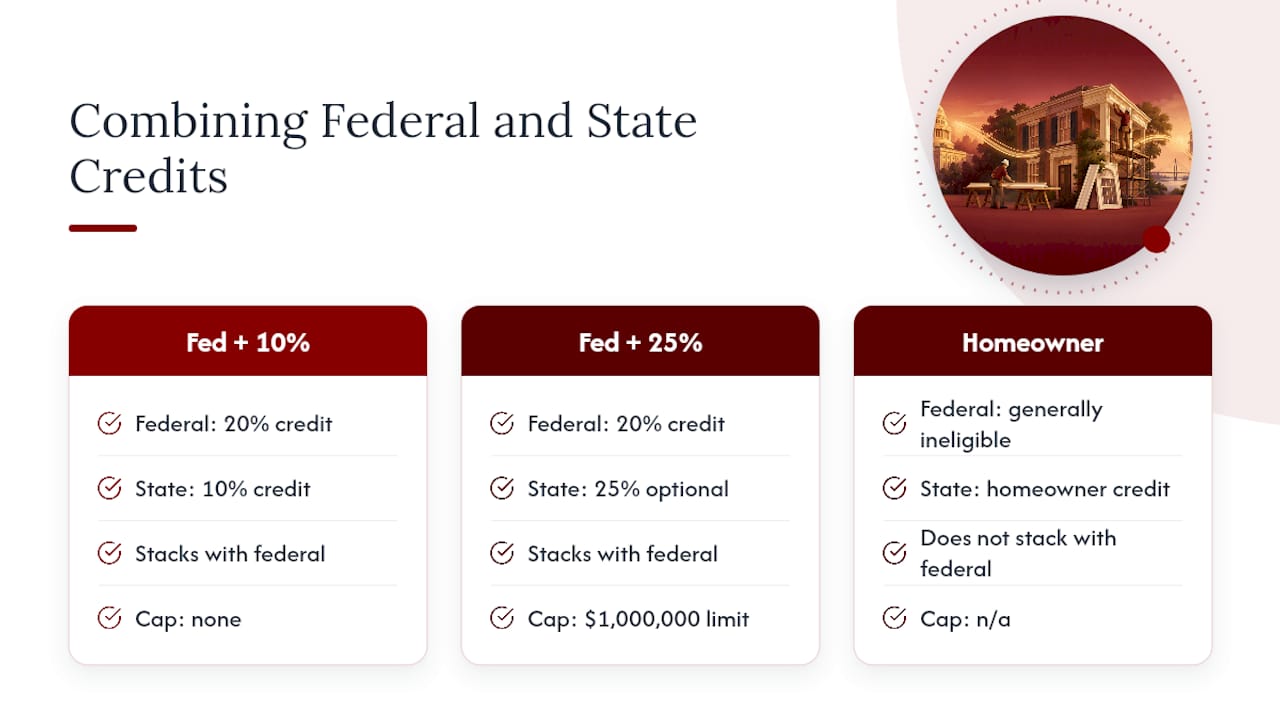
The homeowner credit does not stack with the federal credit in the same way, since the federal 20% credit is reserved for income-producing property and most owner-occupied homes do not qualify as income-producing. An owner who rents out part of a historic residence while occupying the rest may find that expenses need to be allocated between the two uses, with income-producing portions potentially eligible for federal treatment and owner-occupied portions following the state homeowner path. Getting this allocation right, ideally with guidance from both SHPO and a tax professional before construction begins, prevents a project from losing eligibility on either side of the split.
What counts as a qualifying rehabilitation expense
Not every dollar spent on a historic property counts toward these credits, and understanding the boundary matters as much as understanding the percentages.
Qualifying expenses generally include costs directly tied to rehabilitating the historic structure itself: structural repairs, roof replacement, restoration of windows and doors, plaster and masonry repair, and mechanical, electrical, and plumbing upgrades necessary to make the building usable. Architectural and engineering fees connected to the rehabilitation typically qualify as well. Costs for a new addition, site work like landscaping or new parking, and personal property such as furniture generally do not qualify, since the credits are built to reward preservation of the existing historic fabric rather than expansion beyond it.
Millwork and finish carpentry sit squarely within qualifying territory when the work restores or replicates historic elements rather than substituting generic modern stock. Custom wooden windows, replicated solid wood entry doors, and matched trim or casework all fall under rehabilitation expenses when they preserve the building’s documented historic character, provided the costs are separated clearly from any unrelated new construction happening on the same site. Owners planning a rehabilitation budget should build this distinction into their contracts from the start, since a single lump-sum invoice covering both eligible and ineligible work creates unnecessary friction during a Part 3 review.
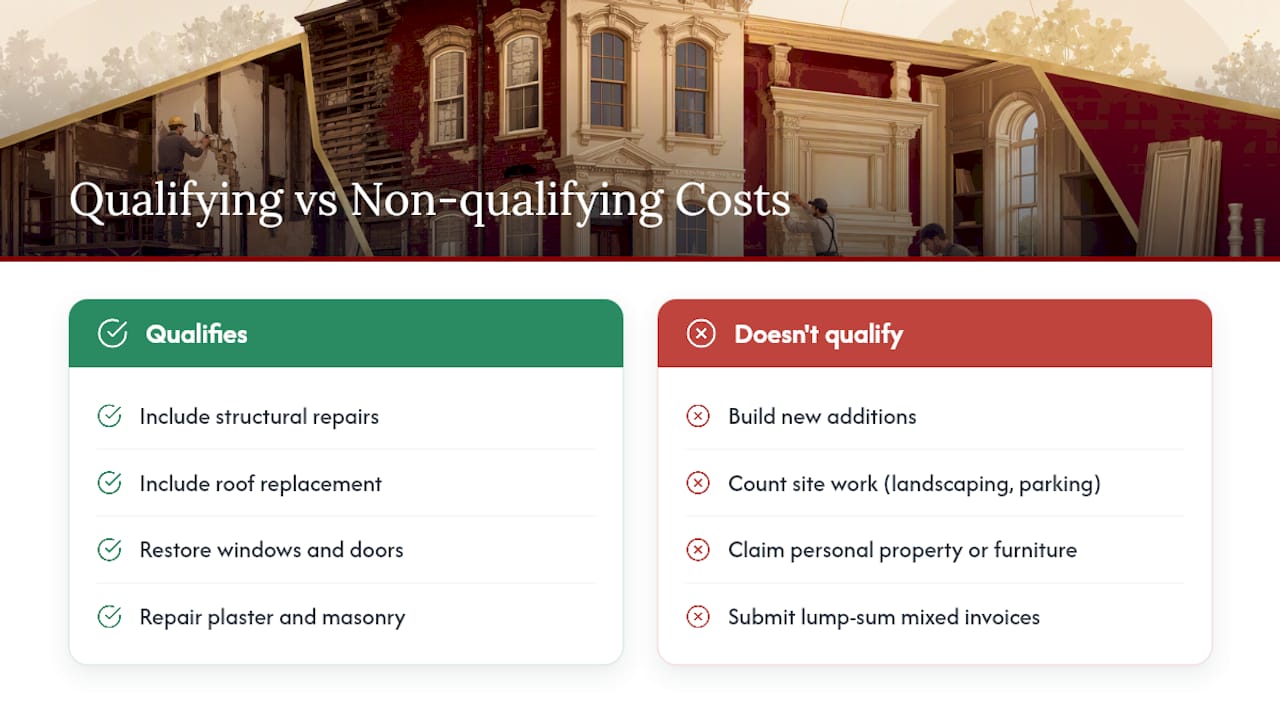
Getting organized early saves months of back-and-forth later. The essential resources sit across three agencies, each responsible for a different part of the process.
- Start with SCDAH’s income-producing program page or its homeowner program page to confirm which credit fits the property.
- Review the NPS application process guidance for the specifics of Parts 1 through 3 before drafting the HPCA.
- Download and review Form TC-22 from the South Carolina Department of Revenue if pursuing the homeowner credit.
- Assemble Part 1 materials, contact SHPO directly, consult a tax advisor familiar with South Carolina’s programs, and set a realistic completion schedule before committing to a start date.
What this process actually rewards, and what it does not
The conventional advice on historic tax credits treats the paperwork as a formality standing between an owner and a check. That framing undersells what the review process is actually built to protect. SHPO and NPS reviewers are not grading intentions. They are grading whether the physical building, down to its window profiles and trim details, still reads as historic after the work is done. A project can be beautifully renovated and still fail certification if the replacement elements do not match what was there before.
What gets underestimated most is the role of the contractor selection made in the earliest weeks of planning, long before Part 2 is submitted. Owners who bring in fabricators capable of matching historic profiles from the outset rarely struggle with Part 3 documentation, because the evidence builds itself as the work proceeds. Owners who choose convenience first, then try to retrofit compliance later, are the ones who end up disputing a denial. The single highest-leverage decision in this entire process is choosing who swings the hammer, not which credit percentage to elect.
— Gepetto
Ready to make your rehabilitation credit-eligible
Choosing the right tax credit is only half the equation. The other half is whether the finished building actually satisfies the Secretary of the Interior’s Standards well enough for SHPO and NPS to certify it, and that outcome depends heavily on the millwork, windows, and doors that define a historic building’s character. Some fabricators specialize in custom design, fabrication, and restoration of wood windows, doors, trim, and staircases for historic buildings, replicating period details that align with certification review expectations.
Whether the project calls for historic window restoration, custom-fabricated shutters, entry doors, or casework, or a full custom kitchen build inside a certified historic structure, having a fabricator who understands both the craft and the documentation reviewers expect removes one of the biggest sources of risk in the entire process. Get in touch to discuss your South Carolina rehabilitation project and start planning the millwork that will carry your HPCA submission through review.
Sources
FAQ
How does a historic tax credit work?
A historic tax credit reduces the amount of tax an owner owes, based on a percentage of qualifying rehabilitation expenses spent restoring a certified historic building. In South Carolina, the federal credit offers 20% for income-producing properties, while state credits add either a homeowner benefit or an income-producing option on top, both requiring certification from SHPO and, for the federal credit, the National Park Service.
Do you get a property tax break at age 65 in South Carolina?
South Carolina offers a homestead exemption for qualifying homeowners, but that program is separate from the historic tax credits discussed here and is administered through local county assessors rather than SHPO or the state’s historic preservation programs. Homeowners should check with their county assessor’s office for the specific eligibility rules and application process for that exemption.
What is the Exceptional SC tax credit and how can I claim it?
Owners looking for the correct program should start with SCDAH’s tax incentives overview to confirm which credit applies to their project.
What tax credits are available in South Carolina?
South Carolina property owners can access the federal 20% rehabilitation credit for income-producing historic buildings, a state homeowner credit of 25% requiring at least $15,000 in qualifying spend within 36 months, and a state income-producing credit of 10% or an optional 25% capped at $1 million per structure. Local Bailey Bill special assessments and preservation easements can offer additional property tax benefits alongside these credits.
Recommended