
Accoya is radiata pine that has been acetylated, a chemical modification that makes the wood far less absorbent, more dimensionally stable and, by the manufacturer’s testing, Class 1 durable against fungal decay. For custom millwork, that means sills, sashes, doors, trim and shutters that hold their profiles and their joints in exposed positions where untreated softwood would fail first. On a historic building, the material is only half the question: the other half is whether the fabricator can reproduce the original profiles exactly, and that is where we at Gepetto Millworks spend our time, on windows, doors, trim, staircases and casework for period buildings across Virginia and the surrounding region.
TL;DR
- Accoya is acetylated radiata pine: acetyl groups replace water-attracting hydroxyl groups in the cell wall, so the wood absorbs less moisture and swells and shrinks less.
- Accoya USA’s August 2026 limited warranty runs 50 years above ground and 25 years in the ground or in fresh water, against defined material damage from fungal decay or rot.
- It machines like a harder softwood, takes paint and stain, and needs sealed end grain and a stain-blocking primer under white or opaque coatings.
- Left uncoated it weathers to silver gray, at a rate similar to other woods.
- On historic projects, the National Park Service judges a replacement by how well it matches the original in appearance and performance, so profile accuracy matters as much as species.
Table of Contents
- What Accoya is, and why acetylation stops rot
- What the durability rating and warranty actually cover
- Where Accoya fits in custom millwork
- Historic windows and tax-credit projects
- Machining, joinery and fabrication
- Paint, stain and end grain
- Does Accoya turn gray?
- How to specify Accoya for a historic project
- Our perspective
- Bringing the right fabricator in early
- FAQ
- Sources
What Accoya is, and why acetylation stops rot
Wood rots when its moisture content stays high enough for decay fungi to establish. The cell walls of ordinary wood are rich in hydroxyl groups, which attract and hold water. Accoya is produced by chemically modifying radiata pine at a molecular level, replacing those water-attracting hydroxyl groups with acetyl groups. The result is a wood that is less hygroscopic, more stable dimensionally and more resistant to biological attack.
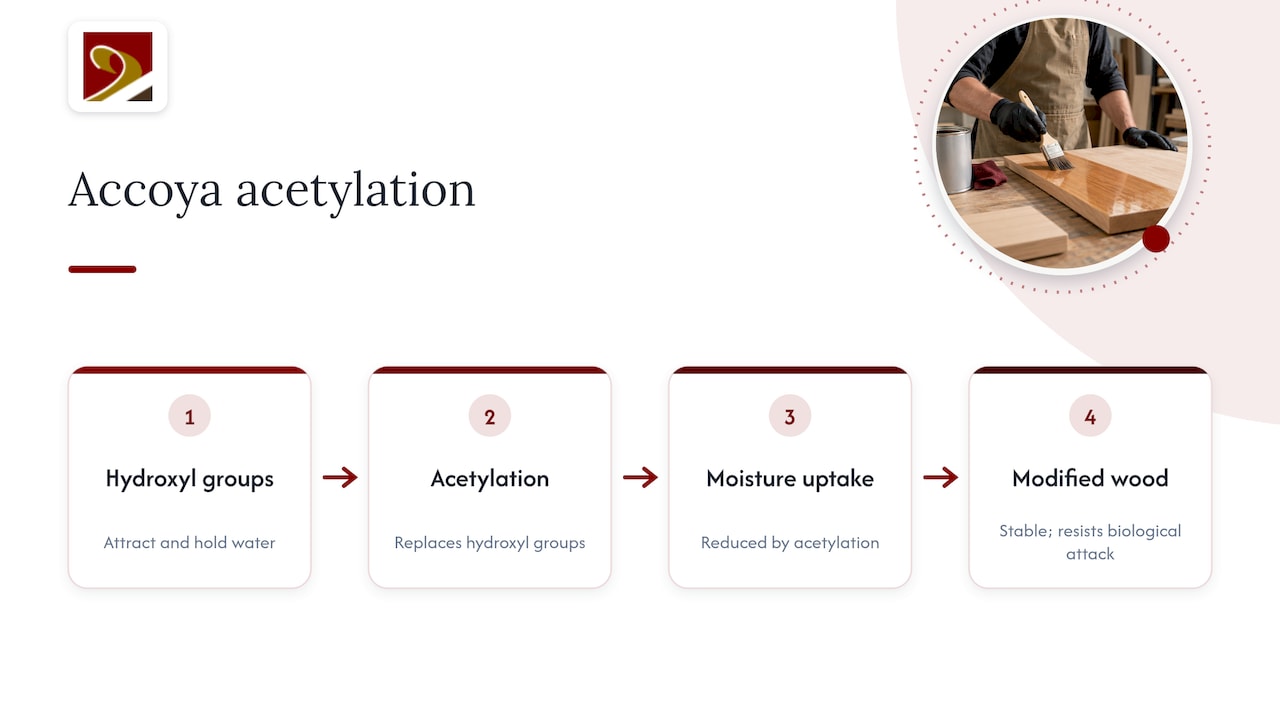
Two consequences matter to a millwork buyer. First, the modification runs through the material rather than sitting in a surface layer, so a freshly cut tenon, a routed profile or a drilled hole exposes the same modified wood as the face of the board. Second, the reduced movement protects coatings and joints as much as it protects the timber, which is why the material is discussed so often in connection with windows and doors.
The feedstock is fast-growing softwood. According to the manufacturer’s US data sheet, Accoya is produced from sustainably sourced wood and carries Cradle to Cradle Gold certification overall, with Platinum in Material Health. The same sheet gives a side Janka hardness of 922 lbf, which places it in the range of a firm softwood rather than a hardwood.
What the durability rating and warranty actually cover
The manufacturer describes Accoya as Class 1 durable, with a 50-year above-ground warranty and a 25-year in-ground or in-water warranty. The legal text matters more than the headline, so read it before you specify. The Accoya USA limited warranty, dated August 2026, covers defined material damage from fungal decay or rot over those two periods and asks that any claim be made in writing within 30 days of discovering the damage.
For an architect or owner writing a specification, three practical points follow:
- Keep the paperwork with the project file. Record the species, the supplier lot information your fabricator receives and the installation date. A warranty on a 1900s house is a document you may need decades later.
- Understand the scope. The warranty addresses the wood’s resistance to decay. It is not a guarantee of the finish, the glazing, the hardware or the installation, each of which has its own life.
- Check code acceptance. The manufacturer’s data sheet lists IBC and IRC compliance for applications requiring decay and termite resistance, and an ICC evaluation report, ESR-2825, covers structural uses. That report calls for Type 304 or 316 stainless-steel fasteners and permits a maximum load-duration factor of 1.6 under the NDS for structural members. Your local building official has the final word on any assembly.
Independent research on long-term performance continues. A ten-year ground-stake study by Mantanis and colleagues reports excellent visual resistance to fungal decay in Accoya test stakes.
Where Accoya fits in custom millwork
The material earns its place wherever wood meets weather or moisture and the part is costly to replace. In our field, those positions are familiar:
- Sills and lower rails. The bottom of a window sash and the sill beneath it take the most water, and they are the parts that fail first on an old house.
- Exterior doors and thresholds. Large door panels move with humidity. A stable material keeps stiles, rails and panels in their original relationship.
- Exterior trim, cornices and porch millwork. Long runs of molded trim at the roofline or porch deck are hard to reach and hard to repaint.
- Shutters. Louvered shutters have many end-grain surfaces, each one an entry point for water.
- Kitchen and bath joinery near water, and exterior-facing built-ins. Moisture swings are a lesser threat indoors, but the stability still applies.
Where the building is a historic one, the choice is not purely technical. The National Park Service’s guidance in Preservation Brief 9 asks owners to respect original materials and features, to repair and retain them wherever possible and, when replacement is necessary, to replace in kind. The same brief observes that duplicating a historic profile depends on a millwork firm that has the correct tools and expertise. A rot-resistant species does nothing for a project if the muntin profile, the glazing rabbet or the sash depth is wrong.
Historic windows and tax-credit projects
Owners pursuing the federal historic tax credit have a specific hurdle: replacement windows must meet the Secretary of the Interior’s Standards. On that question, the National Park Service explains in its guidance on replacement windows that meet the Standards that the adequacy of a match is evaluated on visual and performance characteristics, and that a three-dimensional mock-up is the most definitive test of an effective match.
That framing is useful to architects and contractors because it turns a vague worry into a checklist. For each window type, the match is judged on:
- Overall dimensions and proportions, including sash and frame depth and the meeting-rail height.
- Muntin and rail profiles, where a few sixteenths of an inch change the shadow lines that give a facade its character.
- Glazing, including how the glass sits in the sash and how it reflects light.
- Operation and finish, so that the window works and looks like its neighbors.
A mock-up of a single sash, built from the intended material and finished the way the real units will be, settles these points before the full order is cut. Accoya’s finished appearance is smooth, light and uniform, so its color, grain and coating should be reviewed in that mock-up rather than assumed from a sample board. Our work on historic window restoration and wooden windows is built around exactly this kind of matching, and our own claim is that exact historic replication with authentic materials and techniques is what makes a project eligible for preservation tax credits.
Machining, joinery and fabrication
Accoya is easy to process and comparable to a harder softwood such as yellow poplar, and the same guide notes that it stays stable during processing. For a shop that cuts mortise-and-tenon joints, cope-and-stick profiles and moldings, three details deserve attention:
- Sharp tooling and clean cuts. The guide gives the material’s moisture content as generally below 5%, so a crisp cutter and sensible feed rates give the best edges on fine profiles.
- Fasteners. The evaluation report’s stainless-steel requirement (Type 304 or 316) is the baseline for structural work, and it is the right habit for any exterior assembly.
- Early sealing. Every freshly cut surface is an end-grain or profile surface that should be coated promptly, a point covered below.
Because dimensional stability helps joinery resist movement when conditions fluctuate after installation, the finished parts tend to keep their reveals and their clearances. For a double-hung sash that must slide in a pocket for decades, that stability is a real benefit.
Paint, stain and end grain
Accoya can be painted or stained, and the manufacturer’s wood information guide is specific about preparation. Its porosity differs from untreated wood, so sample testing is recommended for translucent finishes. Opaque systems need a high-quality stain-blocking primer, and all exposed end grain must be sealed before finishing. The guide also says effective anti-stain primers are critical under white or opaque coatings, and that clear or very lightly pigmented coatings are generally discouraged because of poor UV performance.
For historic work, where white and deep-toned paint schemes dominate, that points to a clear sequence:
- Machine and sand all parts, including the back and edges.
- Seal every end grain, including tenon shoulders and the bottoms of stiles, before assembly where possible.
- Apply a stain-blocking primer and the specified topcoats on every face.
- Re-seal any surface cut or drilled on site, such as hardware mortises or trimmed bottoms of doors.
Exposure shapes how much protection a coating system needs. Coastal conditions are the hardest case, and a look at coastal metal roofing specifications shows how salt air, sun and moisture reshape material choices for exterior envelopes. Much of our region, from Virginia Beach to Deal Island, is coastal, so coating schedules deserve the same attention as the species.
Does Accoya turn gray?
Yes, if it is left uncoated. The manufacturer states that Accoya weathers to a silver gray like many other woods, and that weathering does not change its properties: the wood remains stable and durable. The rate and final color depend on UV exposure, building elevation, surroundings, ventilation and surface texture, and partial shading causes uneven graying because the wood starts out light.
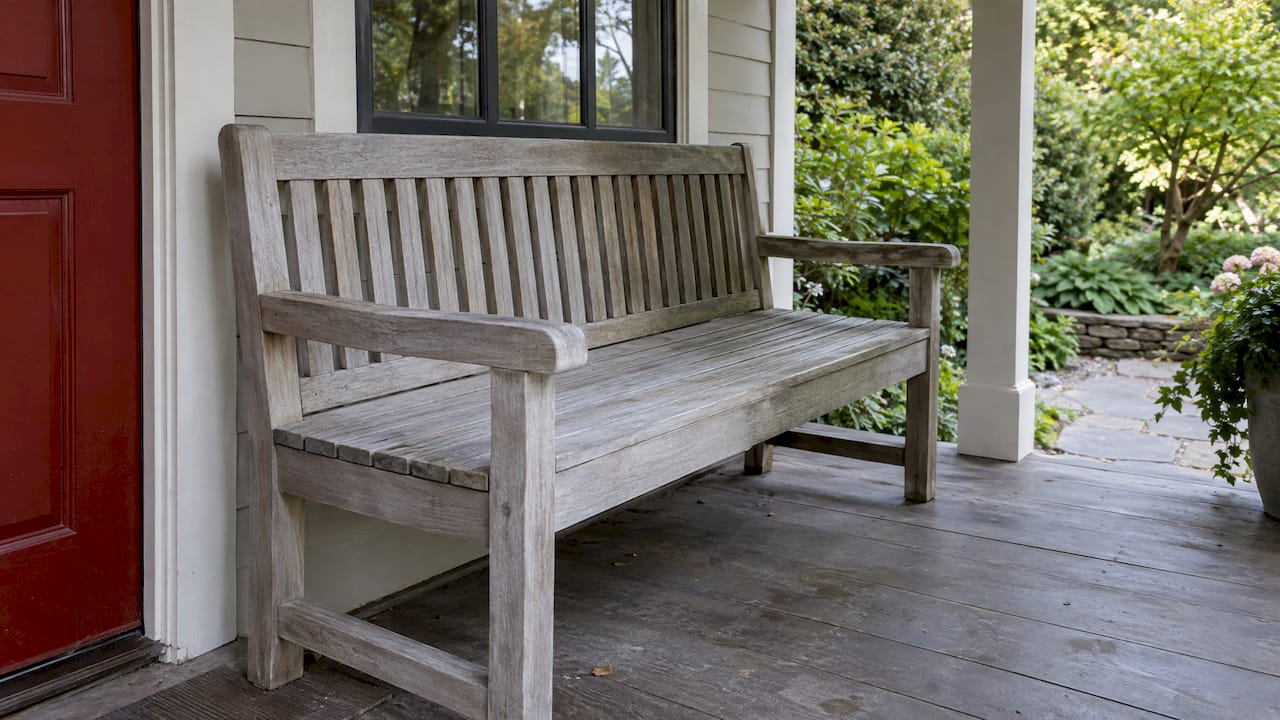
For a painted historic facade, the question mostly disappears, since the coating hides the color change. For a stained or natural element such as a porch bench or a door under a deep overhang, uneven graying is the thing to plan for. Choose either a full finish applied evenly or an exposure where the element weathers uniformly.
How to specify Accoya for a historic project
A specification that lists “Accoya” and nothing else leaves too much to chance. These are the items to put in writing, in roughly the order you will need them:
- The preservation objective. State whether the project is under tax-credit review, local historic district review or neither, and what the reviewing body expects in terms of material and match.
- The profile survey. Measure and document the existing sash, muntin, rail, casing and molding profiles before demolition. Full-size section drawings or templates are the basis for cutter knives.
- The mock-up. Require a three-dimensional sample of the most complex unit, finished as it will be installed.
- The coating system. Name the primer, topcoat and end-seal products, and require end grain to be sealed before assembly.
- Fasteners and hardware. Specify stainless-steel fasteners of the type the evaluation report requires.
- The warranty record. Ask the fabricator to retain material documentation, so a warranty claim, which must be made in writing within 30 days of discovering damage, can be filed without delay.
When the project is a mixture of repair and replacement, keep as much original fabric as possible. Preservation Brief 9 prefers repair over replacement, and a new Accoya sill or lower rail spliced into a sound original sash is often the most conservative use of the material.
Our perspective
Historic buildings reward patience. Every original window and door was shaped by a joiner who knew the building, the climate and the tools at hand, and the work of a modern millwork shop is to read that decision correctly before it cuts anything.
We approach rot resistance as one element of a larger problem: matching profiles, proportions and joinery so the new work disappears into the old. A durable material, finished and detailed well, gives a restored sash or a rebuilt porch column many more decades. A durable material cut to the wrong profile gives only a long-lived mistake.
That is why we begin with the building: its drawings, its surviving fabric, and the review standards that apply to it. Our focus is exact historic replication, authentic materials and techniques, and the complex, architecturally significant requests that others may not accept. When a project’s exposure, budget and review requirements make a modified wood the right choice for sills, doors or exterior trim, we work through the species, the profile and the finish schedule together, in the shop and with the architect and contractor.
Gepetto
Bringing the right fabricator in early
The most expensive millwork mistakes are made before anything is cut: a profile approximated from a photograph, a species chosen for a catalog rating, a finish schedule written after the parts are built. Bringing the fabricator into the design stage avoids all three.
We design, fabricate and restore wood windows, doors, trim, cabinetry, staircases and architectural millwork for historic buildings, including replication of period features and matching for historic tax credit eligibility. Architects, general contractors, builders and historic homeowners can start with our historic window restoration work, our custom fabrication of doors, shutters, casework, staircases and balustrades, or simply contact us through our site with drawings and photographs.
We serve projects in Virginia, West Virginia, North Carolina, South Carolina, Maryland and the District of Columbia, including Virginia Beach and the Deal Island Historic District.
FAQ
What is Accoya wood made of?
Accoya is radiata pine modified by acetylation. The process replaces water-attracting hydroxyl groups in the cell wall with acetyl groups, according to the manufacturer’s information guide. The wood absorbs less moisture, moves less and resists fungal decay better than untreated pine.
Can you stain or paint Accoya?
Yes. Sample testing is recommended for translucent stains because the porosity differs from untreated wood, and opaque paints need a stain-blocking primer. All exposed end grain should be sealed before finishing, as the wood information guide explains.
Does Accoya turn gray?
Uncoated Accoya weathers to a silver gray, and the manufacturer says this does not affect its stability or durability. Partial shade can make the graying uneven. A full coating of paint or pigmented finish keeps the color you specify.
How long does the Accoya warranty last?
The Accoya USA limited warranty runs 50 years above ground and 25 years in the ground or in fresh water, for defined material damage from fungal decay or rot. Claims must be made in writing within 30 days of discovering the damage, per the warranty document.
Can Accoya be used on a tax-credit historic project?
The National Park Service reviews replacement features on how well they match the original in visual and performance characteristics, and treats a three-dimensional mock-up as the most definitive test. Profile accuracy and finish drive approval, so review the mock-up with your preservation reviewer before ordering the full set.
Sources
- Accoya Wood Information Guide (US), 2026
- Accoya Wood Information Guide (US), version 3.9.1
- Accoya Testing and Warranty
- Accoya USA Limited Warranty, August 2026
- Accoya Data Sheet, North America
- ICC-ES Report ESR-2825
- Coatings, Stains and Finishes for Accoya
- Durability of Accoya Wood in Ground Stake Testing after 10 Years
- NPS Preservation Brief 9: The Repair of Historic Wooden Windows
- NPS: Replacement Windows that Meet the Standards