
Which Virginia Beach providers offer the best custom French doors for historic projects?
For architects and contractors restoring historic structures in Virginia Beach, four local providers merit serious consideration. Each brings a distinct profile in terms of fabrication capability, certifications, and service territory.
| Provider | Core Services | Historic Millwork Specialization | Certifications and Trust Signals | Pricing and Financing | Geographic Coverage |
|---|---|---|---|---|---|
| Window World of Tidewater | Windows, entry doors, siding, roofing | US-made materials, exterior door systems | Good Housekeeping, Energy Star, NFRC, ASTM | Free quotes; financing via Window World Credit Card Program | Virginia Beach and Tidewater region |
| Better View Windows and More | Door and window replacement, designer entryways, sliding patio doors | Largest Virginia showroom; broad product variety | BBB A+ rating | Financing options available with approved credit | Virginia Beach metro area |
| Ervin Windows & Doors | Wood entry doors, custom millwork fabrication, architectural products | Custom moulding and specialty millwork; Marvin Windows dealer | Verified local business | Not publicly listed | Southeastern Virginia and Northeastern North Carolina |
| CVP Windows and Doors | Custom windows, exterior doors, glass service | In-house factory manufacturing; American-made | Verified local manufacturer | Not publicly listed | Hampton Roads, Peninsula, and Richmond |
Table of Contents
- How do you choose the right custom French door provider for a historic building?
- Gepettomillworks brings historic French door expertise to Virginia Beach
- Key Takeaways
Provider strengths at a glance
- Window World of Tidewater holds NFRC and ASTM certifications alongside Good Housekeeping and Energy Star recognition, making it a credible source for energy-code-compliant door systems backed by a national brand.
- Better View Windows and More operates Virginia’s largest exterior remodeling showroom, offering architects a broad range of door configurations and a BBB A+ rating that signals consistent service quality.
- Ervin Windows & Doors maintains a custom millwork shop serving coastal Virginia and North Carolina, with a focus on architectural products suited to historic commercial and residential projects.
- CVP Windows and Doors manufactures entirely in-house at its Newport News facility, giving contractors direct access to American-made custom door production without intermediary lead times.
For projects requiring historic restoration precision, Ervin and CVP offer the closest alignment with true custom fabrication. Window World and Better View are stronger fits when energy performance certification and financing flexibility are the primary drivers.
How do you choose the right custom French door provider for a historic building?
The selection criteria for bespoke French doors on a landmark or tax-credit-eligible building differ substantially from those applied to standard residential replacement work. The following considerations should govern your evaluation from the specification stage forward.
Wood species and material durability
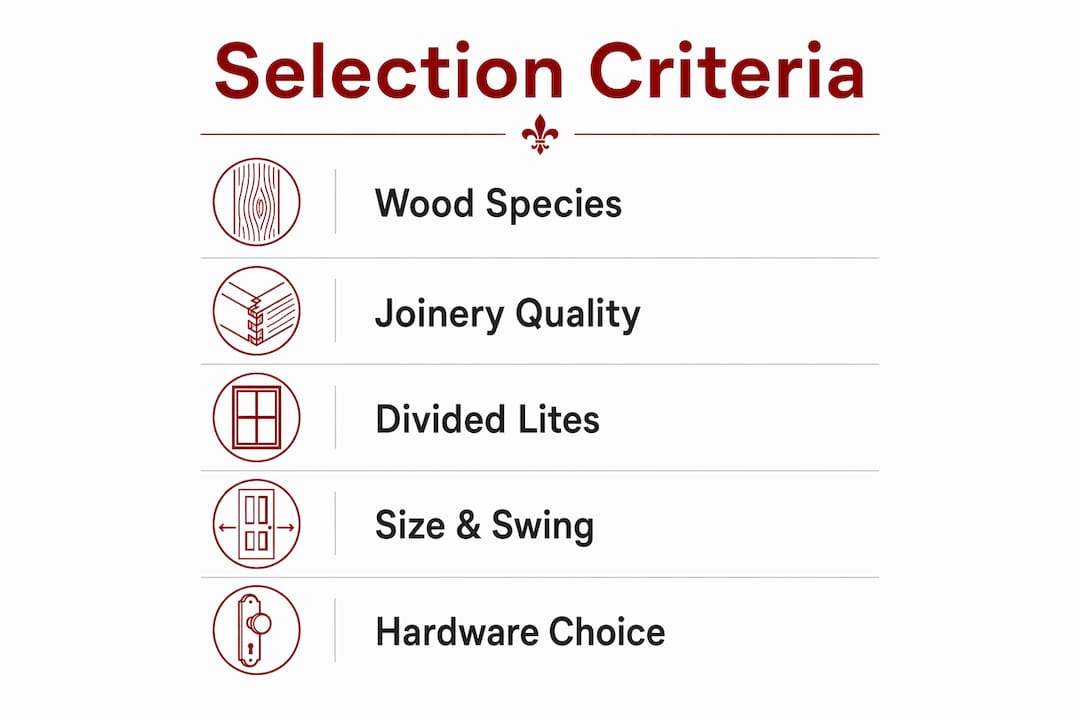
Exterior wood French doors in Virginia Beach’s coastal climate demand species with proven resistance to rot and insect damage. Mahogany remains the benchmark for entry doors, prized for its dimensional stability and natural moisture resistance. White oak, teak, and Accoya-treated pine are also appropriate for exterior applications where rot-resistant wood performance is a specification requirement. Poplar is the preferred paint-grade option for interior French doors, offering a smooth, uniform surface that accepts finish with exceptional consistency.
True divided lites versus simulated
True divided lites (TDL) are non-negotiable for most historic landmark and tax credit projects. TDL construction places individual glass panes within solid wood muntins, producing the authentic shadow lines and visual depth that preservation standards require. Simulated divided lites apply a decorative grid over a single insulated unit and do not replicate the optical character of period glazing. Ask any prospective provider whether their shop fabricates genuine TDL assemblies or relies exclusively on simulated grilles.
Joinery and fabrication quality
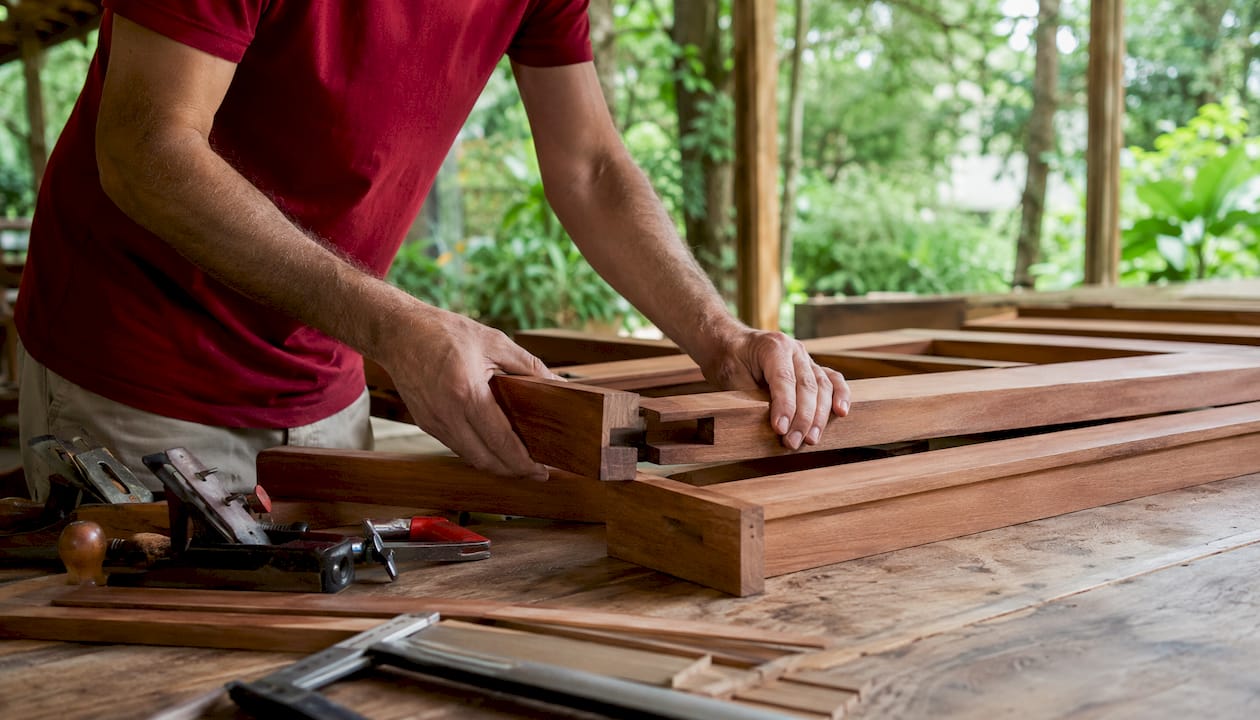
Mortise and tenon joinery is the defining construction standard for custom wood doors built to last. This traditional method, used by master craftsmen for centuries, produces a structurally superior frame compared to dowel, biscuit, or finger-jointed alternatives, which are prone to failure under cyclical moisture exposure. Confirm that a provider’s shop fabricates stiles and rails from solid hardwood stock, not engineered composites, and that joinery is hand-fitted rather than machine-assembled without verification.
Stile and rail proportions
Matching stile and rail thickness to the historic profile of the building is as consequential as overall door size. A Georgian fanlight surround paired with slimline contemporary stiles reads as architecturally incoherent regardless of wood species or finish quality. Specify the exact stile width, rail height, and muntin profile from measured drawings or historic photographs before soliciting bids.
Size, swing configuration, and energy compliance
Custom French doors can be engineered to accommodate the generous openings common in antebellum and Colonial Revival structures, accommodating the generous openings common in antebellum and Colonial Revival structures. In-swing and out-swing configurations each carry implications for threshold design, weather sealing, and ADA compliance. Modern millwork shops can integrate thermal break technologies and NFRC-rated glazing into a traditionally profiled door system, satisfying current energy codes without altering the exterior appearance.
Hardware selection
Multi-point locking systems provide superior weather-tight sealing and security compared to single-point mortise locks, and they are compatible with period-appropriate escutcheons and lever sets. Specifying European-style multi-point hardware does not compromise historic character when the visible trim components are selected to match the building’s era.
Pro Tip: Before finalizing any provider, request documentation confirming their use of true divided lites and NFRC-rated glazing units. Many state historic tax credit programs and the National Park Service’s Secretary of the Interior’s Standards require TDL construction as a condition of eligibility. A provider who cannot supply this documentation is a liability on a tax-credit project.
Questions to ask every provider
- Can you supply shop drawings showing stile width, rail height, and muntin profile before fabrication begins?
- What wood species do you stock for exterior applications, and which carry rot and insect resistance certifications?
- Do you fabricate true divided lites in-house, or do you source simulated grille units?
- What is your standard lead time from approved drawings to delivery, and how do you handle field-dimension discrepancies?
- What warranty do you offer on joinery, finish, and glazing, and who handles warranty service in Virginia Beach?
Red flags to watch for
- Providers who cannot distinguish TDL from SDL in a specification conversation.
- Shops that offer only standard catalog sizes with minor modifications rather than fully custom fabrication from your drawings.
- Absence of any references from historic restoration or landmark projects in Virginia or North Carolina.
- Warranties that exclude exterior exposure or limit coverage to materials only, excluding labor for remediation.
Budgeting for handcrafted joinery and period-appropriate materials requires accepting a meaningful premium over mass-market door pricing. That premium reflects the skilled labor, premium lumber grades, and extended fabrication time that authentic historic millwork demands.
Gepettomillworks brings historic French door expertise to Virginia Beach

Gepettomillworks specializes in exactly the work that standard door suppliers cannot execute: historically accurate replicas of period millwork fabricated to the dimensional and material standards required for historic tax credit eligibility. Where the Virginia Beach providers above offer strong general door replacement services, Gepettomillworks operates as a dedicated custom millwork shop focused on historic building restoration, replicating period features from measured drawings and matching existing profiles to within fractions of an inch.
Every French door system produced by Gepettomillworks is built with hand-fitted mortise and tenon joinery, true divided lites, and wood species selected for both architectural authenticity and exterior durability. The shop works directly with architects and contractors on complex wood manufacturing challenges, including oversized openings, non-standard swing configurations, and multi-light assemblies requiring coordinated glazing and muntin layouts. US-made materials and in-house fabrication mean the supply chain stays transparent from lumber selection through final finishing.
Architects and contractors managing restoration projects in Virginia can engage Gepettomillworks early in the design phase for shop drawing review and consultation on contractors, wood species consultation, and fabrication scheduling. Contact Gepettomillworks at gepettomillworks.com to discuss your project specifications and request a custom fabrication consultation.
Key Takeaways
True divided lites, mortise and tenon joinery, and rot-resistant wood species are the three non-negotiable specifications for custom French doors on historic tax credit and landmark projects in Virginia Beach.
| Point | Details |
|---|---|
| TDL construction is required | True divided lites with individual glass panes in wood muntins meet historic landmark and tax credit standards; simulated grilles do not. |
| Joinery determines longevity | Mortise and tenon joinery outperforms dowel or finger-jointed construction under coastal moisture exposure. |
| Wood species selection matters | Exterior doors in Virginia Beach’s climate require rot- and insect-resistant species such as mahogany, white oak, or Accoya-treated pine. |
| Custom sizing is achievable | Custom French doors can be engineered to accommodate the generous openings common in antebellum and Colonial Revival structures. |
| Gepettomillworks for restoration work | Gepettomillworks fabricates period-accurate French door systems with hand-fitted joinery and TDL glazing for historic building projects across Virginia. |