
The right historic restoration builder in Charlottesville is rarely a single firm. Most successful projects pair a general contractor or architect with a specialist who can repair or replicate the original woodwork: sash, doors, trim, stairs and casework. The difference between the two matters because Charlottesville’s design review and Virginia’s tax credit program both judge the physical fabric of a building, and fabric is mostly millwork. This guide compares the kinds of builders you will meet, explains what the review bodies look at, and shows where a specialist shop such as ours fits.
TL;DR
- Three types of firms work on historic buildings around Charlottesville: general home builders, restoration-minded general contractors, and specialist millwork and restoration shops. They solve different problems.
- Exterior changes in Charlottesville’s Architectural Design Control districts need a Certificate of Appropriateness from the Board of Architectural Review before work begins.
- The Virginia credit equals 25% of eligible rehabilitation expenses and depends on meeting the Secretary of the Interior’s Standards, so windows, doors and trim are where eligibility is won or lost.
- Ask every candidate for built examples of the specific element you need, not only a general portfolio.
Table of Contents
- Why Charlottesville raises the bar for restoration work
- What the review process actually examines
- Three kinds of builder, compared
- Why windows and doors decide so many projects
- Where a specialist shop fits
- Our perspective: match the original, then document it
- What our work covers
- A sensible sequence for your project
- Frequently asked questions
- Sources
Why Charlottesville raises the bar for restoration work
Few American towns concentrate as much early architecture in so small a radius. Monticello, Highland, Montpelier, the Rotunda and Central Grounds at the University of Virginia, Michie Tavern (ca. 1784), the Paramount Theater and the Jefferson School African American Heritage Center represent very different periods, builders and building types. Behind them stands a much larger stock of ordinary historic buildings: Federal and Greek Revival farmhouses in Albemarle County, brick rowhouses and Victorian frame houses near the Downtown Mall, early twentieth-century bungalows, and the schools, churches and community buildings of neighborhoods such as Vinegar Hill and Starr Hill.
That inheritance shapes local expectations. Reviewers, neighbors and preservation-minded buyers are accustomed to seeing true divided-light sash with proper muntin profiles, paneled doors with correct mouldings, and porch work that reads as original. A builder who treats these as interchangeable catalog parts will find the review process unforgiving.
What the review process actually examines
Before comparing builders, it helps to know what they will be measured against. Two systems apply, and a project may involve both.
Local design review
In Charlottesville, owners in Architectural Design Control districts must obtain a Certificate of Appropriateness from the Board of Architectural Review for exterior alterations, additions or new construction. Historic Conservation Districts use simpler guidelines and allow more flexibility for small renovations, although visible street-side changes still need BAR approval. The city’s Historic Preservation Program staff, reachable at (434) 970-3130, answer design review questions, and speaking with them before you hire anyone is inexpensive and clarifying.
The Board’s decisions on windows show how seriously materials are taken. In one recent case, the BAR approved replacement windows at a West Main Street building on conditions that excluded vinyl and required retention or replication of exterior trim. The lesson is general: reviewers look for the right material and profile, and they prefer salvaging original sash where it can be saved.
State and federal tax credit review
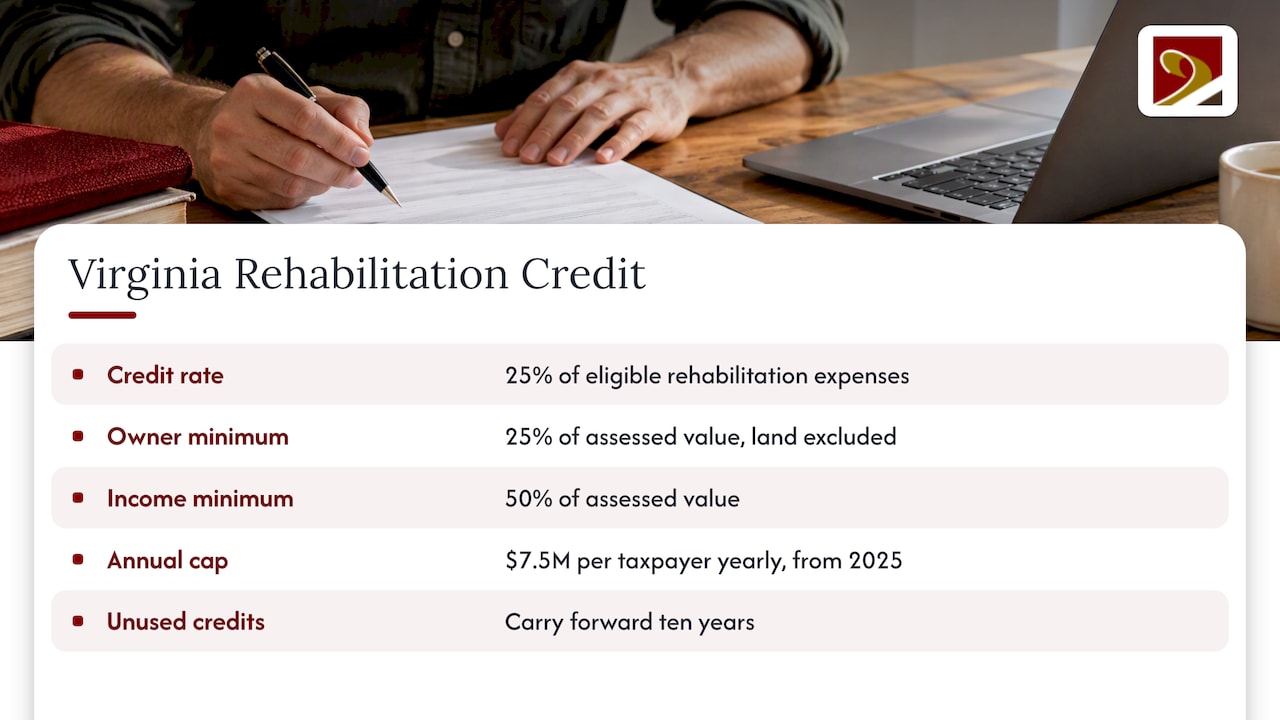
The Virginia Historic Rehabilitation Tax Credit equals 25% of eligible rehabilitation expenses for properties listed on or eligible for the Virginia Landmarks Register. Owner-occupied residences must spend at least 25% of the assessed value excluding land, and income-producing properties at least 50%. The statute caps the credit at $7.5 million per taxpayer per year starting in 2025, and unused credits carry forward for ten years. Verify the current figures with the Department of Historic Resources and a tax professional before you commit, since statute and program rules can change.
The work must meet the Secretary of the Interior’s Standards for Rehabilitation. The National Park Service stresses that these are regulatory criteria for the incentive programs and not merely aesthetic guidance: repair of original features is preferred over replacement, and new work should be compatible with the old yet distinguishable from it.
The most demanding step is usually the Part 2 application. The Department of Historic Resources describes the program and its application stages, and the Part 2 narrative must account for every significant feature and each proposed treatment. DHR publishes a sample Part 2 narrative and photographic standards that are worth reading before you select a builder, because a good builder should be able to contribute directly to that documentation.
Three kinds of builder, compared
When homeowners, architects and contractors search for a historic restoration builder in Charlottesville, they usually find one of three types. None is wrong in itself; each fits a different scope.
| Criterion | General home builder or remodeler | Restoration-minded general contractor | Specialist millwork and restoration shop |
|---|---|---|---|
| Best at | Additions, kitchens, baths, new construction | Whole-building coordination, structure, envelope, trades | Fabricating and restoring windows, doors, trim, stairs, casework |
| Historic millwork | Usually ordered from catalogs or outsourced | Often outsourced to a shop | Made or restored in-house to documented profiles |
| Tax credit familiarity | Varies widely | Often strong on process | Strong on the physical details the reviewers examine |
| Exact replication of lost features | Limited | Depends on subcontractors | Core capability |
| Typical role | Prime contractor | Prime contractor | Specialist subcontractor or direct to owner or architect |
| Main risk | Standard products that fail review | Subcontractor quality and lead times | Needs a prime contractor for full-building scope |
The table shows why the choice is often “and” rather than “or.” A whole-house project needs a prime contractor to schedule trades, manage structure and meet code. The same project needs someone who can take a rotted 1850s sash, record its profile and either rebuild it or fabricate a faithful replacement. Asking one firm to do both is where quality commonly slips.
Questions that separate the types
Put the same questions to every candidate:
- Which Charlottesville or Virginia projects have you taken through BAR or DHR review, and which elements did you supply?
- Do you repair existing sash and doors, or primarily replace them?
- Who makes the custom elements, and where? Can I visit the shop?
- What species and joinery do you use, and can you match the original?
- How do you document existing conditions so the architect can write a Part 2 narrative?
- What lead time should I plan for on custom windows or doors, and how does it affect the schedule?
Vague answers to the third and fifth questions are the most telling.
Why windows and doors decide so many projects
Windows carry disproportionate weight in review. The NPS explains that restoration is favored over replacement under the Standards, and that when replacement is unavoidable the new units must match the original in visual qualities, materials and profile. Practitioners warn that seemingly small errors, such as improper glazing, can jeopardize both historical integrity and credit eligibility.
This is not fussiness. A Palladian or elliptical fanlight, a sash with slender muntins carrying true putty-glazed panes, or a six-panel door with applied mouldings owes its character to dimensions measured in fractions of an inch. A stock unit with a snap-in grille flattens that vocabulary immediately, and a trained reviewer sees it from the street.
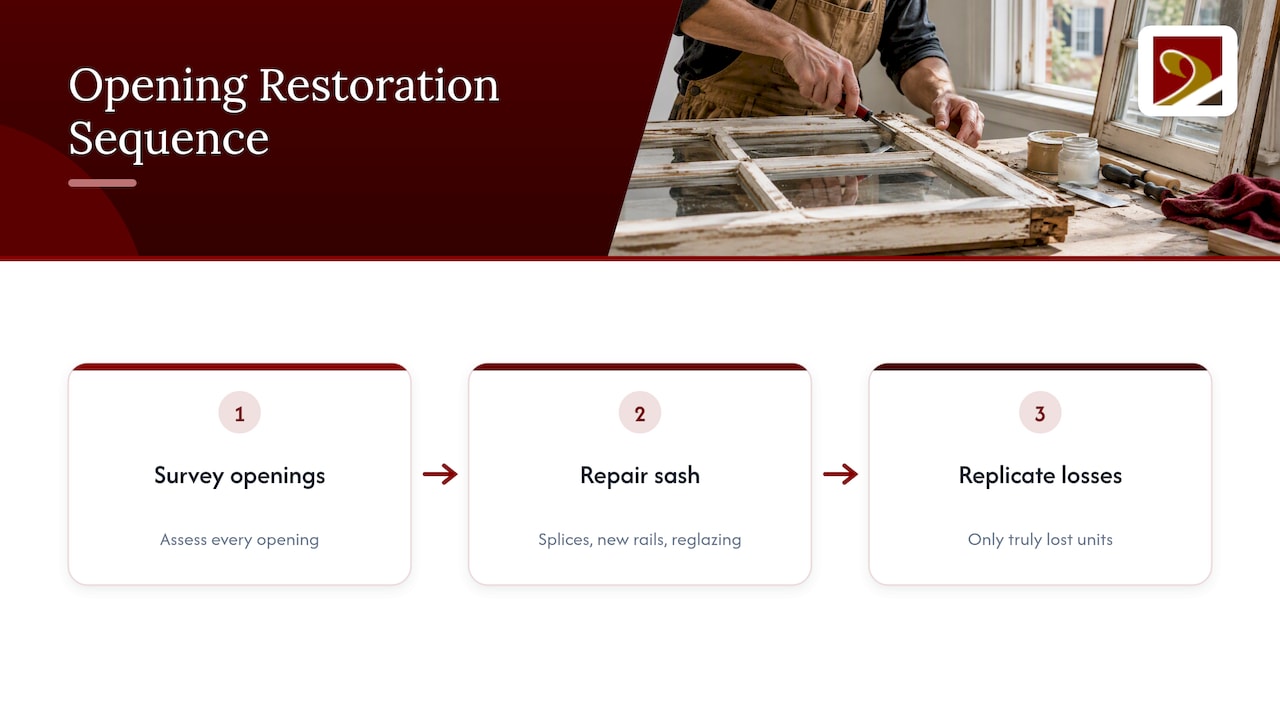
For owners, the practical consequence is to start with a conditions survey of every opening. Many sash that look beyond help can be repaired with dutchman splices, new meeting rails or reglazing, and only the truly lost units need replication. That sequencing also keeps costs rational, because restoration of what survives is often less expensive than fabricating everything new.
Where a specialist shop fits
Gepetto Millworks designs, fabricates and restores wood windows, doors, trim, cabinetry, staircases and architectural millwork for historic buildings, including replication of period features and matching for historic tax credit eligibility. We work with architects, general contractors, builders and historic homeowners, and we take on complex, architecturally significant requests that other shops decline.
For Charlottesville projects, the relevant starting points are our Charlottesville restoration services and our broader historic window restoration work. We also serve the wider region, including Richmond and Roanoke, and our service area includes Virginia, West Virginia, North Carolina, South Carolina, Maryland and the District of Columbia.
Our perspective: match the original, then document it
We approach every historic job from one premise: the building is the specification. Before drawing anything, we study what survives, which means the profile of a bead on a stile, the thickness of a rail, the pitch of a sill, the species, and the evidence of earlier repairs. Replication then uses authentic materials and period techniques, because the Standards ask that new work match in material, profile and visual quality, and because reviewers can tell when it does not.
Two habits matter most. First, we prefer to repair before we replace. A restored original sash keeps the building’s physical record intact and is consistent with how the NPS frames the Standards. Second, we treat documentation as part of the product. Measured drawings, photographs keyed to the plans and a clear description of each treatment make the architect’s Part 2 narrative stronger and shorten conversations with reviewers.
We are not the right firm for every scope. We do not replace your general contractor, and we will tell you when a project needs one. What we offer is the part many prime contractors find hardest to source: millwork that looks and performs as the original did, delivered to a schedule the rest of the trades can plan around.
— Gepetto
What our work covers
The elements most often requested on historic buildings fall into a few families:
- Windows: restoration of existing sash and frames, and new wooden windows built to documented profiles.
- Doors: historic and solid wood entry doors, including solid wood door manufacturing to match period designs.
- Stairs and balustrades: period staircases, newels, rails and balusters, along with wood turning for spindles and columns.
- Casework and interiors: built-in libraries, custom casework and kitchens, trim and mouldings, and shutters made to order, all described on our custom fabrication page.
- Commercial projects: commercial millwork for offices and restaurants, including early manufacturability consulting.
Prices depend on the scope, species, quantity and complexity, so we do not publish them. Send drawings or photographs of the openings and features involved, and we can discuss what restoration and fabrication would involve.
A sensible sequence for your project
A workable order of operations, whether you are an owner or an architect, looks like this:
- Confirm the designation. Find out whether the property sits in an ADC district, a Historic Conservation District, or is individually listed or eligible for the Virginia Landmarks Register.
- Talk to preservation staff early. The city’s Historic Preservation Program can explain what the BAR will expect, and DHR can explain the credit process.
- Survey existing conditions. Record every window, door, stair and piece of trim with photographs that meet the DHR standards, keyed to a plan.
- Decide repair versus replication, opening by opening. Put the reasoning in writing, because it becomes part of the application narrative.
- Assemble the team. Choose a prime contractor for coordination and a millwork specialist for the elements reviewers scrutinize. Bring both in before drawings are final.
- Submit, then build. Do not begin work that requires approval before it is granted, and do not substitute materials mid-project without checking with reviewers.
Tax credit rules are technical, and a mistake can cost eligibility. Consult a Virginia tax professional and DHR staff on your specific property before you start construction.
Frequently asked questions
Do I need a Certificate of Appropriateness for window or door work in Charlottesville?
If the building is in an Architectural Design Control district, exterior alterations require a Certificate of Appropriateness from the BAR. Conservation districts follow simpler guidelines, though visible street-side changes still need approval. Call the Historic Preservation Program at (434) 970-3130 to confirm your address before ordering anything.
Can replacement windows qualify for the Virginia historic tax credit?
Sometimes, but restoration is preferred. The National Park Service says that where replacement is unavoidable, the new windows must match the original in visual qualities, materials and profile. Check your specific units with DHR before you order.
Should I hire a general contractor or a millwork specialist?
Usually both, with different roles. A general contractor coordinates structure, systems and trades, while a specialist fabricates or restores the windows, doors, stairs and trim that review bodies examine most closely. On smaller projects focused on a few openings, going directly to a specialist can be enough.
How early should a millwork specialist join the project?
During design, before the application narrative is written. Early involvement lets the architect describe each treatment accurately, and it allows for the lead time that custom fabrication requires.
Sources
- Historic Districts and Design Review, City of Charlottesville
- Virginia Code § 58.1-339.2, Historic rehabilitation tax credit
- The Secretary of the Interior’s Standards for Rehabilitation, National Park Service
- Historic Rehabilitation Tax Credits, Virginia Department of Historic Resources
- Sample Part 2 Narrative Description of Rehabilitation, DHR
- Photographic Standards, DHR
- Replacement Windows that Meet the Standards, National Park Service
- BAR approves window replacements at 701–705 West Main, Citizen Portal