
South Carolina property owners rehabilitating a historic structure may draw on the federal 20% rehabilitation credit for income-producing buildings and, at the state level, a 25% homeowner credit or a 10% (or optional 25%) credit for income-producing projects, the latter capped at $1 million per certified structure. The prudent first step, before a single wall is opened or a window removed, is to contact the South Carolina Department of Archives and History and begin assembling the Historic Preservation Certification Application.
TL;DR:
- The federal rehabilitation credit applies only to income-producing historic buildings, offering a 20% credit, with claims spread over multiple years.
- South Carolina’s owner-occupied homes qualify for a 25% state credit, but only if at least $15,000 is spent within 36 months, and this is claimed over three years.
- Income-producing projects can choose between a 10% or an optional 25% state credit, with the latter capped at $1 million per certified structure.
- Proper allocation of expenses between historic preservation and unrelated upgrades is essential to avoid disqualification or audits.
- Meeting the Secretary of the Interior’s Standards is critical, as even minor deviations can lead to certification denial or recapture of claimed credits.
Table of Contents
- At a glance: which credits apply and who qualifies
- How eligibility diverges between homeowners and income-producing projects
- Filing the HPCA: what happens at each stage
- The financial mechanics: percentages, installments, and caps
- Preservation standards, common mistakes, and red flags
- What restoration contractors bring to a certification review
- What happens when a project falls out of compliance
- Building a documentation trail SHPO and NPS will accept
- Filing the credit: forms and procedures to know
- Who and what actually qualifies for these programs
- Combining federal and state credits on the same project
- What counts as a qualifying rehabilitation expense
- Key forms, contacts, and next steps
- What this process actually rewards, and what it does not
- Ready to make your rehabilitation credit-eligible
- Sources
- FAQ
At a glance: which credits apply and who qualifies
The federal and state historic tax credit programs serve overlapping but distinct populations, and matching the right credit to the right project saves both time and money.
- The federal credit offers a 20% rehabilitation tax credit for income-producing historic buildings, such as rental properties, offices, or commercial structures generating income.
- South Carolina’s homeowner credit provides a 25% state credit for owner-occupied historic residences, contingent on spending at least $15,000 within a 36-month period.
- Income-producing projects in South Carolina may instead choose a 10% state credit or an optional 25%, though the 25% option is capped at $1 million per certified historic structure.
- Local governments may also offer special property tax assessments, commonly called Bailey Bill programs, and preservation easements can carry their own tax benefits, both of which operate alongside, not instead of, the state and federal credits.
Each program has its own paperwork, its own review body, and its own tolerance for how much of the building’s historic fabric must survive the process intact.
How eligibility diverges between homeowners and income-producing projects
The line between the homeowner credit and the income-producing credits is not simply about who lives in the building. It is about spending thresholds, review pathways, and how mixed-use structures get divided on paper before they are divided by a contractor’s crew.
- Homeowners must spend at least $15,000 on qualifying rehabilitation within a 36-month window, while income-producing projects generally face a substantial rehabilitation test tied to the building’s adjusted basis.
- Listed status matters differently depending on the path: income-producing projects submit through the full HPCA process with SHPO and National Park Service review, while homeowner applications are reviewed by SHPO alone.
- Mixed-use buildings, such as a structure with ground-floor retail and upstairs apartments, can sometimes use both programs concurrently, provided expenses are allocated clearly between the income-producing and owner-occupied portions.
Getting this allocation wrong early tends to cause more delay than any single construction decision later in the project.
Filing the HPCA: what happens at each stage
The Historic Preservation Certification Application, known as the HPCA, is the backbone of both the federal credit and the state income-producing credit, and it unfolds in three distinct parts that correspond to different moments in the project’s life.
- Part 1 documents the building’s historic significance, establishing that it qualifies as a certified historic structure.
- Part 2 describes the proposed rehabilitation work in detail, submitted before construction begins so SHPO and the National Park Service can weigh in on the plan.
- Part 3 documents the completed work, including photographs and final costs, and is required before the rehabilitation can be certified.
Income-producing applications move through an electronic HPCA system with NPS review built into the process, while homeowner applications typically follow a SHPO-only path that may still involve hard-copy submissions.
Parts 1 and 2 are generally reviewed within 60 days of a completed submission, split roughly evenly between the state’s 30-day review and the federal government’s 30-day review. That timeline assumes the application arrives complete. Starting construction before Part 2 approval carries real risk for income-producing projects and will disqualify a homeowner application outright. One further note for anyone filing soon: SCDAH has suspended preliminary and final review fees for applications received during fiscal year 2025 to 2026, running July 1, 2025 through June 30, 2026.
The financial mechanics: percentages, installments, and caps
Understanding how these credits are actually claimed, rather than simply which percentage applies, determines how a project gets financed and when the benefit shows up on a tax return.
- The federal 20% credit for income-producing properties is generally claimed in equal annual installments over several years.
- South Carolina’s 25% homeowner credit is claimed differently: it is taken in equal installments over three years, filed via Form TC-22, with unused portions carried forward according to state rules.
- The income-producing state credit’s 25% option is capped at $1 million per certified historic structure, which matters most on large adaptive reuse projects where qualified expenses could otherwise push the credit well past that ceiling.
- Because credits offset tax liability rather than generate a refund outright in most cases, owners with lighter tax burdens should plan the installment schedule against their expected liability in each of the claim years.
A project’s financing plan should treat these credits as a multi-year cash flow event, not a lump sum arriving the year the paint dries.
Preservation standards, common mistakes, and red flags
Every certified rehabilitation, whether homeowner or income-producing, is measured against the Secretary of the Interior’s Standards for Rehabilitation, which govern methods and materials across the interior, exterior, and site. Failing to meet the Standards on even one significant element can jeopardize certification for the entire project, not just the offending piece.
The most common disqualifying mistakes are avoidable. Homeowners sometimes begin work before SHPO approval, which forfeits the credit regardless of how sensitively the work was done. Others install incompatible replacement windows or doors, keep insufficient documentation of costs and materials, or fail to separate eligible rehabilitation expenses from unrelated upgrades. Early consultation with SHPO, meticulous cost records, and contractors experienced in historic work all reduce these risks substantially.
Pro Tip: Photograph every stage of demolition and construction, not just the finished result. Part 3 review depends heavily on before-and-after documentation.
What restoration contractors bring to a certification review
The Standards are ultimately judged on physical evidence, and the millwork trades often supply the details that make or break a Part 3 review. Historically accurate window sashes, matched muntin profiles, and doors replicated from original hardware and dimensions demonstrate the kind of fidelity SHPO and NPS reviewers look for, especially on facades where a single mismatched sash can raise questions about the whole project.
Contractors who work regularly on historic structures tend to deliver a specific set of documentation alongside the finished product:
- Detailed material specifications tying each element to a historic precedent or salvaged original.
- Shop drawings keyed to the building’s original profiles and dimensions.
- Before, during, and after photographs organized by location and phase of work.
- Change orders and a cost ledger separating eligible rehabilitation expenses from unrelated work.
Gepetto Millworks builds this kind of record into projects involving historic window restoration and custom replication of historic doors, work that gives owners and their tax preparers a paper trail consistent with what SHPO reviewers expect to see. Photo documentation from past restoration projects illustrates the kind of before-and-after evidence Part 3 submissions require.
What happens when a project falls out of compliance
The consequences of an improperly claimed or non-compliant historic tax credit extend well beyond a denied application. If a project fails to meet the Secretary of the Interior’s Standards, NPS review can withhold certification for the entire rehabilitation, not merely the noncompliant portion, which means the owner loses the credit on qualified work that was done correctly alongside work that was not.
For income-producing projects, credits already claimed can be subject to recapture if the property is sold or ceases to qualify within a set period after the work is certified, effectively clawing back the tax benefit years after it was taken. For homeowners, starting construction before SHPO approves Part 2 forfeits eligibility outright, regardless of the quality of the finished work. Misallocating expenses between eligible rehabilitation costs and ineligible new construction or personal upgrades can also trigger a reduced credit or an audit inquiry from the South Carolina Department of Revenue.
The safest posture is treating the certification process as a binding commitment rather than a formality to satisfy after the fact. Owners who document decisions as they are made, keep contractors informed of what the Standards require, and resist the urge to swap in modern materials for convenience tend to avoid these penalties entirely. Those who do not risk losing a credit that, in many cases, was the financial reason the rehabilitation made sense in the first place.
Building a documentation trail SHPO and NPS will accept
Reviewers cannot certify what they cannot see, and the burden of proof rests entirely with the owner. A rehabilitation that meets every standard in practice but lacks documentation is, for certification purposes, indistinguishable from one that does not meet the standards at all.
The strongest documentation packages share a few habits. They photograph the building comprehensively before any demolition begins, capturing details like trim profiles, hardware, and glazing patterns that reviewers will later compare against the finished work. They maintain a running log of materials and methods, noting where original fabric was retained, repaired, or, when necessary, replaced in kind. They keep shop drawings and material specifications for any custom fabrication, since these documents demonstrate that replacement elements match historic precedent rather than approximate it.
Cost records deserve equal attention. Separating eligible rehabilitation expenses from unrelated upgrades in real time, rather than reconstructing the split at tax time, prevents disputes later with either SHPO or the South Carolina Department of Revenue. Owners working with contractors experienced in historic restoration often find this documentation habit is built into the workflow already, since the same photographs and drawings that support a smooth Part 3 submission also protect the contractor against disputes over scope and change orders.
Filing the credit: forms and procedures to know
Claiming these credits requires coordination between the certification process and the actual tax filing, and the two run on separate tracks that eventually need to meet.
For the federal 20% credit, the certified rehabilitation must be reflected on the owner’s federal tax return following IRS procedures for the rehabilitation credit, with certification from the National Park Service serving as the necessary proof that the work qualifies. For South Carolina’s homeowner credit, Form TC-22 is filed with the South Carolina Department of Revenue, claiming the 25% credit in equal installments across three years once SHPO has certified the completed work. Income-producing projects claiming the state’s 10% or optional 25% credit file through comparable state procedures tied to their SHPO certification.
None of these filings happen in isolation from the certification timeline. A homeowner cannot file Form TC-22 claiming a credit for work that SHPO has not yet certified, and an income-producing project cannot claim the federal credit without the NPS certification that follows a completed Part 3 submission. Owners should coordinate with a tax advisor familiar with South Carolina’s specific forms well before the rehabilitation is finished, since the certification and the filing deadline do not always align neatly with a calendar tax year.
Who and what actually qualifies for these programs
Eligibility hinges on both the property and the owner’s intended use of it, and the two programs draw the line differently.
For the federal credit, the building must be a certified historic structure, meaning it is individually listed on the National Register of Historic Places or located in a registered historic district and certified as contributing to that district’s significance. The building must also be income-producing, which excludes a primary residence unless a portion is rented or used commercially. For South Carolina’s income-producing credit, the same certified structure standard generally applies, layered on top of the federal eligibility framework.
The homeowner credit, by contrast, is built for owner-occupied residences. The property must be a certified historic structure under the same listing standards, but the qualifying spend threshold, at least $15,000 within 36 months, replaces the substantial rehabilitation test used for income-producing projects. In both cases, the owner bears responsibility for ensuring the property’s listed or contributing status is confirmed with SHPO before assuming the credit applies, since a building’s historic reputation locally does not always translate into the formal certification these programs require.
Combining federal and state credits on the same project
For income-producing properties, the federal and South Carolina credits are designed to work together rather than compete. An owner completing a certified rehabilitation can claim the federal 20% credit and, on the same project, elect either the state’s 10% credit or its optional 25% credit, subject to the $1 million cap on the 25% option. Stacking these credits is one of the more significant financial advantages available to developers taking on adaptive reuse of historic commercial buildings in South Carolina.
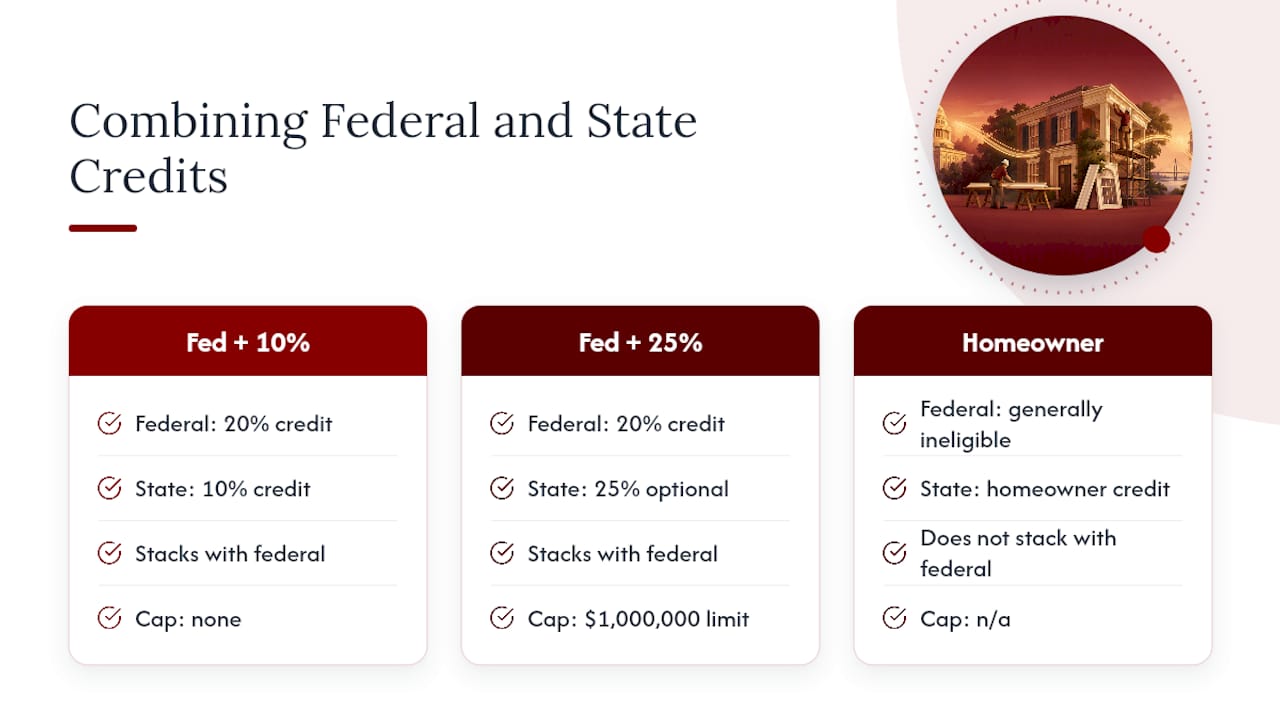
The homeowner credit does not stack with the federal credit in the same way, since the federal 20% credit is reserved for income-producing property and most owner-occupied homes do not qualify as income-producing. An owner who rents out part of a historic residence while occupying the rest may find that expenses need to be allocated between the two uses, with income-producing portions potentially eligible for federal treatment and owner-occupied portions following the state homeowner path. Getting this allocation right, ideally with guidance from both SHPO and a tax professional before construction begins, prevents a project from losing eligibility on either side of the split.
What counts as a qualifying rehabilitation expense
Not every dollar spent on a historic property counts toward these credits, and understanding the boundary matters as much as understanding the percentages.
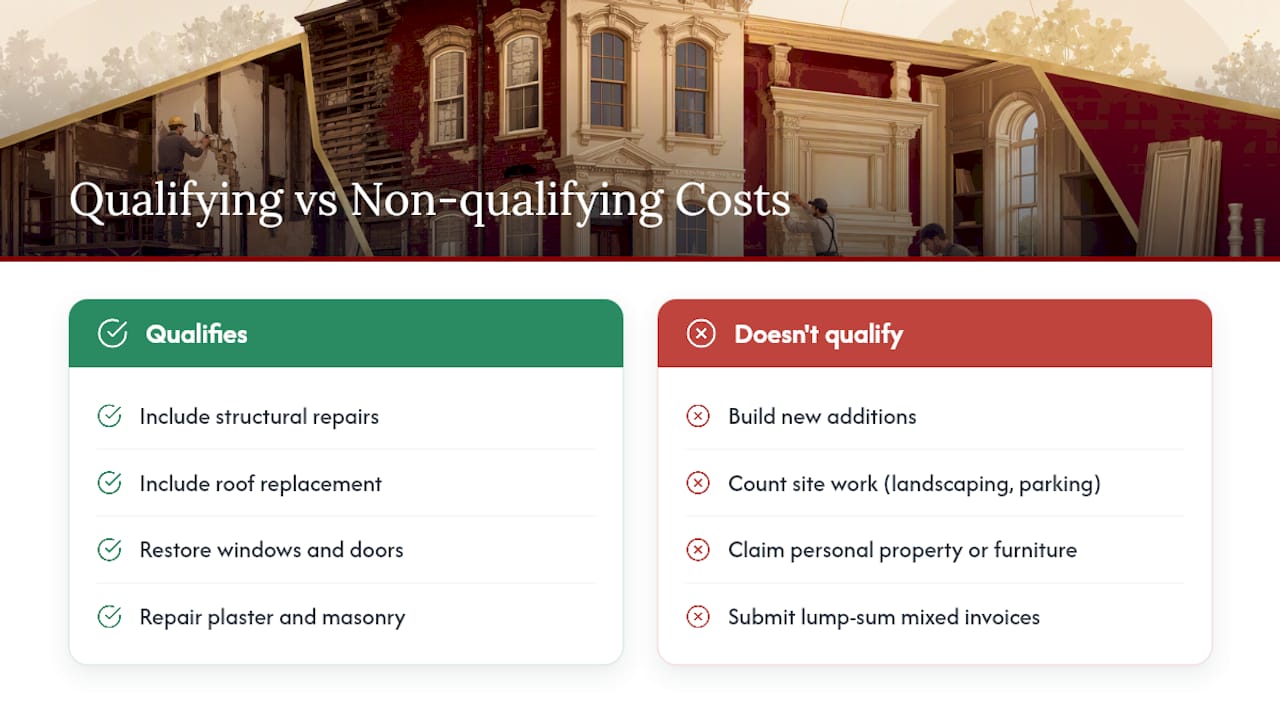
Qualifying expenses generally include costs directly tied to rehabilitating the historic structure itself: structural repairs, roof replacement, restoration of windows and doors, plaster and masonry repair, and mechanical, electrical, and plumbing upgrades necessary to make the building usable. Architectural and engineering fees connected to the rehabilitation typically qualify as well. Costs for a new addition, site work like landscaping or new parking, and personal property such as furniture generally do not qualify, since the credits are built to reward preservation of the existing historic fabric rather than expansion beyond it.
Millwork and finish carpentry sit squarely within qualifying territory when the work restores or replicates historic elements rather than substituting generic modern stock. Custom wooden windows, replicated solid wood entry doors, and matched trim or casework all fall under rehabilitation expenses when they preserve the building’s documented historic character, provided the costs are separated clearly from any unrelated new construction happening on the same site. Owners planning a rehabilitation budget should build this distinction into their contracts from the start, since a single lump-sum invoice covering both eligible and ineligible work creates unnecessary friction during a Part 3 review.
Key forms, contacts, and next steps
Getting organized early saves months of back-and-forth later. The essential resources sit across three agencies, each responsible for a different part of the process.
- Start with SCDAH’s income-producing program page or its homeowner program page to confirm which credit fits the property.
- Review the NPS application process guidance for the specifics of Parts 1 through 3 before drafting the HPCA.
- Download and review Form TC-22 from the South Carolina Department of Revenue if pursuing the homeowner credit.
- Assemble Part 1 materials, contact SHPO directly, consult a tax advisor familiar with South Carolina’s programs, and set a realistic completion schedule before committing to a start date.
What this process actually rewards, and what it does not
The conventional advice on historic tax credits treats the paperwork as a formality standing between an owner and a check. That framing undersells what the review process is actually built to protect. SHPO and NPS reviewers are not grading intentions. They are grading whether the physical building, down to its window profiles and trim details, still reads as historic after the work is done. A project can be beautifully renovated and still fail certification if the replacement elements do not match what was there before.
What gets underestimated most is the role of the contractor selection made in the earliest weeks of planning, long before Part 2 is submitted. Owners who bring in fabricators capable of matching historic profiles from the outset rarely struggle with Part 3 documentation, because the evidence builds itself as the work proceeds. Owners who choose convenience first, then try to retrofit compliance later, are the ones who end up disputing a denial. The single highest-leverage decision in this entire process is choosing who swings the hammer, not which credit percentage to elect.
— Gepetto
Ready to make your rehabilitation credit-eligible
Choosing the right tax credit is only half the equation. The other half is whether the finished building actually satisfies the Secretary of the Interior’s Standards well enough for SHPO and NPS to certify it, and that outcome depends heavily on the millwork, windows, and doors that define a historic building’s character. Some fabricators specialize in custom design, fabrication, and restoration of wood windows, doors, trim, and staircases for historic buildings, replicating period details that align with certification review expectations.
Whether the project calls for historic window restoration, custom-fabricated shutters, entry doors, or casework, or a full custom kitchen build inside a certified historic structure, having a fabricator who understands both the craft and the documentation reviewers expect removes one of the biggest sources of risk in the entire process. Get in touch to discuss your South Carolina rehabilitation project and start planning the millwork that will carry your HPCA submission through review.
Sources
- Income-producing | SC Department of Archives and History
- Application process – Historic Preservation Tax Incentives (National Park Service)
- SC SCH.TC-22 (TC-22 form and instructions)
FAQ
How does a historic tax credit work?
A historic tax credit reduces the amount of tax an owner owes, based on a percentage of qualifying rehabilitation expenses spent restoring a certified historic building. In South Carolina, the federal credit offers 20% for income-producing properties, while state credits add either a homeowner benefit or an income-producing option on top, both requiring certification from SHPO and, for the federal credit, the National Park Service.
Do you get a property tax break at age 65 in South Carolina?
South Carolina offers a homestead exemption for qualifying homeowners, but that program is separate from the historic tax credits discussed here and is administered through local county assessors rather than SHPO or the state’s historic preservation programs. Homeowners should check with their county assessor’s office for the specific eligibility rules and application process for that exemption.
What is the Exceptional SC tax credit and how can I claim it?
Owners looking for the correct program should start with SCDAH’s tax incentives overview to confirm which credit applies to their project.
What tax credits are available in South Carolina?
South Carolina property owners can access the federal 20% rehabilitation credit for income-producing historic buildings, a state homeowner credit of 25% requiring at least $15,000 in qualifying spend within 36 months, and a state income-producing credit of 10% or an optional 25% capped at $1 million per structure. Local Bailey Bill special assessments and preservation easements can offer additional property tax benefits alongside these credits.