
What millwork finishing means for your project
Millwork finishing is the application of protective and decorative surface treatments to architectural wood elements, including trim, moldings, doors, windows, cabinetry, and staircases. The Architectural Woodworking Institute defines its dual purpose plainly: a quality finish must enhance the wood’s natural beauty while shielding it from moisture, contaminants, and handling wear. Getting that balance wrong is the leading cause of specification errors in millwork projects.
AWI Quality Certification sets the professional benchmark, outlining thirteen distinct finishing systems with application rules and performance testing methods. Specifying the wrong system, whether over-specified for a modest interior or under-specified for a high-traffic commercial space, adds unnecessary cost without improving results. Maryland providers such as JPK & Associates Inc., Metropolitan Woodworking, and First American Millwork have built their reputations precisely on matching finish specifications to project requirements.
Key finish types and their expected outcomes:
- Lacquers (nitrocellulose, pre-catalyzed, post-catalyzed): fast-drying, smooth, and easy to touch up on site
- Conversion varnishes: harder film, better chemical resistance, suited to commercial casework
- Water-based latex acrylic (AWI System 4): lower VOC, faster recoat times, widely used in residential work
- Oil-based and synthetic penetrating oils: deep grain enhancement, traditional aesthetic, slower cure
- UV-cured finishes: exceptional durability, require specialized equipment for any on-site repair
- Stains and dyes: alter color and tone without obscuring grain, always applied before a protective topcoat
Techniques, materials, and best practices for finishing millwork
Factory vs. site finishing is the first decision that shapes every other choice. Factory finishing delivers uniform film thickness, controlled curing conditions, and consistent color across large runs, making it the preferred method for high-quality work. Applying finish immediately after machining, before dust or humidity can contaminate the surface, produces the strongest coating bond. Delays introduce moisture and particulate contamination that weaken adhesion noticeably.
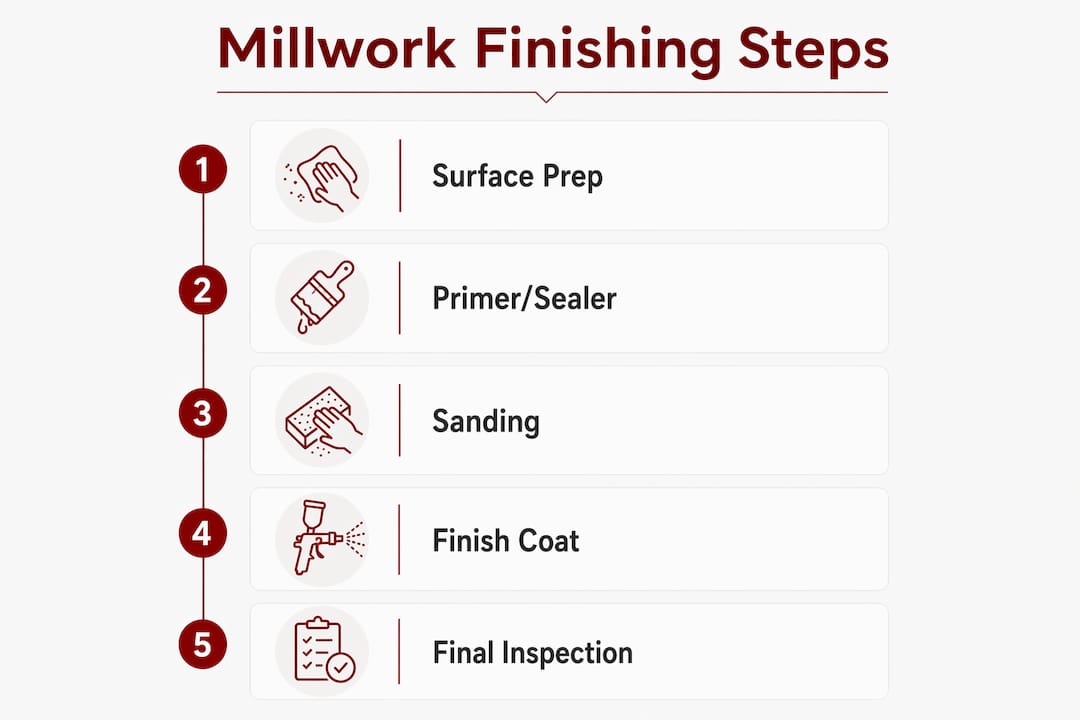
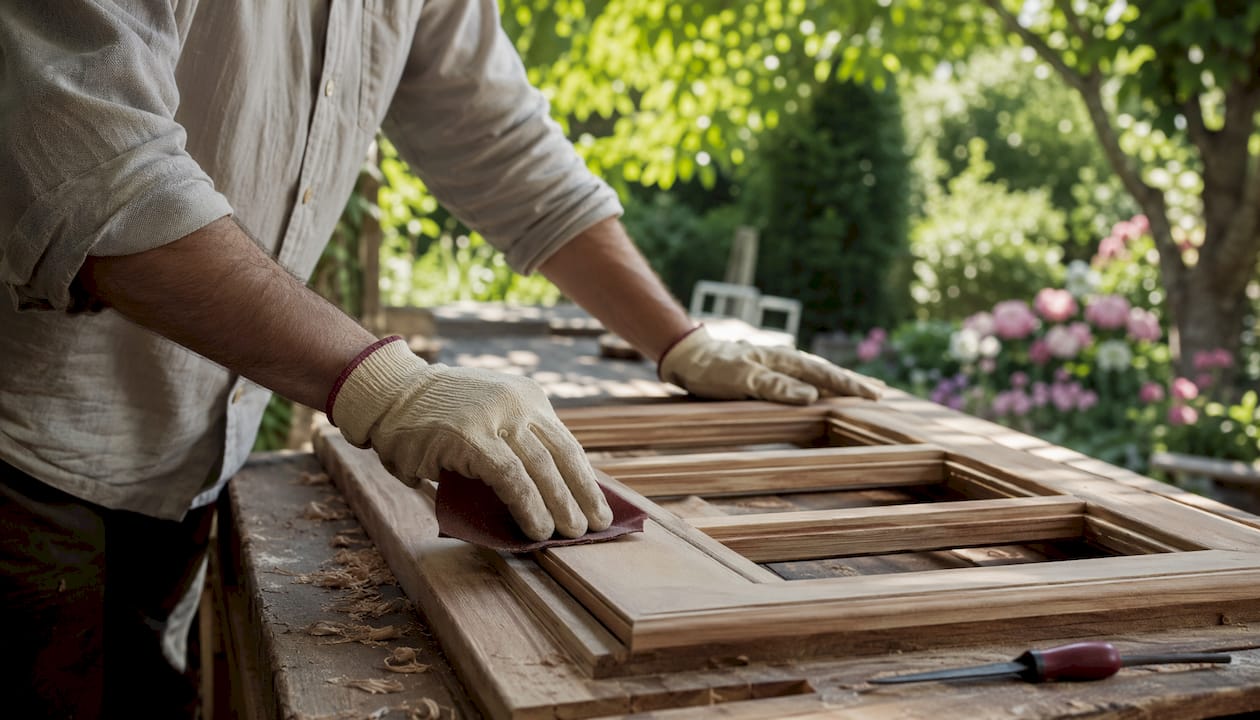
Surface preparation accounts for roughly 80% of final finish quality. The standard sequence runs from degreasing through progressive sanding grits, 120-grit to remove mill marks, 220-grit to refine, and 320-grit for a wash coat pass, then filling nail holes and cleaning before any finish coat touches the wood. Two thin coats with light sanding between them outperform a single heavy application every time.
Oil-based vs. water-based alkyd paints is a choice with real trade-offs. Modern waterborne alkyds deliver durability and smoothness comparable to traditional oil-based systems, but with lower VOC emissions and faster drying times. The industry has shifted steadily toward waterborne alkyds as environmental regulations tighten and product technology improves.
Step-by-step finishing process:
- Degrease and clean all surfaces before any abrasive work
- Sand progressively through 120-, 220-, and 320-grit as required by species and profile
- Apply a wash coat or sealer to raise and cut grain fibers
- Fill open pores if a smooth, filled surface effect is specified
- Apply stain or colorant, allow full penetration, and wipe uniformly
- Apply first topcoat; sand lightly with 320-grit after cure
- Apply final topcoat in a dust-free, temperature-controlled environment
Matching finishes for historic millwork demands particular care. Visual consistency depends on grain structure, light reflection, and sheen level working together. New wood species rarely match aged originals without careful stain layering and sheen calibration. For architectural millwork in Maryland’s historic districts, Gepettomillworks approaches each restoration by testing finish samples against original elements before committing to a full run.
Maryland providers serving this market include Halkias Custom Woodwork, Alex Woodworks & Construction LLC, Charm City Millwork, Mizell Woodworking & Millwork, Timberleigh Millworks, The Washington Woodworking Company LLC, and National Custom Millwork, Inc., alongside the AWI-certified firms noted above. The Washington Woodworking Company has operated for over 125 years, blending period craftsmanship with current technology. For carpentry planning that integrates finishing into the broader construction sequence, early coordination with your millwork manufacturer prevents costly specification mismatches.
Pro Tip: Involve your millwork manufacturer at the design stage, not after shop drawings are approved. The AWI recommends early manufacturer involvement to match finish specifications to actual exposure conditions without over-specifying expensive systems.
Key Takeaways
Professional millwork finishing requires matching the AWI finishing system to project exposure conditions, preparing surfaces through progressive sanding, and choosing factory application over site finishing whenever quality and consistency are the priority.
| Point | Details |
|---|---|
| Surface prep drives quality | Preparation accounts for roughly 80% of final finish quality; sanding through 120-, 220-, and 320-grit is standard. |
| Factory finishing is preferred | Controlled curing and uniform film thickness make factory application superior to site finishing for high-quality work. |
| Waterborne alkyds lead the shift | Modern water-based alkyds match oil-based durability with lower VOC emissions and faster drying. |
| Historic matching requires testing | Grain structure, sheen, and light reflection must align; sample testing against original elements is necessary before full application. |
| AWI certification signals expertise | Maryland providers holding AWI Quality Certification follow the thirteen-system standard, reducing specification errors and cost overruns. |
Gepettomillworks specializes in historic restoration millwork for Maryland properties, from period-accurate window and door replication to finish matching for historic tax credit eligibility. Contact Gepettomillworks to discuss your project’s finishing requirements.