
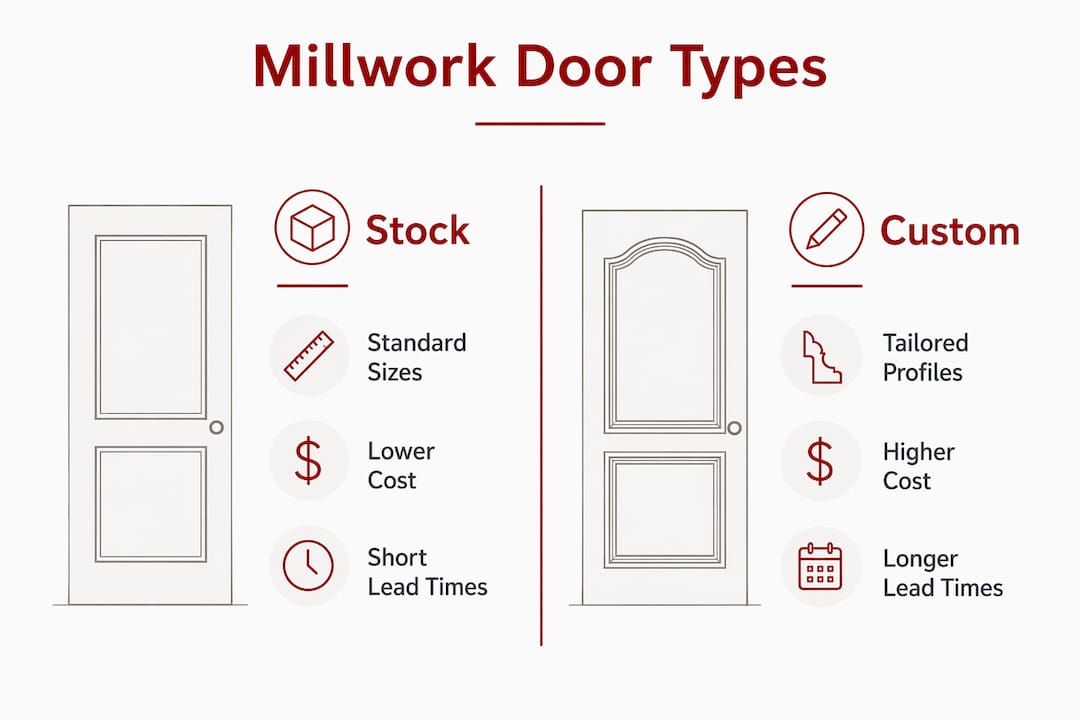
For most new construction and modest remodels, stock millwork doors deliver adequate proportion and finish at a fraction of the cost and lead time of custom work. When your project involves a historic structure, an unusual opening, or a period style that demands precise moulding geometry, custom fabrication is the only path that holds up to scrutiny.
Here is a quick map of common project types to the right door choice:
- New construction, standard openings: Stock catalog doors in Craftsman or contemporary profiles cover the vast majority of cases.
- Historic restoration or tax-credit project: Custom replication using documented profiles and period-correct joinery is required. The National Park Service preservation standards set the bar for what “matching” means in these contexts.
- High-end renovation, non-standard sizing: Custom millwork doors sized to the opening, finished to specification, and detailed to the period.
- Modest remodel, painted interior doors: Primed MDF or finger-jointed stock doors are cost-effective and hold paint well.
Pro Tip: Before you request a quote, photograph every existing door and casing in the space. A millworker who can see the existing shadow lines and panel proportions will give you a far more accurate estimate than one working from dimensions alone.
Gepettomillworks maintains documented archives spanning Prairie School, Mission Revival, and Bungalow styles, making it a strong resource when period accuracy is the priority.
Table of Contents
- What types of millwork doors are available, and which style fits your project?
- What materials and construction methods define high-quality millwork doors?
- How do you identify and replicate historic profiles and mouldings?
- What do you need to know about sizing, installation, and hardware?
- How should you approach finishes and long-term maintenance?
- What do stock and custom millwork doors typically cost, and how long do they take?
- How do you choose the right millwork door and the right millworker?
- Gepettomillworks: period-accurate custom millwork for Virginia projects
- Key Takeaways
- Why getting the proportions right matters more than getting the profile right
- Useful sources and further reading
What types of millwork doors are available, and which style fits your project?
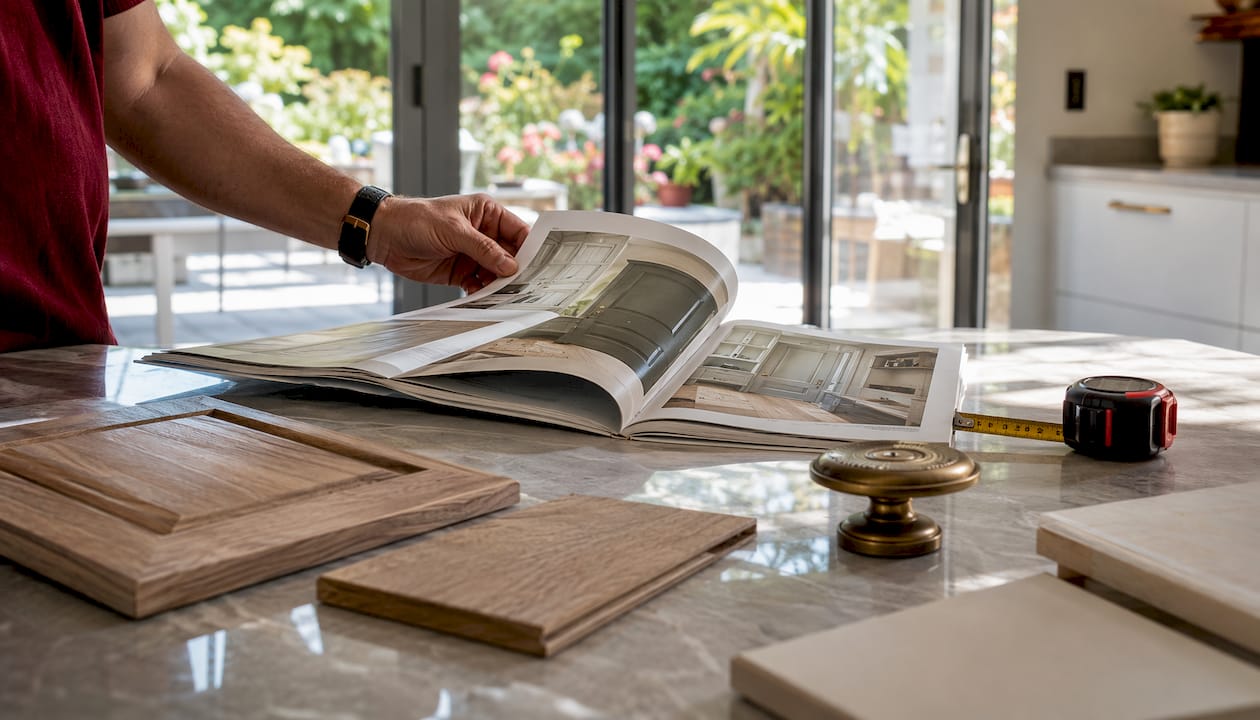
Stock millwork doors are catalog items: fixed sizes, standard profiles, and short lead times. They work well when the opening is a common dimension and the style is broadly compatible with the architecture. Custom millwork doors are fabricated to order, sized to the opening, and profiled to match a specified period or design intent.
Interior and exterior doors differ in more than exposure. Exterior doors require engineered cores or solid species with stable moisture dynamics, weather-resistant glazing, proper thresholds, and sealed end-grain to prevent delamination. Interior doors can use lighter construction, veneered panels, and a wider range of species.
Period styles that commonly drive custom door work include:
- Craftsman/Bungalow: Flat or slightly raised panels, square sticking, broad rails, and simple hardware. Species tend toward quartersawn white oak or Douglas fir.
- Prairie School: Horizontal emphasis, geometric glazing patterns, and restrained moulding profiles with strong linear shadow lines.
- Mission Revival: Arched openings, minimal ornamentation, and heavy proportions that read as solid and grounded.
- Federal: Symmetrical panel arrangements, delicate ovolo or bead-and-cove sticking, and elliptical or fanlight glazing above entry doors.
- Victorian: Elaborate moulding assemblies, multiple panel heights, and ornate hardware that almost always requires custom profile work.
- Art Deco: Geometric inlays, stepped reveals, and stylized hardware that rarely matches any stock catalog.
Style libraries from resources like Mouldings One pair period styles with specific profile geometries, which helps designers confirm whether a catalog match exists before commissioning custom grinding. Gepettomillworks’ new historic build archives show how these styles translate into fabricated assemblies.
What materials and construction methods define high-quality millwork doors?
Material choice determines durability, finish compatibility, and long-term stability. The most common options for custom wood doors are:
- Solid hardwoods (white oak, mahogany, walnut, poplar): Best for stained finishes and high-end painted work. Poplar is the standard choice for painted interior doors because it machines cleanly and holds primer well.
- Softwoods (Douglas fir, pine): Traditional for Craftsman and vernacular styles; dimensionally stable when properly dried and sealed.
- Engineered stile-and-rail cores with veneered faces: Reduce movement across wide panels while maintaining the appearance of solid wood. Standard for exterior doors where dimensional stability matters most.
- MDF and primed composites: Cost-effective for painted interior work; not suitable for exterior exposure without significant protective coating.
- PVC and fiber-cement trim: Used for exterior casing and surrounds where rot resistance outweighs the need for a wood substrate. Hammond Lumber stocks both PVC and composite exterior trim alongside custom millwork services.
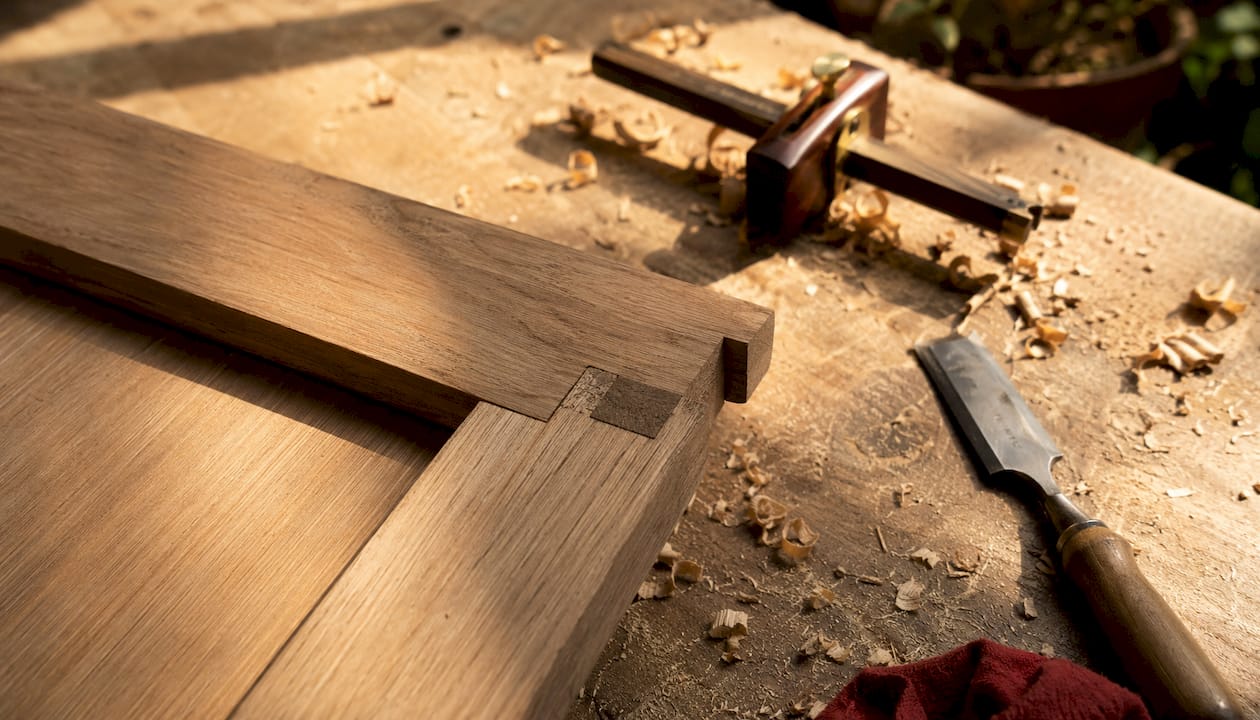
Construction quality shows in the joinery. Mortise-and-tenon rail connections, cope-and-stick joints on stile-and-rail doors, and glued-up panel assemblies with spline joints all indicate shop-grade fabrication. Doors assembled with pocket screws or loose dowels will rack and fail at the joints over time. The architectural details archives at Gepettomillworks document the joinery approaches used in period-correct fabrication.
For exterior structural elements such as posts and surrounds, engineered glulam products offer load-bearing capacity and dimensional stability while maintaining a traditional appearance. Preservative-treated exterior trim, such as the XT Trim lines described by Belco, can carry extended warranties and reduce long-term maintenance in humid Virginia climates.
How do you identify and replicate historic profiles and mouldings?
The workflow for accurate period matching follows a clear sequence:
- Document the existing profile. Photograph the casing, door stop, and base assembly in raking light to reveal shadow lines. Take a scaled rubbing using profile paper or a contour gauge, and measure the full section including reveal depths and fillet widths.
- Compare against a profile library. The Mason’s Mill historical moulding catalog organizes profiles by period and notes knife availability for reproduction. Large shops maintain libraries of thousands of knife profiles; where a match exists, turnaround is faster and cost is lower.
- Decide: catalog match or custom grinding. When no library knife matches the documented profile, custom grinding is the only reliable path to replication. This step is often required for projects seeking historic tax-credit eligibility, where preservation standards demand near-exact matches to existing historic fabric.
- Verify the full assembly, not just the single profile. A door casing that matches the head profile but uses a base of a different period reads as incorrect to a trained eye. Proportion, scale, and the relationship between casing, plinth block, and base must all align.
Successful period-correct renovation depends on breaking historical designs into their component mouldings and matching proportions across the full assembly, not just copying a single profile. A casing that is correct in section but scaled 15% too large will read as wrong even when the geometry is accurate.
Pro Tip: Send a contour-gauge tracing and a raking-light photograph to your millworker before the first call. It compresses the assessment process considerably and allows a shop to check its knife library before quoting.
Gepettomillworks’ replica millwork archives document the profile-matching process across multiple period styles, including cases where custom knife grinding was required to achieve preservation-standard accuracy.
What do you need to know about sizing, installation, and hardware?
Standard interior door widths run 2/0 through 3/0 (24"–36"), with heights typically at 6/8 or 8/0. Historic structures in Virginia often present narrower openings, taller floor-to-ceiling heights, or out-of-square frames that require custom sizing. Exterior doors for period homes frequently need custom widths and heights to match original proportions.
Pre-hung units include the door, jamb, hinges, and often the stop and casing. They simplify installation and reduce field labor, but require accurate rough-opening dimensions. Slab-only deliveries give contractors more control over jamb profiles and reveal tolerances, which matters when matching existing historic jamb details.
Key installation coordination points:
- Jamb profiles must match or complement existing casing assemblies.
- Reveal tolerances (typically 1/8") should be confirmed before the door is hung.
- Exterior doors require field sills, thresholds, and weatherstripping specified before fabrication.
- Contractor handoff points for glazing, hardware, and finish should be defined in the contract.
Hardware selection carries as much period weight as the door itself. Mortise locksets are standard for Federal, Victorian, and Craftsman doors. Surface-mounted closers and rim locks suit certain period styles. Knob and lever profiles, escutcheon shapes, and hinge finishes should all reference the architectural period. For exterior doors, threshold and weatherstripping choices affect both energy performance and the visual base of the door assembly.
How should you approach finishes and long-term maintenance?
Paint systems for millwork doors require a quality primer applied to all six faces, including end-grain, before installation. End-grain absorption is the primary site of moisture infiltration and finish failure, particularly on exterior doors. Two-coat primer followed by a waterborne or alkyd topcoat is standard for painted interior work; exterior doors benefit from an additional topcoat and annual inspection.
Stained finishes require a species with visible grain character (oak, mahogany, fir) and a penetrating oil or wiping varnish base before topcoating. UV-cured factory finishes offer the most durable stain protection for exterior applications but require factory application before delivery.
Maintenance intervals by application:
- Interior painted doors: Inspect annually; repaint every 7–10 years or when finish shows cracking.
- Exterior painted doors: Inspect twice yearly; repaint every 3–5 years depending on sun and moisture exposure.
- Stained exterior doors: Re-coat every 2–3 years; inspect thresholds and weatherstripping annually.
For sustainable material sourcing, specify FSC-certified hardwoods or reclaimed lumber where the species and grade are appropriate. Low-VOC waterborne finishes are widely available and perform comparably to solvent-based systems for interior applications. Belco’s preservative-treated exterior trim illustrates how engineered and treated products can reduce maintenance cycles without sacrificing appearance.
What do stock and custom millwork doors typically cost, and how long do they take?
| Door Type | Relative Cost | Typical Lead Time | Key Cost Drivers |
|---|---|---|---|
| Stock catalog door | Lowest | 1–2 weeks | Species, size, finish option |
| Custom standard profiles | Moderate | 4–8 weeks | Species, panel complexity, finish |
| Full historic replication | Highest | 8 weeks | Profile grinding, joinery, documentation |
Factors that move a quote higher: rare species, multiple raised panels, custom-ground profiles, factory finish, glazing, and installation scope. Seasonality affects shop schedules; orders placed in late summer or early fall often face longer queues as contractors prepare for winter interior work.
When reviewing quotes, look for itemized line items covering fabrication, finishing, hardware, shipping, and installation separately. A single lump-sum quote for a complex historic door makes it impossible to evaluate where cost is concentrated or to make informed substitutions.
How do you choose the right millwork door and the right millworker?
- Define project priorities: period accuracy, budget, lead time, and finish type.
- Confirm style, size, and finish before contacting suppliers.
- Request documented samples and ask whether the shop’s knife library includes your profile.
- Confirm warranty coverage and whether installation is included or contracted separately.
- Ask for references from comparable historic or custom projects.
Questions worth asking any millworker:
- What period styles are represented in your profile library?
- Can you show photographs of past work at a similar scale and period?
- Do you offer custom profile grinding, and what is the lead time for a new knife?
- What documentation do you provide for preservation or tax-credit compliance?
Red flags: vague specifications with no profile drawings, no sample photographs of completed work, no documented joinery details, and unclear warranty terms. A millworker who cannot show you a knife library or a profile catalog is unlikely to deliver period-accurate results.
Trust signals that carry real weight: preserved project archives organized by period style, restoration case studies with before-and-after documentation, demonstrated experience with historic tax-credit compliance, and qualified restoration craftsmen with verifiable trade credentials. Regional lumber suppliers like Hammond Lumber encourage in-person sample review and custom quoting, which is a reasonable first step for straightforward projects.
Pro Tip: Review the wood door suppliers guide before your first millworker conversation. Knowing what a capable shop looks like makes it easier to identify gaps in a quote or a portfolio.
Gepettomillworks: period-accurate custom millwork for Virginia projects
When a project requires documented historic matches, custom profile grinding, or fabrication that may affect tax-credit eligibility, Gepettomillworks offers a direct path from profile documentation to finished door.
The shop maintains archives across Prairie School, Mission Revival, and Bungalow styles, with documented joinery and fabrication records that support preservation compliance. Services cover custom design and fabrication, historic-style profile matching, period-correct finishing, and project documentation for restoration work.
To request an assessment, send photographs of the existing opening, a contour-gauge tracing or scaled rubbing of the profile, your desired finish, and your project timeline. Gepettomillworks will confirm whether an archive match exists or whether custom grinding is required, and provide a scoped quote from there. Contact Gepettomillworks at gepettomillworks.com to start the conversation.
Key Takeaways
Custom millwork doors for historic or period-correct projects require documented profile matching, period-appropriate joinery, and a millworker with verifiable archives and custom grinding capability.
| Point | Details |
|---|---|
| Stock vs. custom | Stock doors suit standard openings and modest remodels; custom fabrication is required for period accuracy, unusual sizing, or tax-credit projects. |
| Profile documentation | Photograph, rub, and measure existing profiles before contacting a millworker — it compresses the assessment and improves quote accuracy. |
| Material and joinery | Mortise-and-tenon and cope-and-stick construction signal shop-grade quality; engineered cores improve stability for exterior doors. |
| Cost and lead time | Full historic replication carries the highest cost and longest lead time (8 weeks); stock doors typically arrive in 1–2 weeks. |
| Gepettomillworks | Maintains Prairie School, Mission Revival, and Bungalow archives with custom grinding capability for period-correct and preservation-compliant projects. |
Why getting the proportions right matters more than getting the profile right
The conventional wisdom in millwork restoration focuses on the profile: match the ogee, replicate the bead, grind the cove to the correct radius. That instinct is correct as far as it goes, but it misses the more consequential variable. Proportion governs how a door reads in a room. A casing with a geometrically accurate profile that is scaled 20% larger than the original will look wrong to anyone who has spent time in period buildings, even if they cannot articulate why.
Virginia’s historic building stock, from Federal-era townhouses in Alexandria to Craftsman bungalows in Richmond’s Fan District, carries proportional relationships between door width, casing width, panel height, and ceiling height that were not arbitrary. They were derived from classical systems, regional craft traditions, and the specific material constraints of the period. When those relationships are broken, the restoration loses its cultural legibility, and in tax-credit contexts, it can lose its eligibility.
The shop-level implication is practical: stage the site before delivery. Wood doors acclimate to ambient humidity, and a door delivered to a construction site with open windows in February will move differently than one installed in a climate-controlled interior. Allow 72 hours of acclimation in the finished space before hanging, and seal all six faces before the door goes in the opening.
Gepettomillworks’ classical architecture archives and 19th-century home documentation reflect this proportional discipline across multiple period styles, which is why the archive is useful not just as a profile reference but as a proportional guide for the full door assembly.
Useful sources and further reading
| Resource | What you will find there |
|---|---|
| National Park Service — Tax Incentives for Historic Preservation | Preservation standards and tax-credit eligibility guidance for restoration projects |
| Mason’s Mill Historical Moulding Catalog | Period-organized profile library with knife availability notes for reproduction work |
| Mouldings One — Architectural Styles | Curated profile sets mapped to architectural periods; useful for style confirmation before custom grinding |
| Belco — Exterior Millwork Designs | Material trade-offs for exterior millwork, including preservative-treated and engineered options |
| Hammond Lumber — Moulding Options | Regional supplier with PVC, composite, and custom millwork; useful for in-person sample review |
| Gepettomillworks — Replica Millwork Archives | Documented profile-matching cases across multiple period styles |
| Gepettomillworks — Architectural Design Woodworking | Fabrication process documentation and custom millwork project examples |
| Period property renovation guide | Trade-offs and techniques for period-property restoration, including millwork and joinery |
| The role of joinery in a home build | Practical overview of joinery workflows and contractor coordination for custom millwork projects |