
What is millwork carpentry, and how does it differ from general carpentry?
Millwork carpentry is the discipline of producing custom architectural wood elements through precision factory fabrication, then integrating those elements on-site through skilled finish carpentry. The result is woodwork that achieves a level of dimensional consistency and decorative refinement that purely site-based construction cannot reliably replicate.
The distinction between millwork and carpentry is more than logistical. Millwork is fabricated off-site in controlled factory environments, where CAD/CNC technology governs tolerances and decorative profiles with exacting precision. General carpentry, by contrast, is site-based and oriented toward structural assembly, framing, and adaptive problem-solving in the field. Millwork involves longer setup and fabrication times, but the on-site installation phase is considerably shorter and more predictable.
Custom millwork draws on premium hardwoods, veneers, and period-appropriate profiles to match historic or architecturally specific details. Mass-produced millwork relies on standard profiles and lower-cost materials such as MDF, which reduces unit cost but eliminates the capacity for exact architectural replication. For historic buildings, that distinction is decisive.
Core characteristics of millwork carpentry at a glance:
- Fabricated off-site under controlled conditions using CAD/CNC machinery
- Focused on decorative and design-centric elements: moldings, cabinetry, doors, paneling, staircases, and architectural trim
- Governed by quality-control standards that ensure consistent profiles and finishes across an entire project
- Installed on-site by finish carpenters who adapt factory-precise components to real-world building conditions
- Capable of replicating period architectural features for historic preservation and tax credit compliance
- Distinct from structural carpentry, which prioritizes load-bearing assembly over decorative precision
Table of Contents
- How millwork carpentry developed across American architectural history
- Where millwork carpentry matters most: construction and restoration applications
- Training and certification pathways for millwork and finish carpentry
- Historic millwork specialization: where craftsmanship and architectural scholarship converge
- What drives the cost of a millwork carpentry project?
- How to maintain millwork installations for long-term durability
- Gepettomillworks: custom historic millwork fabricated for South Carolina’s architectural heritage
- Key Takeaways
How millwork carpentry developed across American architectural history
American millwork has its roots in the water-powered sawmills of the colonial period, when the abundance of old-growth timber and the demands of rapid settlement drove the earliest standardization of wood components. By the mid-nineteenth century, steam-powered mills were producing window sash, door frames, and decorative moldings at a scale that made architectural ornament accessible far beyond the wealthiest households.
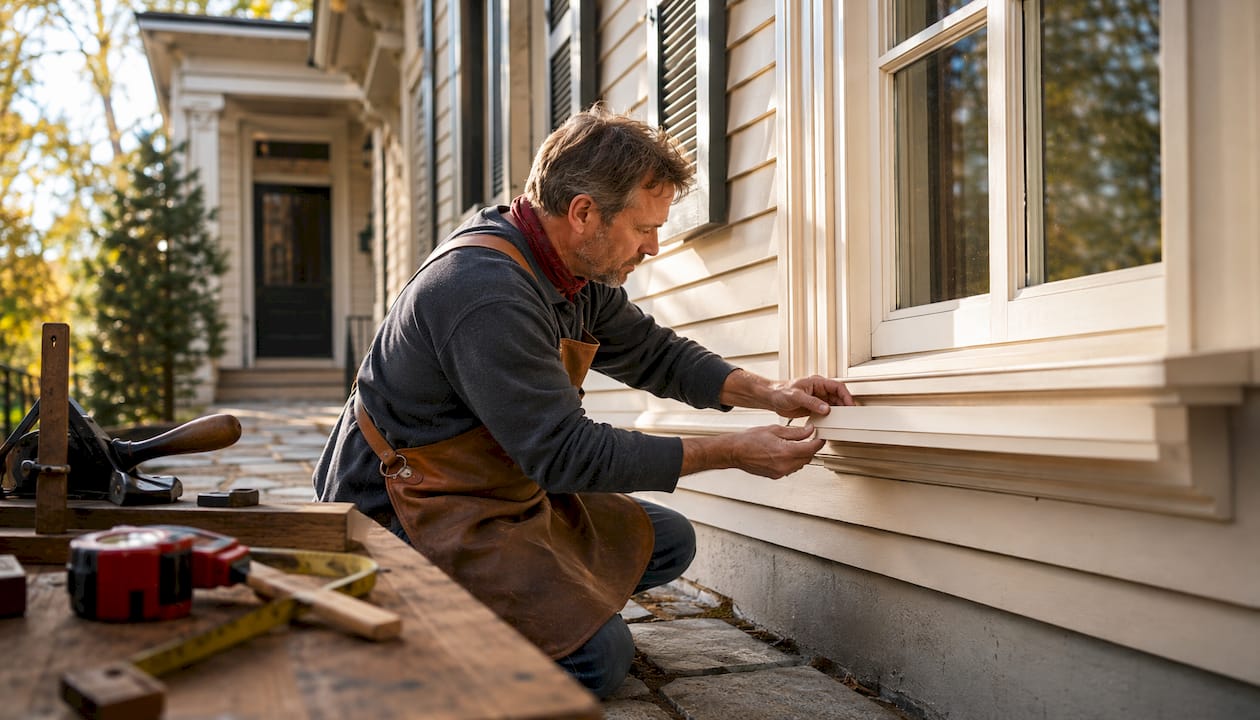
The late Victorian era accelerated this democratization. Pattern books by architects such as Andrew Jackson Downing and the proliferation of mail-order millwork catalogs allowed builders across the country to specify Italianate brackets, Eastlake spindles, and Queen Anne fretwork with reasonable confidence that the components would arrive dimensionally consistent. The Craftsman-style millwork movement of the early twentieth century represented a deliberate reaction to that industrial excess, favoring quartersawn oak, exposed joinery, and restrained profiles that expressed the integrity of the material itself.
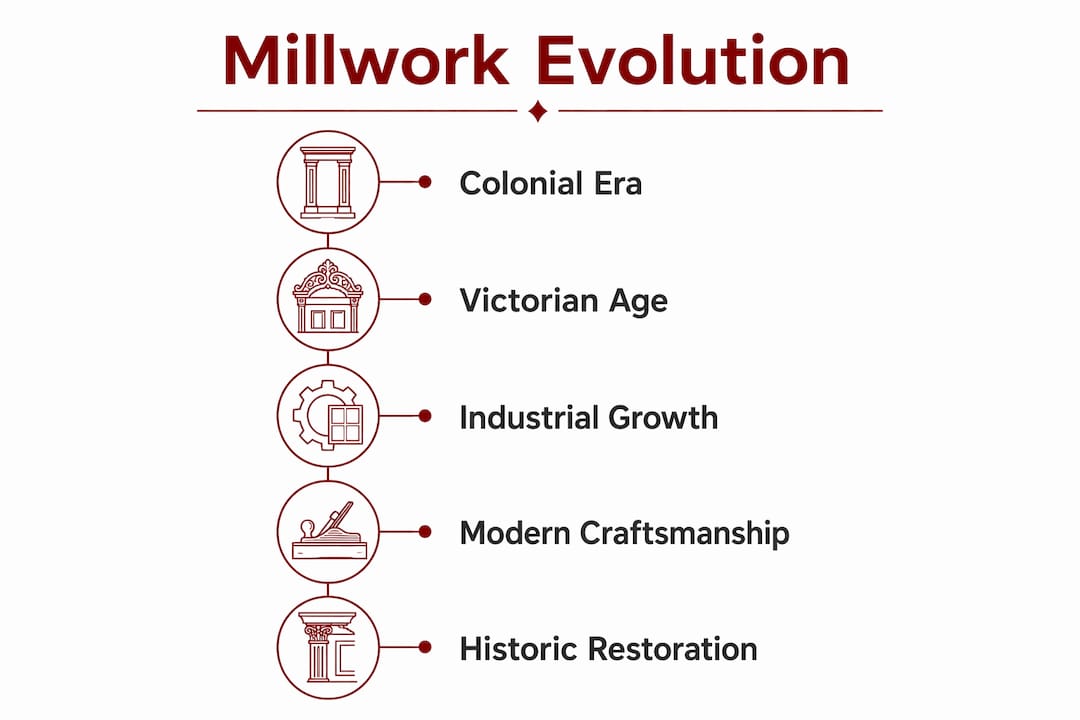
The postwar decades brought a contraction in decorative millwork as modernist aesthetics and cost pressures reduced interior trim to minimal profiles. The historic preservation movement of the 1970s and 1980s reversed that trajectory, creating sustained demand for period-accurate millwork in restoration projects. The introduction of CNC routing in the 1990s gave fabricators the ability to reproduce complex historic profiles, from Mission Revival arcading to Prairie School geometric banding, with a precision that hand-routing could not consistently achieve.
Key milestones in U.S. millwork history:
- Colonial-era water-powered sawmills establish the first standardized wood components
- Mid-1800s steam mills enable mass production of decorative moldings and sash
- Late Victorian pattern books and catalogs distribute period millwork nationally
- Early 1900s Arts and Crafts movement reorients millwork toward material honesty and joinery craft
- 1970s–1980s preservation movement revives demand for historically accurate fabrication
- 1990s–2000s CNC technology enables precise replication of complex historic profiles
Where millwork carpentry matters most: construction and restoration applications
Millwork carpentry contributes to three broad project categories: new residential construction, commercial interiors, and historic restoration. Each demands a different balance of design collaboration, material selection, and fabrication precision, but all three share the same underlying requirement for woodwork that performs structurally while reading as architecturally coherent.
In residential construction, the principal millwork elements are base moldings, door and window casings, crown moldings, wainscoting, built-in cabinetry, and staircases. These components define the interior character of a home more than almost any other finish decision. In commercial settings, millwork extends to reception millwork, wall paneling systems, and custom casework that must meet both aesthetic and code-compliance requirements.
Historic restoration is where millwork carpentry reaches its greatest complexity. Replicating a Federal-period fanlight, a Greek Revival entablature, or a Victorian-era newel post requires not only technical fabrication skill but also a thorough understanding of period joinery conventions and material behavior. Projects pursuing historic tax credit eligibility must demonstrate that replacement millwork matches the original in profile, material, and finish, a standard that mass-produced components cannot meet.
Factory fabrication supports sustainable building by reducing lumber waste, minimizing off-cut scrap, and limiting VOC exposure on-site. Carpenters then adapt those precision-fabricated components to the inevitable irregularities of existing structures, reconciling factory tolerances with walls that have shifted over decades. That collaboration between off-site precision and on-site adaptability is what produces the highest-quality architectural woodwork outcomes.
Typical millwork applications by project type:
- Residential: base and crown moldings, door and window casings, built-in cabinetry, staircases, wainscoting
- Commercial: reception millwork, wall paneling, custom casework, decorative ceiling systems
- Historic restoration: period-accurate window sash, door surrounds, entablatures, newel posts, and fretwork
- New construction with historic character: Prairie-style millwork, Craftsman built-ins, neoclassical trim packages
Training and certification pathways for millwork and finish carpentry
Formal training in architectural carpentry spans vocational programs, community college certificates, and dedicated craft schools. The Architectural Carpentry program at the Academy of Classical Building Arts, for example, covers traditional woodworking techniques alongside the period-specific knowledge required for historic replication work. Vocational training programs for architectural carpentry include specialized millwork techniques and finishing skills that are directly applicable to replicating historic details.
Certification requirements vary by state, but licensure is often decisive for legal contracting and client confidence. In California, the C-6 license classification governs millwork and finish carpentry contractors, covering cutting, joining, fabricating, and on-site installation of wood products including cabinetry and doors. That classification replaced the older C-5 category in 2003 to refine licensing standards. Other states maintain comparable contractor licensing structures, and South Carolina’s contractor licensing board similarly requires demonstrated competency for finish and specialty carpentry work.
Apprenticeship components typically include hands-on training in hand-tool joinery, power tool operation, CAD/CNC programming, and finish techniques such as staining, glazing, and pre-finishing. The last skill is particularly consequential: pre-finishing trim pieces before installation produces cleaner results and more durable surfaces than finishing in place.
Core competencies developed through millwork training:
- Hand-tool joinery: mortise-and-tenon, dovetail, cope-and-stick
- CAD drafting and CNC programming for profile replication
- Wood species identification and material selection for period accuracy
- Finish carpentry installation: scribing, coping, mitering, and fitting to irregular surfaces
- Surface preparation and pre-finishing techniques
- Reading architectural drawings and collaborating with preservation architects
Historic millwork specialization: where craftsmanship and architectural scholarship converge
The most demanding millwork work is not the production of new profiles but the accurate replication of those that no longer exist in any catalog. A 19th-century plantation home in the South Carolina Lowcountry may carry Greek Revival pilasters, Federal-period mantelpieces, and Italianate window hoods on the same facade, each requiring a different fabrication approach and a different understanding of period joinery conventions.
Successful historic millwork restoration depends on reading the building itself as a primary document. The surviving profiles, tool marks, and joinery details embedded in original fabric tell you more about what the replacement must be than any pattern book. Fabrication precision matters, but it must be preceded by careful material investigation and measured drawing of what remains.
Dry fitting all millwork components on-site before final fastening is a practice that separates disciplined restoration work from expedient installation. Dry fitting prevents misalignment and allows correction of irregularities before they become permanent, a discipline especially critical when working within the dimensional tolerances of historic fabric that has moved, settled, or been altered over generations.
Pro Tip: When replicating historic trim profiles, always take a physical cross-section sample from surviving original material and use it as the shop template rather than relying solely on measured drawings. Dimensional drawings can carry cumulative errors; the original wood does not.
Gepettomillworks brings this level of scholarly and technical rigor to every historic restoration project, combining measured investigation, period-accurate fabrication, and finish carpentry installation to produce results that satisfy both preservation standards and the expectations of architects and building owners who understand the difference.
What drives the cost of a millwork carpentry project?
Millwork carpentry costs more than standard carpentry primarily because of factory precision, material quality, and the degree of design customization involved. A straightforward base molding package in a standard profile costs far less than a bespoke entablature replicating a specific Federal-period design, even when both are produced in the same shop.
The principal cost drivers are material selection, profile complexity, finish specification, and installation conditions. Premium hardwoods such as white oak, cherry, and old-growth heart pine carry significantly higher material costs than poplar or MDF. CNC-routed profiles with multiple passes and tight tolerances require more machine time than simple single-pass moldings. Pre-finishing with multiple coats of oil-based paint or stain adds labor but reduces on-site time and produces a more durable result.
Historic restoration projects carry additional cost factors: measured drawing of surviving original fabric, material sourcing to match species and grain character, and the slower installation pace required when working within existing historic structure. Projects pursuing federal or state historic tax credits must also meet documentation standards that add professional time to the process. For residential and commercial projects alike, the investment in custom millwork consistently returns value in architectural character and long-term durability that mass-produced alternatives cannot match.
How to maintain millwork installations for long-term durability
Wood millwork is a durable material when properly finished and maintained, but it responds to moisture, temperature cycling, and UV exposure in ways that require periodic attention. The finish coat is the primary line of defense: oil-based paints and penetrating oil finishes provide superior moisture resistance compared to latex, particularly on exterior millwork elements such as window sash, door surrounds, and porch trim.

Interior millwork in South Carolina’s humid climate benefits from maintaining consistent indoor humidity levels, ideally between 35% and 55%, to minimize the seasonal expansion and contraction that opens joints and cracks paint films. Nail holes and minor joint gaps should be filled with wood filler rather than caulk, which tends to shrink and crack over time. Caulk is appropriate for the interface between wood and adjacent materials, not for filling voids within the wood itself.
Periodic inspection of painted exterior millwork should include probing for soft spots at end grain, checking sill nosings and drip edges for paint film failure, and examining any joint where water could pool. Catching and addressing these points early, with spot-priming and repainting before the wood substrate is compromised, extends the service life of millwork installations by decades. Historic millwork that has survived a century or more in South Carolina’s climate is a testament to what sound fabrication, proper finishing, and attentive maintenance can achieve together.
Gepettomillworks: custom historic millwork fabricated for South Carolina’s architectural heritage
South Carolina’s built environment carries some of the most architecturally significant historic fabric in the country, from the Federal-period townhouses of Charleston’s South of Broad neighborhood to the Lowcountry plantation houses that defined antebellum domestic architecture. Preserving that fabric demands millwork fabrication that goes beyond catalog profiles and standard dimensions.

Gepettomillworks specializes in the custom design, fabrication, and restoration of wood windows, doors, trim, cabinetry, staircases, and architectural millwork for historic buildings. Every project begins with measured investigation of surviving original material, proceeds through period-accurate shop fabrication, and concludes with finish carpentry installation that meets the documentation standards required for historic tax credit eligibility. Whether the project involves replicating a lost Federal mantelpiece, restoring a set of six-over-six double-hung sash, or fabricating a complete interior trim package for a qualified restoration craftsman working on a National Register property, Gepettomillworks brings the fabrication precision and preservation knowledge the work requires. Contact Gepettomillworks to discuss your project and receive a custom fabrication consultation.
Key Takeaways
Custom millwork carpentry combines off-site factory fabrication with skilled on-site finish carpentry to produce architecturally precise woodwork that mass-produced alternatives cannot replicate, particularly in historic restoration contexts.
| Point | Details |
|---|---|
| Millwork vs. carpentry | Millwork is fabricated off-site with CAD/CNC precision; carpentry is site-based and structurally adaptive. |
| Historic restoration demands | Replicating period profiles for tax credit eligibility requires custom fabrication, not catalog components. |
| Training and certification | Programs cover hand-tool joinery, CNC operation, and finish techniques; state licensing governs contracting. |
| Cost drivers | Material species, profile complexity, finish specification, and historic documentation requirements all affect project cost. |
| Gepettomillworks | Specializes in custom historic millwork fabrication and restoration for South Carolina’s architecturally significant buildings. |