
Which custom trim providers in North Carolina serve historic and architectural projects?
For architectural professionals and historic homeowners across North Carolina, the search for qualified custom trim near me yields a distinct set of regional specialists, each with particular strengths in fabrication, period accuracy, and material expertise. The table below maps the verified local providers against the criteria that matter most for historic and architectural work.
| Provider | Core Services | Specialization | Location | Pricing Approach | Customization |
|---|---|---|---|---|---|
| Gepettomillworks | Windows, doors, trim, cabinetry, staircases, architectural millwork | Historic restoration, period replication, tax credit eligibility | North Carolina | Quote-based | Full custom design and fabrication |
| Cardinal Millwork & Supply, Inc. | Custom millwork, mouldings, cabinets, shutters, stair parts, beam work | CNC machining, interior trim | Greensboro, NC | Quote-based | High; CNC-driven profiles |
| JT’s Woodworking | Custom woodworking solutions | Local custom fabrication | Clayton, NC | Quote-based | Moderate |
| Timbers NC Interior Trim | Custom trim, built-in furniture | Interior trim, built-ins | Kenly, NC | Quote-based | Tailored to client design vision |
| Custom Trim Co LLC | General contracting, custom trim | Architectural trim | Raeford, NC | Quote-based | Custom |
| J.B. Custom Trim Molding and Finish Carpentry | Trim fabrication, finish carpentry | Custom molding, finish work | Seven Lakes, NC | Quote-based | Custom fabrication |
| Villegas Custom Trim LLC | Tailored trim solutions | Local custom trim | Kenly, NC | Quote-based | Custom |
Quote-based pricing across all seven providers reflects the inherent individuality of each project, where design complexity, wood species selection, and profile intricacy all shape the final scope. Historically accurate custom millwork is also essential for qualifying for historic tax credits, which adds another layer of specificity to the fabrication process that mass-market suppliers simply cannot address.
As the National Park Service notes, mass-market trim lacks the period-accurate profiles and wood species necessary for historic building restoration, making specialist providers the only viable path for preservation work.
Table of Contents
- How to choose the right custom trim provider for your project
- Gepettomillworks: precision millwork for North Carolina’s historic buildings
- Key Takeaways
How to choose the right custom trim provider for your project
Selecting a qualified provider for custom wood trim near me, particularly for historic or architecturally significant buildings, requires a structured evaluation that goes well beyond price comparison.
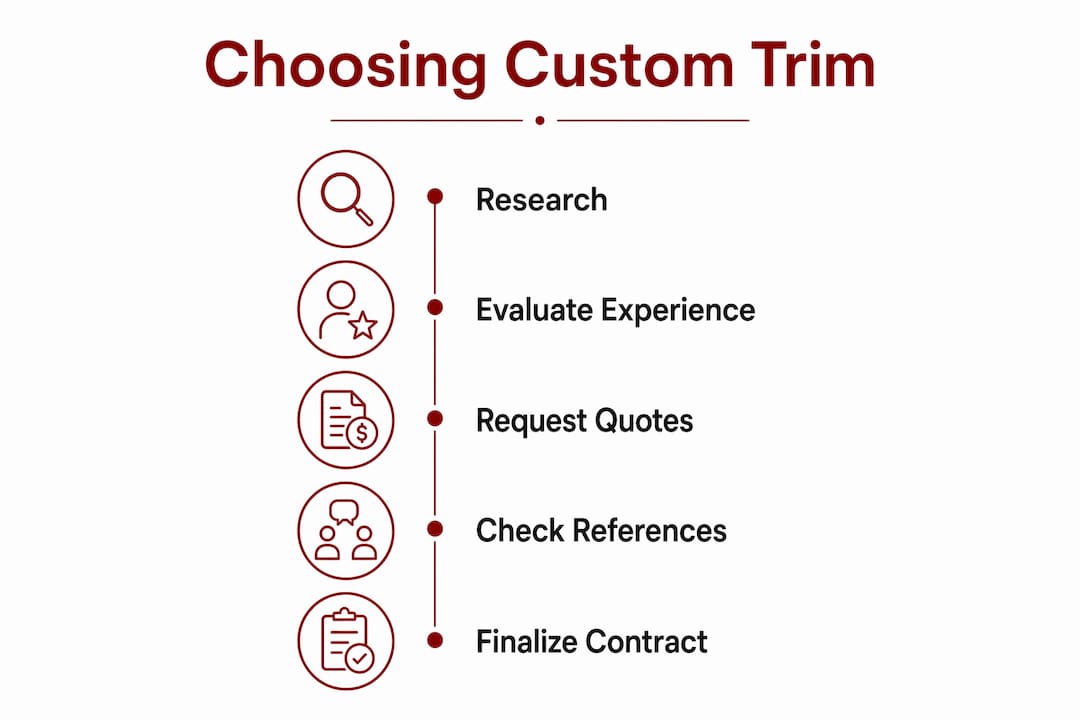
Experience with historic buildings is the single most decisive criterion. A provider who has replicated Federal-period architraves or Greek Revival pilaster casings understands the dimensional tolerances and profile geometries that preservation standards demand. Ask directly whether the firm has worked on projects subject to State Historic Preservation Office review or federal historic tax credit documentation.

Material expertise shapes every downstream decision. For period-accurate custom moldings, natural wood species remain the standard: pine and poplar for paint-grade Colonial and Federal interiors, white oak for Craftsman and Prairie School applications, and walnut or cherry for high-end stain-grade installations. Material selection in 2026 U.S. custom trim projects typically follows three paths: natural wood for traditional stain-grade finishes, MDF for paint-grade affordable trim, and PVC or vinyl for moisture-prone areas such as exterior sills or bathroom wainscoting.
Key questions to ask any prospective provider:
- Can you provide references from completed historic restoration or tax credit projects?
- What wood species do you stock or source for period-accurate profiles?
- Do you offer measured drawings or shop drawings before fabrication begins?
- What is your typical lead time from consultation to delivery and installation?
- How do you handle profile matching when original trim is damaged or missing?
Red flags worth noting: vague or verbal-only pricing with no written estimate, inability to name specific historic projects in their portfolio, and no familiarity with the Secretary of the Interior’s Standards for Rehabilitation. A provider who cannot distinguish between a cyma recta and an ovolo profile is unlikely to replicate a neoclassical cornice with the fidelity a preservation review requires.
Timeline expectations for custom baseboards nearby or more complex architectural millwork typically run several weeks from initial consultation through fabrication and installation, depending on profile complexity, wood species availability, and project scale. Simpler paint-grade trim for a single room may fall at the shorter end; a full staircase restoration with period-accurate balusters and newel posts will occupy the longer range. For broader context on how custom interior trim fits within a full home remodeling project, the scope and sequencing of trim work relative to other trades is worth mapping early.
Pro Tip: When a project must qualify for federal or state historic tax credits, ask your provider whether their shop drawings and material specifications are formatted to support the Part 2 Historic Preservation Certification Application. Gepettomillworks produces documentation aligned with these requirements, which can materially reduce the administrative burden on the architect of record.
Gepettomillworks: precision millwork for North Carolina’s historic buildings

Where other local trim providers offer capable fabrication for contemporary or light-commercial applications, Gepettomillworks occupies a more specific position: the full-cycle custom millwork partner for historic buildings, from measured field documentation through period-accurate fabrication and final installation. The firm’s scope covers wood windows, doors, interior and exterior trim, cabinetry, staircases, and architectural millwork, with particular depth in replicating features that must satisfy historic tax credit eligibility requirements.
That distinction carries real weight for architectural professionals managing preservation projects. Matching a surviving section of historic replica millwork demands not only the correct profile geometry but the right species, grain orientation, and finish preparation, all documented to a standard that a State Historic Preservation Office reviewer will accept. Gepettomillworks brings that combination of craft and documentation discipline to every engagement.
For qualified restoration craftsmen and the architects who specify their work, the practical next step is a project consultation. Contact Gepettomillworks directly to discuss your building’s period, surviving trim conditions, and tax credit requirements, and to receive a detailed project quote.
Key Takeaways
North Carolina’s strongest custom trim providers for historic and architectural work are distinguished by period-accuracy, material expertise, and documentation capability, with Gepettomillworks offering the most comprehensive historic restoration scope in the state.
| Point | Details |
|---|---|
| Specialist providers are essential | Mass-market trim cannot replicate the period-accurate profiles required for historic restoration or tax credit eligibility. |
| Material choice is project-specific | Natural wood, MDF, and PVC each serve different finish, budget, and environmental conditions in custom trim work. |
| Evaluation requires direct questions | Ask every provider about historic project references, profile-matching capability, and shop drawing documentation. |
| Timelines vary by complexity | Custom trim projects typically run four to twelve weeks from consultation through installation. |
| Gepettomillworks leads in historic scope | Gepettomillworks covers the full cycle from documentation to fabrication and installation, aligned with historic tax credit requirements. |