
The best woods for exterior doors are white oak, Honduras mahogany, and Accoya for most U.S. climates, with teak and sapele as strong premium alternatives. Each species earns its place through a specific combination of rot resistance, dimensional stability, and finishability — and the right pick depends on your exposure, maintenance commitment, and whether the door must match a historic profile.
Quick shortlist:
- White oak — Best for durability and sustainable sourcing; mid-range cost
- Honduras mahogany (Swietenia macrophylla) — Best for historic accuracy and fine staining; mid-to-premium cost
- Sapele — Best mahogany-family alternative with interlocked grain; mid-range cost
- Western red cedar — Best for sheltered, rustic, or craftsman applications; low-to-mid cost
- Douglas fir — Best cost-effective painted door; entry-to-mid cost
- Accoya (acetylated radiata pine) — Best for coastal or wet exposure with minimal maintenance; premium cost
- Teak — Best natural low-maintenance option for full sun and coastal salt; premium cost
- Knotty alder — Best for warm aesthetic appeal in sheltered, dry climates; low-to-mid cost
Key Takeaways
White oak and Honduras mahogany are the most reliable all-climate choices for exterior wood doors; Accoya is the preferred specification where coastal or wet exposure makes regular maintenance impractical.
| Point | Details |
|---|---|
| Top all-climate picks | White oak and Honduras mahogany offer the best balance of durability, stability, and finishability across U.S. climates. |
| Coastal and wet exposure | Accoya (acetylated wood) carries a 50-year above-ground warranty and outperforms natural species in high-humidity and coastal conditions. |
| Finish is non-negotiable | Marine-grade finishes with UV blockers are required for clear-coated doors; recoat every 2–3 years on south- and west-facing exposures. |
| Hardware and end grain | Seal all end grain before finishing; specify heavy-plate ball-bearing hinges sized to the door weight to prevent jamb failure. |
| Gepettomillworks | Gepettomillworks fabricates and restores exterior doors in white oak, mahogany, and Accoya for historic and period-accurate projects across the U.S. |
Table of Contents
- How do common species compare at a glance?
- Detailed profiles for each recommended species
- How to finish and construct a wood door that lasts decades
- Questions to ask your millworker and red flags to avoid
- When engineered or modified wood is the right call
- The species choice that most buyers get wrong
- Gepettomillworks crafts exterior doors built to last generations
- Useful sources and references
How do common species compare at a glance?
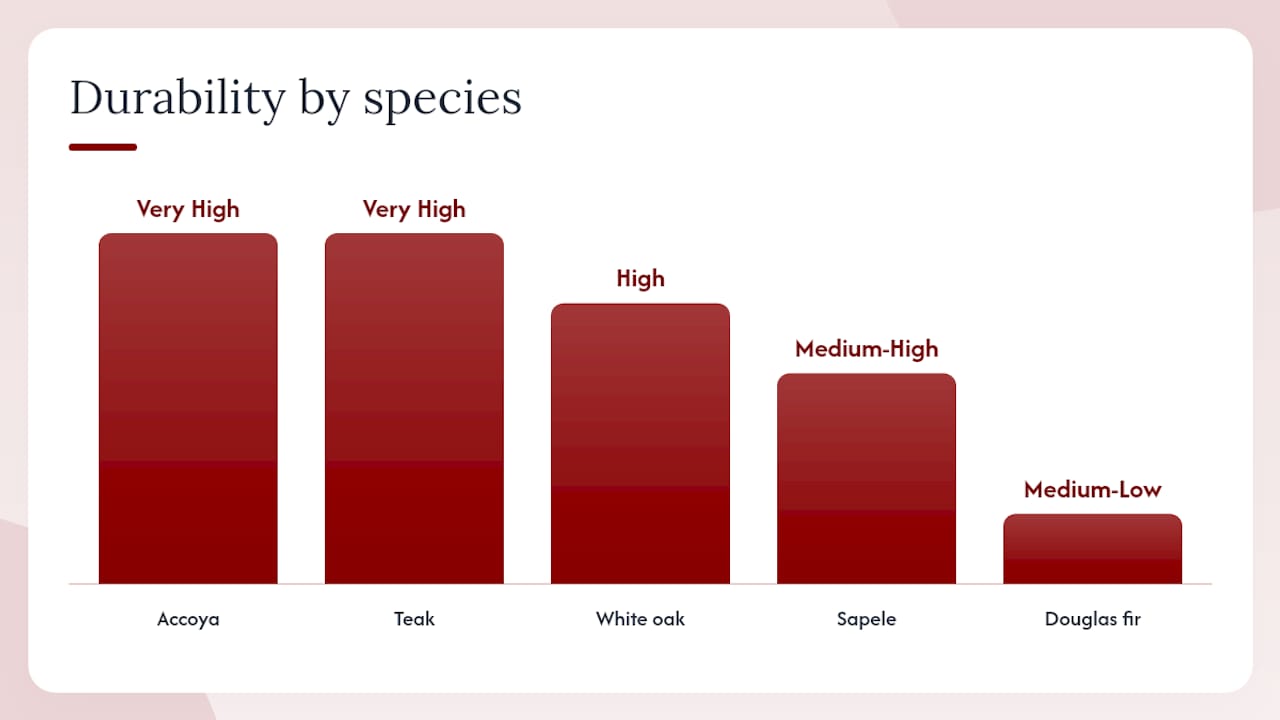
| Species | Durability / rot resistance | Dimensional stability | Appearance / stain potential | Maintenance level | Cost / U.S. availability | Best climates / exposure |
|---|---|---|---|---|---|---|
| White oak | High (closed-cell grain) | High (esp. quartersawn) | Warm tan; accepts stain well | Moderate | Mid; widely available | All U.S. climates; humid and freeze-thaw |
| Sapele | Medium-High | Medium | Ribbon figure; rich reddish-brown | Moderate | Mid; specialty suppliers | Temperate; partial exposure |
| Honduras mahogany | High | High | Fine grain; excellent stain depth | Low-Moderate | Mid-Premium; declining supply | All climates; historic restoration |
| Western red cedar | Medium (soft) | Medium | Rustic; limited stain depth | Moderate-High | Low-Mid; widely available | Sheltered; dry or mild climates |
| Douglas fir | Medium-Low | Medium-Low | Straight grain; best painted | High (if exposed) | Low-Mid; widely available | Sheltered; painted applications |
| Accoya | Very High (modified) | Very High | Pale; accepts paint/stain | Low | Premium; specialty suppliers | Coastal, wet, severe exposure |
| Teak | Very High (natural oils) | High | Golden-brown; distinctive grain | Low | Premium; limited supply | Coastal, full sun, tropical |
| Knotty alder | Low-Medium | Low-Medium | Warm knots; rustic character | High | Low; widely available | Sheltered, dry, interior-facing |
Detailed profiles for each recommended species
White oak
White oak’s closed-cell grain makes it measurably less porous than red oak, which is why it outperforms its close relative in every exterior application. Tyloses — microscopic structures that plug the pores — block moisture ingress at the cellular level.
- Pros: — Excellent rot resistance; quartersawn stock offers outstanding stability; takes oil and film finishes beautifully; domestically sourced and FSC-certified stock is readily available.
Honduras mahogany (Swietenia macrophylla)
Custom builders consistently name Honduras mahogany as the benchmark for exterior door fabrication — its combination of natural stability, moderate density, and exceptional finishability has made it the standard for high-end millwork for centuries. Supply has tightened considerably, and FSC-certified stock commands a premium.
- Lifespan: 40–60 years with proper maintenance; the preferred species for historic replica doors where period accuracy is required.
Accoya (acetylated wood)
Acetylation permanently alters Accoya’s cell chemistry to reduce moisture uptake, producing a modified wood with dimensional stability and decay resistance that rivals or exceeds most tropical hardwoods. The manufacturer’s 50-year above-ground warranty is the strongest in the category.
- Pros: — Exceptional dimensional stability; Class 1 durability (equivalent to teak); accepts paint and stain; non-toxic modification process; FSC-certified base material.
How to finish and construct a wood door that lasts decades
Species selection accounts for roughly half the performance equation. Construction method and finish quality determine the rest.
Finish checklist:
- Seal all end grain with epoxy consolidant or a dedicated end-grain sealer before any topcoat — end grain absorbs moisture at 10–15 times the rate of face grain, and unsealed mortise cuts are the most common point of early failure.
- Apply marine-grade finishes with UV blockers for any clear-coated door; two-component polyurethane or marine spar urethane outperforms standard exterior varnish in UV and moisture resistance.
- Factory finishing (applied before installation) produces a more uniform, penetrating coat than site finishing because the door can be finished on all six faces before the jamb is set.
- Recoat schedule: south- and west-facing doors typically need recoating every 2–3 years; north- or east-facing doors with good overhang can extend to 4–5 years.
Construction basics:
- Stile-and-rail construction (rather than solid slab) allows the panel to float and move independently, reducing the risk of cracking.
- Laminated stiles (finger-jointed or edge-glued from kiln-dried stock) are more dimensionally stable than single-piece stiles for wide doors.
- Sill design matters: a properly sloped sill with a drip kerf on the underside prevents water from wicking back under the door threshold.
- Hardware sizing for exterior doors is frequently underspecified. Heavy solid-wood doors require appropriately sized heavy-plate, ball-bearing hinges, with more hinges recommended for very heavy doors, because the jamb mounting points fail before the door itself when hardware is undersized.
Pro Tip: Order factory-finished doors whenever possible, or apply the first two finish coats in a controlled shop environment before delivery. Site-applied finishes on installed doors rarely penetrate the bottom rail and end grain adequately, and that gap is where moisture enters first.
Questions to ask your millworker and red flags to avoid
Bring this checklist to any supplier or fabricator conversation.
Checklist before ordering:
- Door thickness (1¾" minimum for solid exterior doors; 2¼" for heavy custom doors)
- Species grade and whether it is kiln-dried to 6–8% moisture content
- Laminated vs. solid stiles (laminated is preferred for wide doors)
- Finish system: factory-applied or site-applied, and number of coats
- Hardware specs: hinge size, plate weight, and whether ball-bearing hinges are standard
- Whether FSC chain-of-custody documentation is available for the species
Questions to ask your fabricator:
- What is the Latin name of the species? (“Mahogany” without a Latin name is a red flag.)
- What moisture content was the stock kiln-dried to, and when was it dried?
- Is the finish factory-applied or site-applied, and what product system is used?
- Does the finish warranty cover UV degradation, or only adhesion failure?
- How are end grain and mortise cuts sealed before finishing?
- What hinge specification do you use for a door of this weight?
- Can you provide FSC-certified sourcing documentation if required for a historic tax credit project?
- What is the lead time, and does the door ship primed or fully finished?
Red flags:
- “Mahogany” listed without a species name or Latin designation — it may be any of a dozen unrelated species with widely varying performance.
- Hinges specified at 3.5" or lighter for a door over 60 lbs.
- No mention of end-grain sealing in the finish process.
- Finish described only as “exterior stain” with no UV-blocker specification.
- Moisture content not documented or stated as “air-dried.”
- No warranty on the finish system.
When engineered or modified wood is the right call
Accoya is not a compromise — it is a deliberate specification choice for conditions where natural species reach their limits. Understanding when to choose it, and when not to, is the mark of an informed buyer.
Performance trade-offs vs. traditional species:
- Stability: Accoya’s dimensional movement is among the lowest of any wood product, outperforming teak and white oak in high-humidity cycling.
- Durability: Classified as Class 1 durable (equivalent to teak), with a 50-year above-ground warranty.
- Appearance: Pale, uniform grain lacks the figure of mahogany or the warmth of white oak. It accepts paint and stain well but does not produce the same visual depth as a fine-grained tropical hardwood.
- Cost: Consistently higher than white oak and sapele; comparable to or slightly above teak depending on market conditions.
Selection rules:
- Choose Accoya for severe coastal exposure, high-humidity climates, or any installation where the maintenance schedule cannot be reliably kept.
- Choose Honduras mahogany or white oak where historic appearance, fine-grain staining, or period-accurate profile replication is the primary requirement.
At Gepettomillworks, the decision to specify Accoya in a restoration context typically arises when an original door profile must be replicated exactly but the replacement will face exposure the original never did — a previously sheltered entry now exposed after a porch removal, for example, or a coastal property where the maintenance cycle cannot be guaranteed. In those cases, Accoya’s stability and warranty provide a performance baseline that no natural species can match at the same maintenance commitment. The restoration millwork process at Gepettomillworks treats species selection as an architectural decision, not a material substitution.
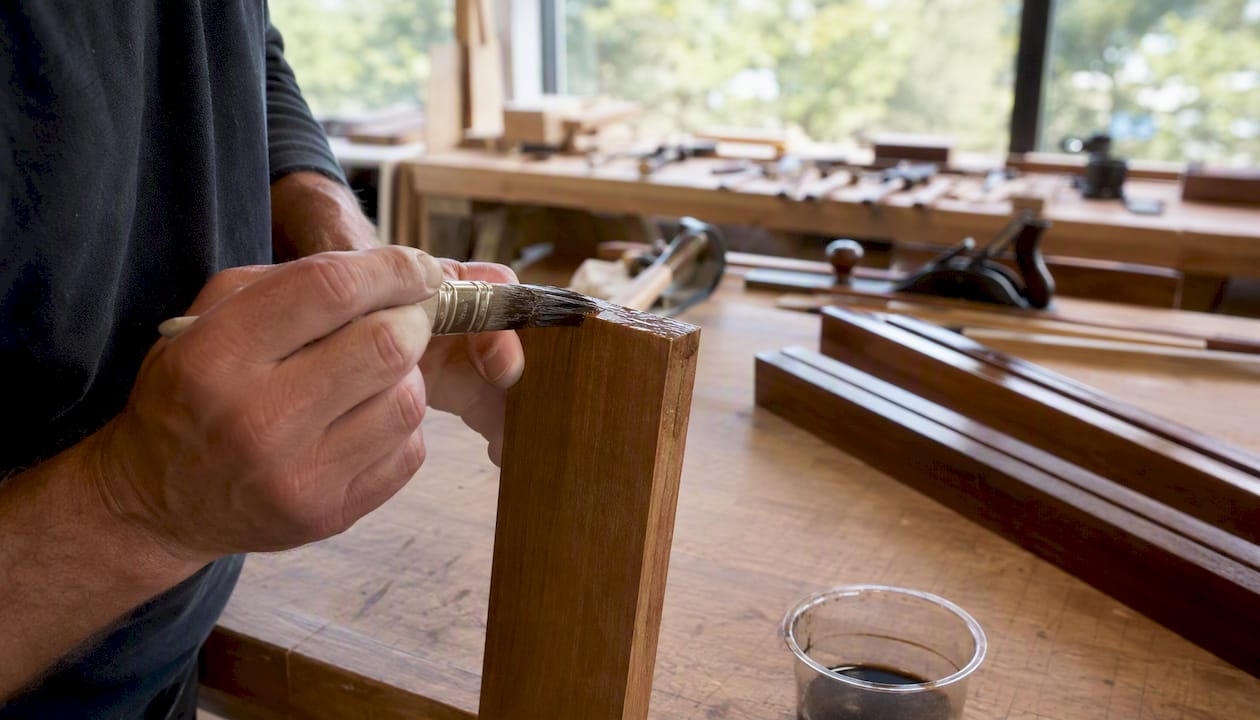
Pro Tip: When using Accoya or any acetylated wood, seal every cut edge immediately with a compatible end-grain sealer — the acetylation process does not extend to freshly cut surfaces, and unsealed cuts are the primary moisture entry point. This applies to hinge mortises, lock bore holes, and any site-cut adjustments.
The species choice that most buyers get wrong
The most common mistake in specifying an exterior wood door is treating species selection as a style decision and finish selection as an afterthought. The reality runs in the opposite direction: a well-finished Douglas fir door in a sheltered, north-facing entry will outlast a poorly finished mahogany door on a south-facing, fully exposed facade by a decade or more.
What the species determines is the margin for error — how much the door can tolerate a missed recoat cycle, a season of heavy rain, or a hardware failure before it begins to degrade. Teak and Accoya offer a wide margin. Knotty alder and flat-sawn Douglas fir offer almost none. The practical implication is that buyers who know they will not maintain a strict recoat schedule should move up the species list, not down, regardless of budget pressure. The cost of replacing a failed door far exceeds the premium for a more durable species at the outset.
There is also a persistent misconception that “mahogany” is a single, well-defined material. It is not. The trade term covers dozens of species from multiple continents, with performance ranging from excellent (genuine Swietenia macrophylla) to marginal (some African and Asian substitutes). Requesting the Latin name is not pedantry — it is the only way to know what you are actually buying.
Gepettomillworks crafts exterior doors built to last generations
Custom exterior doors fabricated from the right species, finished correctly, and hung with proper hardware are among the most durable architectural elements a building can have. Gepettomillworks designs and fabricates exterior doors in white oak, Honduras mahogany, sapele, Accoya, and other period-appropriate species for historic homes, restoration projects, and new construction that demands period accuracy.

Whether the project calls for a craftsman-style millwork entry, a bungalow supplier specification, or a full historic replica with documented species sourcing for tax credit eligibility, Gepettomillworks brings fabrication precision and restoration knowledge to every door. To get started, gather your rough opening dimensions, desired species, exposure notes (compass orientation, overhang depth, coastal proximity), and any reference photos of the existing or period door. Then contact Gepettomillworks directly to discuss fabrication options and lead times.
Useful sources and references
- A Guide to Wooden Front Doors: Cost, Safety, and Buying Tips – This Old House
- Choosing Wood for an Exterior Door
- Wood Database — wood identification and properties
- Types of wood: Bob Vila
- Best Wood Types for Doors: Guide & Comparisons 2026