
A curved staircase can usually be repaired rather than replaced, but the repair has to respect geometry that a straight stair never presents: every tread is a tapered wedge, every riser an arc, and every stringer a laminated or kerfed curve. Small defects such as a chipped nosing or a squeaking tread are manageable. Structural movement, failed stringers and damaged handrail wreaths call for a millwright, particularly in a historic house where the original fabric carries both architectural and, potentially, tax-credit value.
TL;DR
- Inspect first: walk the flight up and down, test every tread, the handrail and the balusters, and look at the underside wherever it is accessible.
- Chips, small cracks and squeaks are often repairable in place with fillers, epoxy, glue and shimming. Split treads, failed risers and weakened stringers need cut-out and replacement in matching wood.
- Any repair must leave the stair within the code limits for tread depth, riser height, guards and handrails, or within what your local building official accepts for existing buildings.
- Nationally, stair repair averages about $2,046 according to Angi’s 2026 data, and curved work sits toward the upper end because labor is harder.
- On a historic building, repair before replacement, and document the original profiles before anything is touched.
Table of Contents
- Why a curved stair fails differently
- Inspecting the staircase before you repair anything
- Repairing treads and nosings
- Repairing curved risers
- Stringers, strings and structural movement
- Handrails, balusters and wreaths
- Patch or replace: a working rule
- Code limits a repair must respect
- What curved stair repair costs
- Perspective
- When to bring in a millwright
- Restoration and fabrication for your stair
- FAQ
- Sources
Why a curved stair fails differently
The elliptical or helical stair is among the most admired devices of the Federal and Greek Revival periods, and among the least forgiving to maintain. Straight flights shed load in a predictable line from tread to stringer to floor. A curved flight distributes that load around an arc, so the outer stringer, often a bent or laminated member, carries a disproportionate share and any weakness expresses itself as movement in the treads above.
Three features explain most of the problems owners report:
- Winders and tapered treads. The narrow inner end of each tread has little bearing surface, so fasteners loosen and squeaks begin where tread, riser and stringer meet.
- Curved risers. These are frequently thin bent veneer or kerfed boards. A hole or split cannot be patched with a flat board.
- Curved handrails and wreaths. A handrail follows a spiral in three dimensions, so a break cannot be fixed by swapping a straight length.
Knowing which of these you are dealing with determines whether a repair is a weekend of glue and shims or a shop project.
Inspecting the staircase before you repair anything
A repair that treats a symptom while ignoring the cause will fail again. Begin with a systematic walk of the flight.
Walk it, then look under it
The American Society of Home Inspectors recommends walking the stairs both up and down with a hand on the rail, gripping the railing firmly to test for looseness, and inspecting accessible undersides for the top attachment, the base support and the landing framing. HUD’s NSPIRE standard asks inspectors to walk the stairs and contact the treads to detect stability, and to feel the full run for instability or bouncing. The same standard counts missing, loose or unlevel treads, and nosing damage greater than 1 inch deep or 4 inches wide, among its deficiencies. It is written for federally assisted housing, but the benchmarks are a useful yardstick for any owner.
What to look for
InterNACHI’s stairway checklist lists defects that translate directly to a curved flight:
- cracked, uneven, worn, loose or poorly supported treads;
- uneven risers;
- loose, incomplete, splintery or hard-to-grasp handrails;
- broken or loose nosing;
- balusters spaced more than 4 inches apart.
On an exterior or porch stair, add moisture. CCPIA notes that decayed wood, deteriorated finishes and ponding water are part of a proper inspection, and that freeze-thaw cycles and deicing salts speed deterioration.
Mark what you find
Photograph the flight, number the treads from the bottom, and note each defect against its number. On a historic staircase this record has a second purpose: it becomes the baseline for any later documentation of what was original and what was repaired.
Repairing treads and nosings
Most curved tread repairs fall into three tiers.
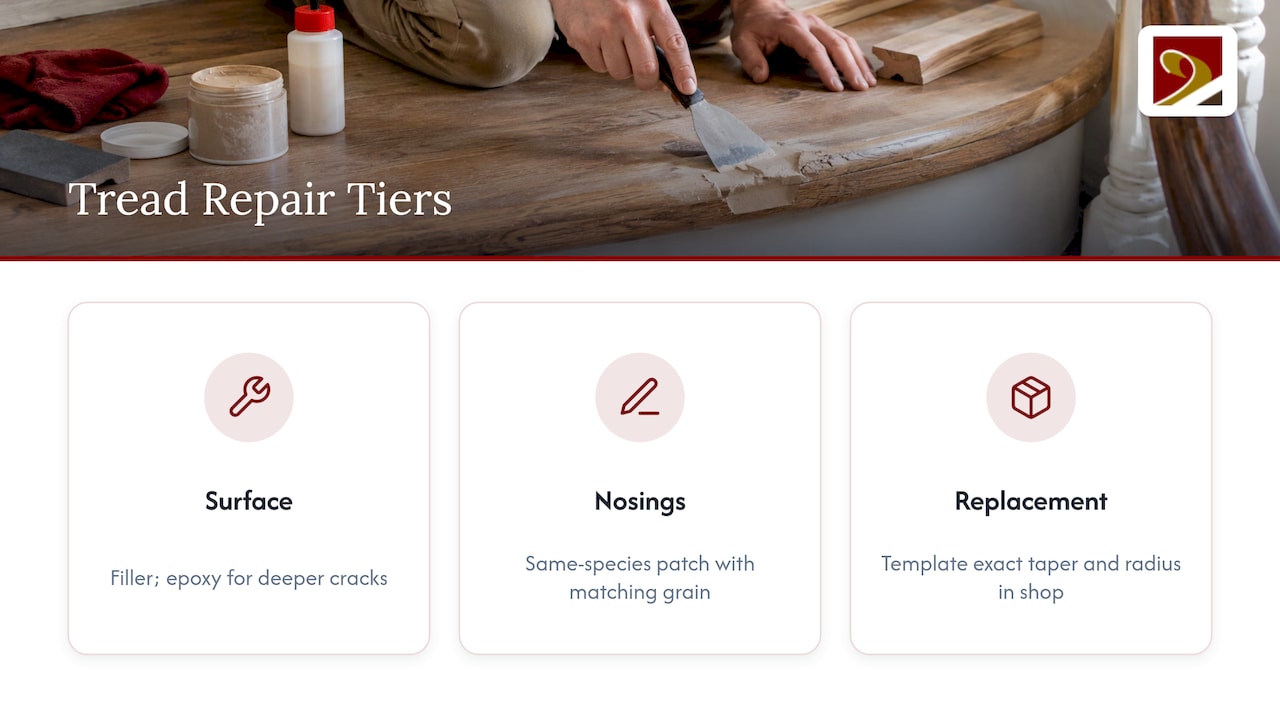
Surface damage. Small cracks and shallow holes can be filled with wood filler. For deeper cracks, wood epoxy is the usual step up. These are cosmetic and modest structural repairs, suitable where the tread is otherwise sound and well supported.
Chips and broken nosings. A chipped nosing on a clear-finished tread is as much a color-matching problem as a carpentry one. The reliable method is to cut back to clean wood, shape a patch of the same species with matching grain direction, glue it with a tight joint and finish to blend. Patching a nosing with the wrong species, or with a flat-sawn piece against a quartersawn tread, will show in raking light for years.
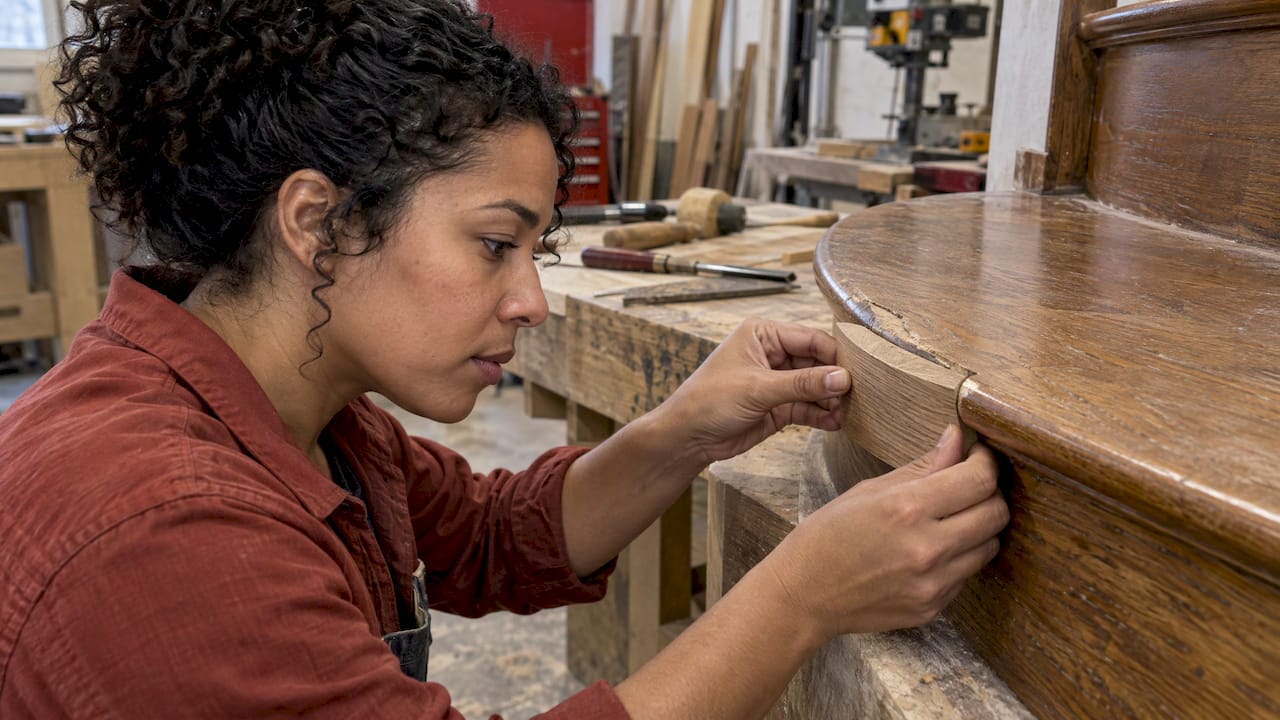
Split or severely damaged treads. When the tread is cracked through, rotted or no longer bears on its stringer, the damaged section is cut out and a matching piece fitted and secured with glue and fasteners. On a curved flight the replacement must be cut to the exact taper and radius of its neighbors, and it is rarely possible to buy that off the shelf. Treads are normally templated from the existing flight and made in the shop.
Stopping squeaks
Squeaks nearly always mean two surfaces rubbing where a joint has loosened. Where the underside is open, the traditional repair is done from below: glue blocks are refreshed and shims tapped tight so no nail holes appear on the visible face. Where the underside is plastered, owners on home-improvement forums describe pocket-screwing along the risers into the treads with construction adhesive between the pieces. Treat that as a field improvisation. On a historic stair with plaster soffit, a restoration carpenter will usually prefer to open a small, reversible access panel rather than drive visible fasteners into original treads.
Repairing curved risers
A curved riser is typically thin bent stock or veneer over a core, which is why it breaks differently from a straight board. Experienced woodworkers in a long-running Fine Woodworking thread suggest gluing a shaped backer block behind a hole and then applying a veneer patch, or covering the entire riser with new veneer when damage is widespread.
For a historic stair the same logic applies with more care:
- Remove loose fragments and keep them; they are evidence of the original profile and finish.
- Fit a backer behind the void, shaped to the curve, so the patch has something to bond to.
- Inlay a patch in matching species, with the grain running the same way as the original face.
- Finish to match the surrounding riser, not to look new.
Where several risers have failed, new bent or laminated risers made to the original radius are more honest and more durable than a series of patches.
Stringers, strings and structural movement
If the stair moves as a unit, the problem is not the treads. A curved stringer that has cracked, delaminated, been notched by a plumber or detached from the wall or landing framing is a structural matter. HUD’s standard directs inspectors to check that visible stringers are undamaged and remain attached, and to note when a concealed stringer cannot be evaluated at all. That limitation matters at home too: if the stringer is hidden behind plaster, a bounce under foot is a reason to open the soffit and look.
Some how-to guides describe sistering a stringer by laminating plywood or oak alongside and lagging it. On a straight stair this can work. On a curved one, a sister has to follow the same radius, which usually means bent lamination made in a shop, and it should be designed by someone who understands how the load travels. This is the point where we recommend stopping the DIY path.
Handrails, balusters and wreaths
A loose handrail is a safety defect before it is a cosmetic one. ASHI’s advice is to grasp the railing firmly to test for looseness. A rail that shifts usually has a failed connection at the newel or a loosened baluster dowel, both fixable. A cracked wreath or easing, the section that spirals the handrail around the turn, is another matter, because its geometry is three-dimensional and cannot be spliced casually.
For historic buildings, Gepetto Millworks has published guidance for architects and contractors on keeping tax credits on curved handrail repair, explaining the repair-before-replacement principle and the documentation that SHPO and National Park Service reviewers expect. In brief: splice, patch or piece in where original fabric allows, and when replacement cannot be avoided, match profile, species and joinery and record it.
Patch or replace: a working rule
| Condition | Usual approach |
|---|---|
| Chip, small crack, shallow hole | Fill, epoxy or inlay a patch |
| Squeak with sound components | Reglue, shim, add blocking from below |
| Hole in a veneer riser | Backer block and matching veneer or inlay |
| Tread split through or rotted | Cut out and replace, templated to the flight |
| Several failed risers | Replace with new bent risers to original radius |
| Cracked, detached or bouncing stringer | Structural repair or lamination designed for the curve |
| Broken wreath or easing | Shop-made section matched to the original |
The preservation principle sits underneath all of it: the more original material you can keep sound, the better the staircase serves its history.
Code limits a repair must respect
Repairs and replacements are not exempt from the safety numbers. Under the 2018 International Residential Code, as summarized by Knox County’s code office, treads should be at least 10 inches deep, risers no higher than 7¾ inches, and the variation within a flight no more than ⅜ inch. Open sides of stairs with four or more risers need guards at least 34 inches high, with infill that blocks a 4-inch sphere (triangular openings may allow 6 inches). Required handrails are continuous and set 34 to 38 inches high.
Two cautions follow:
- Replacement treads and risers must be consistent. One new tread cut even half an inch off its neighbors creates the sort of irregularity people trip on, since they climb by habit and not by looking.
- Existing historic stairs often cannot meet current dimensions. Local building officials commonly have a process for existing and historic buildings, so ask yours before assuming a change is required or prohibited. Your state or jurisdiction may also have adopted a different code edition than the 2018 IRC.
What curved stair repair costs
Millwork repair is quoted per project, and Gepetto Millworks does not publish prices, so the best public benchmark is national data. Angi reports a 2026 national average of $2,046 for stair repair, with most homeowners paying between $952 and $3,234, and notes that labor can account for half or more of the total, especially on curved staircases or in tight spaces. It lists squeak repair at $150 to $500 and tread replacement at $200 to $600 as typical ranges for ordinary stairs.
What moves a curved stair above those figures:
- Species and finish matching. Old-growth stock, quartersawn grain and period finishes cost more than stock lumber.
- Templating and shop time. Each tapered tread, bent riser or laminated string is custom.
- Access. Plastered soffits, tight turns and finished spaces slow every step.
- Documentation. Historic projects often need measured drawings and photographs.
- Hidden conditions. Rot, prior bad repairs and concealed structural damage are discovered when the stair is opened.
A written scope that distinguishes repair from replacement, and names the species and finish, is the most reliable way to compare quotes.
Perspective
Curved stairs reach us in three conditions: tired, repaired badly, or quietly failing. In each case the question we ask first is how much of the original can honestly be kept.
Our work is the exact replication of historic features using authentic materials and techniques, and it is built for projects where matching matters, including those pursuing historic tax-credit eligibility. That means we template from the surviving stair, match species and profile, and fabricate the pieces that cannot be repaired: treads, bent risers, strings, balustrades and period handrail sections.
We also accept complex, architecturally significant stairs that other shops decline. A curved flight rewards a single shop that can design, make and fit its parts together, because the geometry of one component governs the next.
Gepetto
When to bring in a millwright
Call a specialist when any of these apply:
- the stair bounces, sways or has treads that have dropped;
- the damage is in the stringer, wreath or a bent riser;
- the building is listed, in a historic district or part of a tax-credit project;
- the original wood species or profile cannot be bought and must be made;
- you are an architect or contractor who needs fabricated parts that fit measured drawings.
Gepetto Millworks designs, fabricates and restores staircases, balustrades and architectural millwork for historic buildings across Virginia, West Virginia, North Carolina, South Carolina, Maryland and the District of Columbia. You can see the range of wooden staircase projects and wooden spiral staircases in our archives.
Restoration and fabrication for your stair
If the damage goes beyond a tread or a squeak, our custom fabrication services cover period staircases, balustrades, casework and made-to-order woodwork, matched to the original and documented for historic review where required.

Send us photographs of the flight, a note of the building’s age and any drawings you have, and we will advise on what can be repaired and what must be rebuilt.
FAQ
Can a curved staircase be repaired without taking it out?
Usually, yes. Treads, nosings, risers, squeaks and loose handrails are commonly repaired in place. Severe stringer damage or a failed wreath may require removing sections, but that is far less than replacing the whole stair.
How do I fix a squeaky curved stair?
Squeaks come from a loose joint between tread, riser and stringer. From below, refresh glue blocks and tap shims tight. If the underside is closed, a carpenter may open a small panel to reach it. Avoid driving fasteners through visible treads on a historic stair.
Does a repaired curved stair still have to meet code?
New treads, risers, guards and handrails should follow the adopted code, such as the 2018 IRC limits of 10-inch treads and 7¾-inch risers. Existing historic stairs are often handled differently, so confirm with your local building official.
How much does curved stair repair cost?
Angi’s 2026 national data puts average stair repair at $2,046, with a typical range of $952 to $3,234. Curved and historic stairs often cost more because of custom templating, matched wood and difficult access. Each project is quoted individually.
Sources
- American Society of Home Inspectors: Watch Your Step
- HUD NSPIRE Standard: Stairs, Version 2.2
- InterNACHI: Stairway Inspection
- CCPIA: Stairway Inspection
- Knox County Code Administration: Stairs (2018 IRC)
- Angi: How Much Does Stair Repair Cost?
- Fine Woodworking: Repairing curved riser
- DIY Stack Exchange: Stopping curved stairs from squeaking
- ToolsRadar: Restoring Broken Staircase Parts