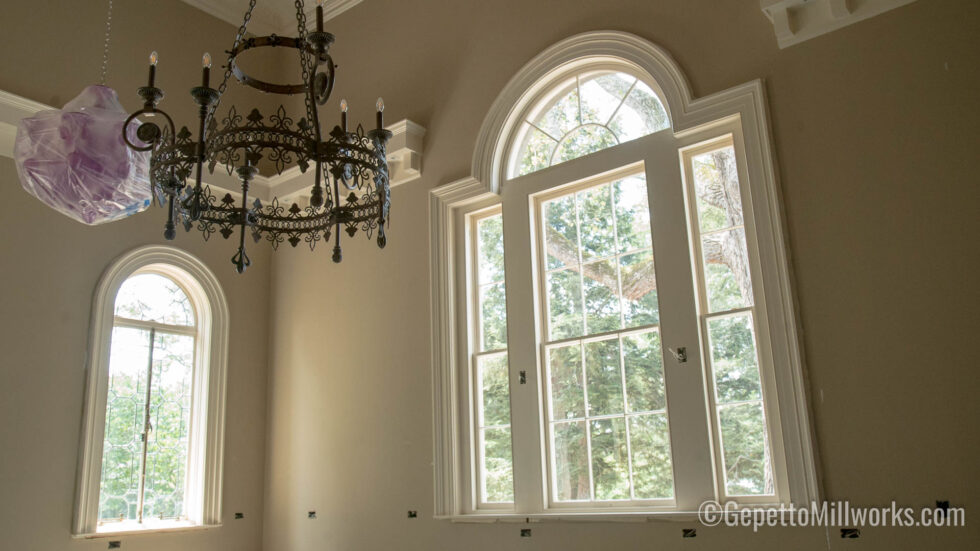
Palladian window = three-part windows composed of a central section coverd by ot topped with a full half round arched window flanked by two narrower, shorter sections having square tops. Popular in 17th- and 18th-century English versions of Italian designs, was inspired by the so-called Palladian motif, similar three-part openings having been featured in the work of the 16th-century Italian architect Andrea Palladio; his basilica at Vicenza, designed in 1546, was especially numerous presentation. Because the motif was first described in the work L’architettura (1537), by the Italian architect Sebastiano Serlio, it is also known as the Serlian motif, or Serliana, and the window derived from it may be called a Serlian window. It is also sometimes called a Venetian window. Palladian windows are common wherever an elegant touch is desired. George Washington had one installed at his Virginia home, Mount Vernon, to illuminate the large dining room. At the beginning of the Georgian period (1714–1830), a second and more consuming interest in Palladio developed. Partly as a reaction to the grandiose architecture of the later Stuarts, the newly powerful Whigs expressed a desire to return to a more rational and less complicated style. Their wish coincided with the publication of an English translation of Palladio’s treatise I quattro libri dell’architettura (1570; Four Books of Architecture) and the first volume of Colen Campbell’s Vitruvius Britannicus (1715), a folio of 100 engravings of contemporary “classical” buildings in Britain (two more volumes followed in 1717 and 1725), the designs of which had enormous influence in England.